
EX PARTE REEXAMINATION
Advanced Petition Practice
ANDREW S. BALUCH
WASHINGTON DC | 2026
© 2026 Andrew S. Baluch. All rights reserved.
This is a living treatise. Each section reflects its own “last updated” date. Citations may include the section’s update date where relevant. Cite as: Andrew S. Baluch, Ex Parte Reexamination: Advanced Petition Practice § [section] (last updated [date]).
PREFACE
Petition practice in ex parte reexamination is often opaque and poorly understood. Errors frequently arise from misidentifying the proper procedural vehicle—particularly under 37 C.F.R. §§ 1.181, 1.182, and 1.183—or from overlooking regulations that confer specific or limited authority. Properly understood, petition practice defines the procedural boundaries of the proceeding alongside substantive examination conducted by the Central Reexamination Unit.
This treatise provides a structured framework for analyzing petition practice in ex parte reexamination. It addresses the core questions that arise in practice: what issues are petitionable; who may file; what authority governs; when a petition may be filed; and whether an opposing party may respond. The analysis emphasizes the procedural posture and identity of the actor, including the asymmetries between patent owner and third-party requester participation.
The treatise is organized by procedural stage—from pre-order proceedings through examination and appellate review—and is grounded in the governing statutes and regulations, the Manual of Patent Examining Procedure, Official Gazette notices, and representative petition decisions.
ABBREVIATIONS AND CONVENTIONS
Abbreviations
- AIA — Leahy-Smith America Invents Act
- CRU — Central Reexamination Unit
- IPR — Inter partes review
- MPEP — Manual of Patent Examining Procedure
- OPLA — Office of Patent Legal Administration
- PGR — Post-grant review
- SNQ — Substantial New Question of Patentability
- PTAB — Patent Trial and Appeal Board
- USPTO — United States Patent and Trademark Office
Conventions
Statutory citations refer to Title 35 of the United States Code unless otherwise indicated.
Regulatory citations refer to Title 37 of the Code of Federal Regulations unless otherwise indicated.
“MPEP” citations refer to the current version of the Manual of Patent Examining Procedure (9th Edition, Rev. 01.2024) unless otherwise specified.
Petition decisions are cited by ex parte reexamination control number and decision date (e.g., Ex parte reexamination 90/019,115 (2024-02-07 Petition Decision)).
References to “the Office” mean the United States Patent and Trademark Office acting through the Central Reexamination Unit, the Office of Patent Legal Administration, or the Patent Trial and Appeal Board, as appropriate to the procedural posture.
References to “examiner” mean an examiner within the Central Reexamination Unit unless otherwise indicated.
References to “petition” refer to petitions under 37 C.F.R. §§ 1.181, 1.182, 1.183 or other Office regulation, unless a different procedural mechanism is specified.
References to “appeal” refer to appeal to the Patent Trial and Appeal Board under 37 C.F.R. Part 41 unless otherwise indicated.
Part I
Terminology and Structural Framework
Part I establishes the foundational terminology and structural distinctions that govern petition practice in ex parte reexamination. The terms “request,” “petition,” and “motion” perform distinct procedural functions depending on the governing framework, and those distinctions define the architecture within which all subsequent petition practice operates.
Chapter 1
Taxonomy of “Request,” “Petition,” and “Motion”
This chapter establishes the foundational terminology that governs ex parte reexamination and distinguishes it from related post-grant proceedings. Although terms such as “request,” “petition,” and “motion” appear across multiple procedural regimes, they perform materially different functions depending on the statutory and regulatory framework in which they arise.
In ex parte reexamination, the proceeding is initiated by a request under 35 U.S.C. § 302, while petitions under 37 C.F.R. §§ 1.181–1.183 provide mechanisms for supervisory and discretionary relief within that framework. By contrast, in AIA trials, the petition initiates an adversarial proceeding and motion practice governs its progression.
The distinctions developed in this chapter are not merely semantic. They define the procedural architecture within which advanced petition practice operates and inform the application of provisions such as 35 U.S.C. § 325(d) and statutory estoppel under 35 U.S.C. §§ 315(e)(1) and 325(e)(1).
§ 1.1 The “Request” in Ex Parte Reexamination
Last updated: April 5, 2026
Ex parte reexamination is initiated not by a petition, but by a request. A request under 35 U.S.C. § 302 invokes the Director’s statutory authority to determine whether a substantial new question of patentability (“SNQ”) exists with respect to one or more claims of an issued patent.1
Unlike petitions under 37 C.F.R. §§ 1.181–1.183, a request does not seek supervisory or procedural relief. It is the initiating paper that asks the Office to reopen examination of an issued patent. The request is therefore the gateway to the proceeding itself.
Section 302 provides that “[a]ny person at any time may file a request for reexamination” based on prior art patents or printed publications.2 The breadth of this language reflects Congress’s decision to create a mechanism by which the Office may reconsider issued claims in light of prior art raising an SNQ.3
The request must comply with 37 C.F.R. § 1.510, including identification of the patent, identification and explanation of the prior art relied upon, and a certification that the requester is not barred by statutory estoppel under 35 U.S.C. §§ 315(e)(1) and 325(e)(1).4 Filing the request does not itself institute reexamination. It triggers an administrative determination.
Acting under delegated authority from the Director, the Central Reexamination Unit (“CRU”) determines whether the cited art raises an SNQ under 35 U.S.C. § 303(a).5 That determination results in an order under § 304 either granting reexamination or denying the request.6
Issuance of an order under § 304 marks a structural dividing line that governs the availability and operation of petition practice addressed in later chapters. Several advanced petition doctrines—particularly statutory estoppel under §§ 315(e)(1) and 325(e)(1)—turn on whether the proceeding remains in its pre-order posture or has entered its post-order phase.
Footnotes
- 1.35 U.S.C. § 302.
- 2.Id.
- 3.See 35 U.S.C. § 303(a) (substantial new question of patentability standard); H. Rept. No. 107-120, at 3 (Jun. 28, 2001) (congressional intent in broadening the bases for finding the existence of an SNQ under § 303(a)).
- 4.37 C.F.R. § 1.510(b).
- 5.35 U.S.C. § 303(a).
- 6.35 U.S.C. § 304; see also MPEP § 2246.
§ 1.2 The “Petition” in Ex Parte Reexamination
Last updated: April 5, 2026
In contrast to the statutory request under § 302, a petition in ex parte reexamination is a supervisory procedural mechanism grounded in regulation rather than statute. A petition does not initiate reexamination. It seeks review, waiver, or discretionary relief within the reexamination framework.
Petitions arise primarily under three provisions:
- 37 C.F.R. § 1.181
- 37 C.F.R. § 1.182
- 37 C.F.R. § 1.183
Each serves a distinct function.
A. Petitions Under 37 C.F.R. § 1.181
Rule 1.181 provides a mechanism for supervisory review of examiner action. In the reexamination context, § 1.181 commonly governs:
- Post-order petitions invoking § 325(d);
- Petitions asserting that an order granting reexamination is ultra vires;
- Petitions challenging procedural rulings by the CRU.
Rule 1.181 is not a substitute for appeal. It addresses supervisory and procedural questions—not the substantive merits of patentability. Where the dispute concerns the merits of a rejection, the proper vehicle is prosecution and appeal, not petition practice.
B. Petitions Under 37 C.F.R. § 1.182
Rule 1.182 provides relief “not otherwise provided for” in the rules. It functions as residual authority. In reexamination practice, § 1.182 frequently governs:
- Pre-order discretionary denial petitions;
- Pre-order estoppel petitions;
- Petitions seeking merger of proceedings;
- Petitions raising issues for which no specific regulatory vehicle exists.
Because § 1.182 is residual, the petitioner bears the burden of demonstrating that the requested relief is appropriate and consistent with orderly administration of the proceeding.
C. Petitions Under 37 C.F.R. § 1.183
Rule 1.183 permits suspension of the rules “in an extraordinary situation” when justice requires. In reexamination practice, § 1.183 often operates in conjunction with §§ 1.181 or 1.182 to permit entry of papers that would otherwise be barred.
In the pre-order context, § 1.183 allows the Office to consider discretionary arguments under § 325(d) before issuing an order under § 304. It therefore serves as a procedural release valve, allowing the Office to suspend or waive any regulatory requirement that is not a statutory requirement.
D. OPLA Jurisdiction
Petitions in ex parte reexamination are often decided by the Office of Patent Legal Administration (“OPLA”), acting on behalf of the Director. This allocation reflects the legal character of petition issues.
Substantive examination, including determinations bearing on patentability, is conducted by examiners within the Central Reexamination Unit (“CRU”), whereas OPLA petition decisions address procedural, supervisory, and discretionary aspects of the proceeding. Consistent with that division, the distinction between petition and appeal turns on whether the issue concerns procedural administration (petitionable) or substantive patentability (appealable).
Petition decisions define the procedural and discretionary boundaries of the proceeding. Maintaining that distinction is essential to preserving the structural separation between substantive examination and procedural review.
§ 1.3 The “Petition” in AIA Trials
Last updated: April 5, 2026
The term “petition” carries a different procedural meaning in Leahy-Smith America Invents Act (“AIA”) trials than in ex parte reexamination. In inter partes review (“IPR”) and post-grant review (“PGR”), the petition is the initiating pleading.
An AIA trial begins when a petitioner files a petition under 35 U.S.C. § 311 (IPR) or § 321 (PGR).1 The petition must satisfy the statutory threshold for institution. In IPR, the petitioner must demonstrate a reasonable likelihood of prevailing on at least one challenged claim.2 In PGR, the petitioner must show that at least one claim is more likely than not unpatentable or that the petition raises an important novel legal question.3
The petition defines the claims challenged, the grounds asserted, the prior art relied upon, and the supporting evidence.4 The patent owner may file a preliminary response before the Board decides whether to institute trial.5
Institution is discretionary. Even where the statutory threshold is met, the Board may deny institution under 35 U.S.C. §§ 314(a) or 325(d).6
This architecture differs fundamentally from ex parte reexamination. In reexamination, a request triggers an Office determination under § 303(a). Once reexamination is ordered under § 304, the Office conducts examination. The proceeding is not structured as a bilateral adversarial contest.7 In AIA practice, by contrast, the petition frames and defines the adjudicative trial.8
Understanding this distinction is critical when interpreting provisions that appear in both regimes—particularly § 325(d) and statutory estoppel. Identical statutory text performs different procedural functions in different structural settings.
Footnotes
- 1.35 U.S.C. §§ 311(a), 321(a).
- 2.35 U.S.C. § 314(a).
- 3.35 U.S.C. § 324(a).
- 4.See 37 C.F.R. § 42.104 (IPR petition requirements); 37 C.F.R. § 42.204 (PGR petition requirements).
- 5.35 U.S.C. §§ 313, 323.
- 6.35 U.S.C. §§ 314(a), 325(d).
- 7.See SAS Inst., Inc. v. Iancu, 584 U.S. 357, 365–66 (2018) (“The ex parte reexamination statute allows the Director to assess whether a request raises ‘a substantial new question of patentability affecting any claim’ and (if so) to institute reexamination limited to ‘resolution of the question.’’” § 304 (emphasis added). In other words, that statute allows the Director to institute [reexamination] proceedings on a claim-by-claim and ground-by-ground basis.”).
- 8.See id. at 363 (“Much as in the civil litigation system it mimics, in an inter partes review the petitioner is master of its complaint and normally entitled to judgment on all of the claims it raises, not just those the decisionmaker might wish to address.”).
§ 1.4 The “Motion” in AIA Trials
Last updated: April 5, 2026
If the petition initiates an AIA trial, then a motion governs its progression. AIA proceedings operate under the structured motion framework of 37 C.F.R. Part 42.
Once instituted, the AIA proceeding unfolds through motions and their corresponding oppositions, replies, and sur-replies.1 Each substantive step in the trial—amendment, exclusion of evidence, additional discovery, termination—proceeds through motion practice.2
For example, a patent owner seeking to amend claims must file a motion to amend.3 A party seeking to exclude evidence must file a motion to exclude.4 Requests for additional discovery are likewise made by motion.5
This framework presupposes adversarial participation: one party moves, the opposing party responds, and the Board adjudicates the dispute.6
Ex parte reexamination, by contrast, does not operate under a general motion regime. Although limited oppositions to petitions are permitted in defined circumstances, the default structure is examination conducted by the Office, not adversarial motion practice.7
Terminological precision therefore matters. The same word—petition—does not perform the same procedural function across these regimes. In AIA trials, the petition initiates the trial and motions advance it. In ex parte reexamination, the request initiates examination while petitions invoke interlocutory or supervisory review within that examination framework.
Footnotes
- 1.See 37 C.F.R. Part 42, Subpart A.
- 2.37 C.F.R. § 42.23.
- 3.35 U.S.C. § 316(d); 37 C.F.R. § 42.121 (IPR); § 42.221 (PGR).
- 4.37 C.F.R. § 42.64(c).
- 5.37 C.F.R. § 42.51(b)(2).
- 6.37 C.F.R. § 42.23.
- 7.See Return Mail, Inc. v. United States Postal Serv., 587 U.S. 618, 633–34 (2019) (“In an ex parte reexamination, the third party sends information to the Patent Office that the party believes bears on the patent’s validity, and the Patent Office decides whether to reexamine the patent. If it decides to do so, the reexamination process is internal; the challenger is not permitted to participate in the Patent Office’s process.”) (citing 35 U.S.C. §§ 302, 303).
§ 1.5 Why Terminology Matters
Last updated: September 3, 2026
The distinctions drawn in this chapter define the procedural architecture within which advanced petition practice operates.
In ex parte reexamination, the request under 35 U.S.C. § 302 invokes the Director’s authority to determine whether an SNQ exists. The petition, by contrast, is a regulatory mechanism under 37 C.F.R. §§ 1.181–1.183 that seeks supervisory or discretionary relief within that statutory framework. In AIA proceedings, the petition initiates an adversarial trial and motion practice governs its progression.
Although provisions such as 35 U.S.C. § 325(d) and 35 U.S.C. §§ 315(e)(1) and 325(e)(1) appear in both regimes, their procedural operation differs because the structural settings differ. Section 325(d) permits the Director to reject a petition or request when the same or substantially the same prior art or arguments previously were presented to the Office. Because the nature of the two proceedings differs, however, § 325(d) principles developed in the AIA trial context do not necessarily apply in the same manner when determining whether to order reexamination. Similarly, §§ 315(e)(1) and 325(e)(1) impose estoppel following a final written decision in an AIA trial, but operate differently in ex parte reexamination because, once reexamination is ordered, the Office—not the requester—maintains the proceeding.
Terminological precision prevents analytical error. Mischaracterizing a request as a petition, or importing adversarial motion concepts into reexamination, obscures the structural distinctions that govern petition practice.
Ex parte reexamination occupies a hybrid procedural space. The request initiates an Office determination; petitions define procedural boundaries; and limited oppositional participation arises only where authorized. Mastery of advanced petition practice depends on recognizing where each procedural device fits within that structure.
Throughout this treatise, the term “petition” is used in its reexamination-specific sense—as a procedural mechanism for supervisory or discretionary relief—and not in the AIA sense of an initiating pleading. This definitional framework governs the use of the term “petition” throughout this treatise.
§ 1.6 Functional Framework of Petition Practice
Last updated: April 5, 2026
Petition practice in ex parte reexamination operates across four distinct functional domains, each corresponding to a different procedural stage of the proceeding:
(1) Threshold access control — governing whether reexamination will be ordered (Chapters 2–3);
(2) Institutional and discretionary review — addressing post-order challenges and case management (Chapters 4–5);
(3) Procedural control of examination — regulating timing, entry of papers, and prosecution conduct (Chapters 6–7); and
(4) Jurisdictional and appellate management — governing the transition to and conduct of appeal and judicial review (Chapters 8–9).
This functional framework provides the organizing structure for the petition practice addressed throughout this treatise.
Part II
Pre-Order Petitions
Part II addresses petition practice before the Office issues an order under 35 U.S.C. § 304 determining whether to institute reexamination. As developed in Chapters 2 and 3, this stage is governed by threshold access-control principles, where petition practice is directed to whether reexamination should proceed at all, rather than to ultimate questions of patentability resolved during examination.
Chapter 2
Patent Owner’s Pre-Order Petitions
This chapter addresses petitions filed by the patent owner before the Office issues an order under 35 U.S.C. § 304 determining whether to institute ex parte reexamination. At this stage, the proceeding has not yet been ordered, and the regulatory framework does not contemplate patent owner participation absent suspension of the rules.
Accordingly, pre-order practice is defined by a threshold procedural constraint: patent owner submissions are generally not entered unless the Office grants relief under 37 C.F.R. § 1.183. A limited exception now exists for patent owner submissions directed to the substantial new question of patentability (“SNQ”), which may be filed without petition or fee under Office procedure, subject to strict timing and scope limitations.
Within that constraint, patent owners may raise via petition a limited set of threshold issues—most prominently discretionary denial under 35 U.S.C. § 325(d), statutory estoppel under §§ 315(e)(1) and 325(e)(1), certification defects under § 1.510(b)(6), and coordination of parallel proceedings under § 315(d). These petitions are not merits vehicles. They operate at the gateway stage of the proceeding and are directed to whether the Office should order reexamination, independent of the merits of any substantial new question of patentability. Timing is critical, as the Office must act within the three-month period prescribed by 35 U.S.C. § 303(a).
§ 2.1 Petitions Under 35 U.S.C. § 325(d)
Last updated: September 4, 2026
The second sentence of 35 U.S.C. § 325(d) provides that, in determining whether to order ex parte reexamination, “the Director may take into account whether, and reject the … request because, the same or substantially the same prior art or arguments previously were presented to the Office.” The provision is discretionary (“may”) and is directed to a gatekeeping decision—whether the Office should order reexamination in response to a request. In the ex parte reexamination regime, a patent owner can invoke § 325(d) via a petition and do so before the Central Reexamination Unit (“CRU”) issues its order under § 304. When considered, the § 325(d) issue is decided within that § 304 order along with the SNQ determination.
As a practical matter, pre-order § 325(d) practice sits at the intersection of (i) a statutory discretion vested in the Director, (ii) CRU’s delegated authority to make the § 304 ordering decision, and (iii) the procedural reality that patent-owner submissions are generally not entered before the order unless the Office suspends the rules. Petition Decisions typically reflect the following sequence: (a) the patent owner seeks entry of a pre-order § 325(d) submission; (b) OPLA waives the relevant rules under § 1.183 to permit entry of the § 325(d) submission; and (c) the CRU considers the § 325(d) arguments in the first instance when deciding whether to order reexamination.
A. Procedural Vehicle and Timing
1. Proper petition vehicle: § 1.182, not § 1.181.
Before a § 304 order exists, there is typically no examiner action from which to seek supervisory review under 37 C.F.R. § 1.181. Accordingly, the pre-order procedural vehicle used in practice is a § 1.182 petition requesting relief that is “not specifically provided for” in another rule—namely, consideration of § 325(d) arguments at the request stage. Petition Decisions treat pre-order § 325(d) filings as § 1.182 petitions and address entry through suspension practice under § 1.183.1
2. Why a waiver is usually required.
Ex parte reexamination rules (specifically, 37 C.F.R. §§ 1.515(a) and 1.540) contemplate that the patent owner responds only after the order. To permit a patent owner’s pre-order § 325(d) petition to be entered and considered before the Office makes its § 304 decision, however, OPLA has granted petitions under § 1.183 waiving the rules “to the extent necessary” to allow entry and CRU consideration. Petition Decisions identify pre-order consideration of § 325(d) as an “important purpose” that justifies § 1.183 waiver, where the filing is prompt and sufficiently early for CRU to consider it in the § 304 decision.2
3. Who decides § 325(d) “in the first instance” at the pre-order stage.
At the pre-order stage, the CRU considers the § 325(d) arguments as part of its § 304 order—rather than OPLA deciding the § 325(d) issue prior to the CRU’s order. The pre-order OPLA decision is commonly limited to the procedural question of entry (i.e., whether to suspend the rules to permit consideration); thereafter, the CRU will decide whether to exercise discretion under § 325(d) in the order granting or denying reexamination itself.3
4. Timing is critical.
Section 303(a) imposes a three-month deadline for the Office to determine whether to order reexamination. Because the CRU often acts well before the statutory deadline, pre-order § 325(d) practice is highly timing-sensitive. Petition Decisions granting § 1.183 relief repeatedly emphasize that the submission must be “promptly filed in sufficient time for entry and consideration” before the CRU acts.4 Once the CRU issues the § 304 order, the case shifts into a post-order posture, and any challenge to the ordering decision proceeds (if at all) as a petition for supervisory review under § 1.181, with its timeliness constraints.
B. “Same or Substantially the Same”
1. The inquiry is keyed to what was presented “to the Office.”
Petition Decisions repeatedly reject § 325(d) theories that rely on prior district court validity litigation as the predicate “presentation.” The statute’s express limitation—to art and arguments “previously … presented to the Office”—has been applied to foreclose district-court overlap theories. This matters in practice because many “repeat challenge” narratives are built from litigation records. Petition Decisions make clear that those records do not satisfy the statutory predicate for § 325(d) discretion in ex parte reexamination.5
2. “Same or substantially the same” is applied to the request as a whole, not to a single overlapping reference.
In practice, patent owners often point to an overlapping reference and argue that overlap alone satisfies § 325(d). Decisions instead evaluate the totality of the grounds raising an SNQ and ask whether the request presents “the same or substantially the same” prior art or arguments as those previously presented to the Office. Decisions hold that even where an overlapping reference exists, the presence of additional references, new combinations, newly cited portions of a reference, or newly challenged claims—each of these scenarios can render the reexamination request materially different for § 325(d) purposes.6
3. Prior “presentation” is not equivalent to prior “evaluation.”
Whether the prior art or arguments were meaningfully evaluated on the merits in a prior Office proceeding has historically been an important consideration in § 325(d) practice.7
C. Previously Presented Art or Arguments
1. IDS citation versus substantive Office consideration.
Decisions distinguish between art that was merely cited (e.g., in an IDS) and art that was substantively applied or analyzed on the record. Where prior proceedings did not meaningfully address the relevant teachings, the Office has declined to treat the prior “presentation” as sufficient to support discretionary rejection under § 325(d).8
2. Focus is on what was actually presented, not what could have been presented.
A recurring holding is that § 325(d) in reexamination concerns what prior art or arguments were actually presented to the Office, not what a requester could have presented earlier. The decisional record draws an express contrast to PTAB discretionary practices under § 314(a), where “could have raised” considerations may be relevant to serial-petition management in AIA trials. In ex parte reexamination, by contrast, § 325(d) has not been applied by the Office to require a prompt-filing obligation on the requester or an explanation for why art was not cited earlier.9
D. Prior IPR Denials and § 314(a) Discretionary Denials
Pre-order § 325(d) petitions frequently arise in cases where the same patent was previously challenged in an AIA trial. Earlier OPLA Petition Decisions and CRU orders generally treated the absence of a prior merits evaluation as weighing against exercise of § 325(d) discretion. More recent CRU orders, however, have denied reexamination under § 325(d) based on prior IPR presentations even where the IPR was discretionarily denied without a merits determination. These decisions reflect an evolving—and presently unsettled—area of § 325(d) practice.
1. Earlier decisions distinguished § 314(a) discretionary denials from merits evaluation.
Where a prior IPR was discretionarily denied under § 314(a)—including under Fintiv-type parallel-litigation considerations—earlier OPLA and CRU decisions emphasized that the Board had not reached the merits of the asserted prior-art grounds. Those decisions treated the absence of a merits evaluation as an important consideration weighing against § 325(d) denial in a subsequent reexamination.10
2. The absence of a merits evaluation has likewise been significant where an IPR was terminated or the overlapping grounds were otherwise not fully considered.
OPLA has similarly declined to treat prior presentation of art or arguments as dispositive where an earlier IPR was terminated before merits evaluation. Where the requester was not a party to the settlement that terminated the earlier IPR, OPLA reasoned that automatically precluding subsequent consideration would effectively eliminate the discretion conferred by § 325(d). More generally, earlier Petition Decisions repeatedly considered whether the Office had “fully evaluate[d]” the overlapping art or arguments and reached a final decision on them.11
3. Recent CRU orders have exercised § 325(d) discretion notwithstanding the absence of a prior merits determination.
In contrast to those earlier decisions, several recent CRU orders denied reexamination under § 325(d) following prior IPR denials that did not result in merits determinations. The orders emphasized that the requester was the same challenger as the prior IPR petitioner and that the reexamination request presented the same or substantially the same prior art or arguments previously presented to the Office. The degree of overlap varied: in some proceedings the reexamination grounds essentially duplicated the IPR grounds, while in others the request included additional or modified combinations. The orders do not announce a generally applicable standard, explain how the absence of a prior merits evaluation should be weighed, or purport to supersede the earlier decisions. Nor has the Office announced a corresponding change through formal guidance or a precedential Director petition decision. The resulting decisional record therefore remains unsettled: the absence of a prior merits determination continues to distinguish a discretionary IPR denial from substantive Office consideration, but recent CRU orders demonstrate that it does not necessarily preclude denial under § 325(d).12
E. Roadmapping Arguments
“Roadmapping” arguments appear in pre-order § 325(d) practice in two common forms: (i) an accusation by the patent owner that the requester is using prior PTAB decisions as a roadmap to “fix” deficiencies in those prior challenges, and (ii) an attempt by the patent owner to convert § 325(d) into an early merits vehicle by arguing that the requester’s revised claim construction or obviousness framing is wrong.
Decisions consistently treat roadmapping as a poor fit for § 325(d) in reexamination. They emphasize that § 325(d) is not a vehicle for litigating claim construction, obviousness analysis, or other substantive merits of unpatentability. The proper question is whether the same or substantially the same art or arguments were previously presented to the Office. Assertions that a requester is “curing deficiencies” are described as more prominent in PTAB’s § 314(a) serial-petition framework than in § 325(d) reexamination practice.13
Equally important, OPLA polices the scope of what may be entered at the pre-order stage. When OPLA grants § 1.183 relief to allow CRU consideration of a patent owner’s § 325(d) petition, OPLA often includes explicit limitations: if a petition (or any opposition) strays into claim-patentability merits, those arguments will not be entered or considered by the CRU at the pre-order stage.14
F. Public Interest Considerations
A recurring theme in § 325(d) Petition Decisions is the “strong public interest that all of the prior art be considered” in a reexamination. This public-interest rationale is often deployed as the overriding reason to not exercise discretionary denial of a request for reexamination where an earlier Office proceeding did not fully evaluate the art or arguments on the merits.15
In reexamination, the Office’s public-interest framing often functions as the doctrinal bridge between (i) acknowledging overlap and (ii) declining discretionary rejection because the public interest favors a proceeding that permits full substantive evaluation of grounds not previously considered. Decisions have applied that logic where: (a) overlapping references were previously presented but had not been substantively applied; (b) earlier PTAB proceedings did not reach merits due to discretionary denial or termination; and (c) the request presented additional grounds or challenged claims that had not been evaluated before.16
At the same time, Petition Decisions do not treat § 325(d) as a generalized efficiency doctrine. Resource-management arguments and “delay” narratives untethered to prior Office evaluation have been treated as insufficient to warrant discretionary denial of reexamination requests.17
G. Inapplicability of Advanced Bionics to Ex Parte Reexamination
Patent owners frequently invoke Advanced Bionics, LLC v. MED-EL Elektromedizinische Geräte GmbH as supplying the controlling framework for § 325(d) discretion. That reliance is misplaced in the ex parte reexamination context.
Advanced Bionics articulated a two-step inquiry for the PTAB when deciding whether to institute an AIA trial under § 325(d): (1) whether the same or substantially the same art or arguments previously were presented to the Office, and (2) whether the petitioner has demonstrated that the Office materially erred in its prior evaluation. The framework was developed in the context of PTAB discretionary institution of IPR and PGR petitions, where the PTAB must manage serial petitions and trial administration.18
The Advanced Bionics two-part framework clarified the process for applying the six non-exclusive factors enumerated in Becton, Dickinson & Co. v. B. Braun Melsungen AG—the PTAB’s first precedential decision interpreting § 325(d).19
Decisions in ex parte reexamination consistently decline to import the Advanced Bionics/Becton framework. Several themes recur.
First, the PTAB Trial Practice Guide itself underscores that the Becton factors were specifically formulated to apply to AIA trial proceedings, not to ex parte reexaminations. In discussing § 325(d), the PTAB Trial Practice Guide states:
“The above-listed [Becton] factors are considered by the Board when determining whether to institute a trial. When determining whether to order ex parte reexamination, however, the Office may not necessarily consider these factors. An ex parte reexamination proceeding is not a trial proceeding, and the considerations with respect to issues involving 35 U.S.C. § 325(d) may differ due to the different nature of an ex parte reexamination proceeding.”20
This statement confirms that the discretionary factors articulated for AIA trials are not automatically transferrable to ex parte reexamination. The “different nature of an ex parte reexamination” has thus limited the application of § 325(d) to reexaminations.21
Second, OPLA and the CRU have rejected the notion that a reexamination requester must demonstrate “material error” in a prior Office evaluation to avoid § 325(d) denial. The “material error” concept derives from Advanced Bionics’ second prong and Becton factors (c), (e), and (f). Material error is not a statutory requirement in ex parte reexamination. Instead, decisions focus on whether the prior art or arguments were fully evaluated on the merits in a prior Office proceeding. If they were not, the Office declines to exercise § 325(d) discretion, without requiring a showing of material error.22
Third, addressing “roadmapping” arguments, OPLA and the CRU have explained that concerns about curing deficiencies in earlier IPR petitions (raising new art/argument in combination with previously-presented art/argument) are more prominent in PTAB discretionary denial analysis under § 314(a) than in § 325(d) reexamination practice. Even where the same references or arguments were nominally “presented” in a prior IPR petition itself, the Office has ordered reexamination where the earlier IPR did not reach the merits, thereby declining to extend PTAB serial-petition doctrines into the reexamination framework.23
Footnotes
- 1.35 U.S.C. § 325(d); Ex parte reexamination 90/015,399 (2025-08-29 Petition Decision) (OPLA granting § 1.183 relief to permit entry and CRU consideration of a pre-order § 1.182 petition addressing § 325(d)).
- 2.Ex parte reexamination 90/015,399 (2025-08-29 Petition Decision); Ex parte reexamination 90/015,400 (2025-10-01 Petition Decision); Ex parte reexamination 90/015,695 (2026-01-02 Petition Decision).
- 3.Ex parte reexamination 90/015,400 (2025-10-01 Petition Decision); Ex parte reexamination 90/015,400 (2025-10-21 Order Granting Reexamination); Ex parte reexamination 90/019,819 (2025-03-12 Petition Decision); Ex parte reexamination 90/019,819 (2025-03-17 Order Granting Reexamination).
- 4.35 U.S.C. § 303(a) (“Within three months following the filing of a request for reexamination under the provisions of section 302, the Director will determine whether a substantial new question of patentability affecting any claim of the patent concerned is raised by the request….”); Ex parte reexamination 90/015,399 (2025-08-29 Petition Decision) (waiver justified where promptly filed “in sufficient time for entry and consideration”); Ex parte reexamination 90/015,400 (2025-10-01 Petition Decision) (same).
- 5.Ex parte reexamination 90/019,115 (2024-02-07 Petition Decision) (“the plain language of § 325(d) relates to prior art or arguments that previously were before the Office, not before a district court”); Ex parte reexamination 90/019,996 (2025-09-10 Order Granting Reexamination) (district court proceedings do not encompass art/arguments “presented to the Office” for § 325(d) purposes).
- 6.Ex parte reexamination 90/019,150 (2025-06-17 Petition Decision) (overlap in one reference did not render request “same or substantially the same” where request added new references/combinations and prior proceedings did not evaluate those grounds on the merits); Ex parte reexamination 90/019,287 (2025-02-27 Petition Decision) (overlapping references did not warrant § 325(d) denial where prior Office proceedings did not evaluate arguments on the merits and request applied grounds to additional claims and different reference combinations); Ex parte reexamination 90/019,708 (2026-01-16 Petition Decision) (same/substantially same analysis focuses on what was actually presented, not what could have been presented).
- 7.Ex parte reexamination 90/014,814 (2022-09-21 Petition Decision) (Office may decline to exercise discretion where Office “did not fully evaluate, and come to a final decision on, prior art or arguments” previously presented); Ex parte reexamination 90/019,287 (2025-02-27 Petition Decision) (same); Ex parte reexamination 90/019,819 (2025-03-17 Order Granting Reexamination) (declining discretion where “grounds were not fully evaluated by either the PTAB or the CAFC”).
- 8.Ex parte reexamination 90/019,287 (2025-02-27 Petition Decision) (overlapping references and arguments were not addressed on the merits; distinguishing IDS citation versus merits evaluation); Ex parte reexamination 90/019,612 (2024-10-28 Order Granting Reexamination) (rejecting roadmapping theory; addressing absence of merits evaluation in prior denied IPR).
- 9.Ex parte reexamination 90/019,115 (2024-02-07 Petition Decision) (whether art/arguments could have been presented is evaluated under PTAB § 314(a), not § 325(d) reexamination; § 1.510 does not require explanation why references not cited earlier); Ex parte reexamination 90/019,708 (2026-01-16 Petition Decision) (same principle).
- 10.Ex parte reexamination 90/019,073 (2022-07-18 Order Granting Reexamination) (prior IPR denial based on § 314(a)/Fintiv did not address merits; Vivint distinguished; § 314(a) does not apply to reexamination); Ex parte reexamination 90/019,996 (2025-09-10 Order Granting Reexamination) (“[prior IPR] petition was discretionarily denied and therefore, the prior art and arguments were not considered on the merits”). But see Ex parte reexamination 90/015,984 (2026-05-22 Order Denying Reexamination) (CRU denying ex parte reexamination request under § 325(d) where the same challenger presented the same grounds following discretionary denial of its prior IPR in IPR2025-00929); Geotab Inc. v. Fractus, S.A., IPR2025-00929 (PTAB Sept. 12, 2025) (discretionary denial based on “settled expectations”).
- 11.Ex parte reexamination 90/019,150 (2025-06-17 Petition Decision) (prior IPR not involving the requester was terminated after settlement; nothing prevents Office from considering lack of merits evaluation; automatic rejection after settlement would negate discretion; requester not party to settlement should not be prevented from advancing grounds "not previously evaluated" by PTAB).
- 12.Compare Ex parte reexamination 90/019,073 (2022-07-18 Order Granting Reexamination), and Ex parte reexamination 90/019,996 (2025-09-10 Order Granting Reexamination), with Ex parte reexamination 90/016,038 (2026-06-05 Order Denying Reexamination) (same challenger; denying under § 325(d) where request included the same or substantially the same prior art or arguments, notwithstanding differences between some IPR and reexamination combinations), and Ex parte reexamination 90/016,072 (2026-06-23 Order Denying Reexamination) (same challenger; denying under § 325(d) where reexamination request included some repeated grounds as well as additional or modified prior-art combinations), and Ex parte reexamination 90/016,174 (2026-06-02 Order Denying Reexamination) (same challenger; denying under § 325(d) where request presented same grounds as those in prior IPR). See also Consolidated Trial Practice Guide, at 62 (Nov. 2019) (“An ex parte reexamination proceeding is not a trial proceeding, and the considerations with respect to issues involving 35 U.S.C. § 325(d) may differ due to the different nature of an ex parte reexamination proceeding.”).
- 13.Ex parte reexamination 90/019,529 (2025-06-10 Petition Decision) (roadmapping/claim construction arguments not germane to § 325(d); § 325(d) petition is not vehicle for challenging substantive merits of request; merits may be addressed in prosecution after order); Ex parte reexamination 90/019,996 (2025-09-10 Order Granting Reexamination) (roadmapping rejected; prior IPR petition was discretionarily denied and thus not evaluated on merits).
- 14.Ex parte reexamination 90/019,529 (2025-06-10 Petition Decision) (“A petition raising a § 325(d) argument is not the proper vehicle for challenging the substantive merits of a request for reexamination. Such arguments are not germane to the Office’s § 325(d) analysis and the Office declines to entertain patent owner's arguments related to such arguments.”); Ex parte reexamination 90/015,399 (2025-08-29 Petition Decision) (CRU will not enter or consider patentability arguments embedded in § 325(d) petition/opposition); Ex parte reexamination 90/019,836 (2025-04-07 Petition Decision) (§ 1.182 petition and opposition entered only to extent addressing § 325(d)).
- 15.Ex parte reexamination 90/014,814 (2022-09-21 Petition Decision) (strong public interest in having all prior art considered); Ex parte reexamination 90/019,612 (2024-10-28 Order Granting Reexamination); Ex parte reexamination 90/019,287 (2025-02-27 Petition Decision); Ex parte reexamination 90/019,529 (2025-06-10 Petition Decision); Ex parte reexamination 90/019,708 (2026-01-16 Petition Decision).
- 16.Ex parte reexamination 90/014,814 (2022-09-21 Petition Decision); Ex parte reexamination 90/019,287 (2025-02-27 Petition Decision); Ex parte reexamination 90/019,150 (2025-06-17 Petition Decision); Ex parte reexamination 90/019,708 (2026-01-16 Petition Decision); Ex parte reexamination 90/019,529 (2025-06-10 Petition Decision).
- 17.Ex parte reexamination 90/019,287 (2025-02-27 Petition Decision) (resource-management/delay narratives insufficient where Office has not fully evaluated the grounds on merits; timing of request not the § 325(d) issue; § 1.510(a) permits request at any time during enforceability); Ex parte reexamination 90/019,115 (2024-02-07 Petition Decision) (“By making 35 U.S.C. 314(a) applicable only in inter partes review, Congress made the determination that aspects of the statutory authority to require the efficient use of the inter partes review process are not applicable in ex parte reexamination.”).
- 18.Advanced Bionics, LLC v. MED-EL Elektromedizinische Geräte GmbH, IPR2019-01469, Paper 6 (PTAB Feb. 13, 2020) (precedential) (articulating two-step § 325(d) framework in AIA trial context).
- 19.Becton, Dickinson & Co. v. B. Braun Melsungen AG, IPR2017-01586, Paper 8 (Dec. 15, 2017) (precedential as to § III.C.5, first paragraph) (listing non-exclusive factors: (a) the similarities and material differences between the asserted art and the prior art involved during examination; (b) the cumulative nature of the asserted art and the prior art evaluated during examination; (c) the extent to which the asserted art was evaluated during examination, including whether the prior art was the basis for rejection; (d) the extent of the overlap between the arguments made during examination and the manner in which petitioner relies on the prior art; (e) whether petitioner has pointed out sufficiently how the examiner erred in its evaluation of the asserted prior art; and (f) the extent to which additional evidence and facts presented in the petition warrant reconsideration of the prior art or arguments).
- 20.Consolidated Trial Practice Guide, at 63 (Nov. 2019).
- 21.Ex parte reexamination 90/014,814 (2022-09-21 Petition Decision); Ex parte reexamination 90/014,853 (2023-11-08 Petition Decision); Ex parte reexamination 90/019,115 (2024-02-07 Petition Decision); Ex parte reexamination 90/019,612 (2024-10-28 Order Granting Reexamination).
- 22.Ex parte reexamination 90/019,073 (2022-07-18 Order Granting Reexamination) (declining to require showing of Office “material error” under § 325(d) in reexamination); Ex parte reexamination 90/014,814 (2022-09-21 Petition Decision); Ex parte reexamination 90/019,115 (2024-02-07 Petition Decision); Ex parte reexamination 90/019,287 (2025-02-27 Petition Decision).
- 23.Ex parte reexamination 90/019,612 (2024-10-28 Order Granting Reexamination) (“35 U.S.C. 325(d) does not prohibit a requester from addressing, in a subsequent reexamination request, deficiencies that were identified with respect to a prior IPR petition”); Ex parte reexamination 90/019,115 (2024-02-07 Petition Decision); Ex parte reexamination 90/019,529 (2025-06-10 Petition Decision); Ex parte reexamination 90/019,708 (2026-01-16 Petition Decision). But see Ex parte reexamination 90/015,984 (2026-05-22 Order Denying Reexamination) (CRU denying ex parte reexamination request under § 325(d) where the same challenger presented the same grounds following discretionary denial of its prior IPR in IPR2025-00929); Geotab Inc. v. Fractus, S.A., IPR2025-00929 (PTAB Sept. 12, 2025) (discretionary denial based on “settled expectations”).
§ 2.2 Estoppel-Based Petitions Under 35 U.S.C. §§ 315(e)(1) and 325(e)(1)
Last updated: September 3, 2026
Sections 315(e)(1) and 325(e)(1) provide that a petitioner in an inter partes review (“IPR”) or post-grant review (“PGR”) that results in a final written decision “may not request or maintain a proceeding before the Office with respect to that claim on any ground that the petitioner raised or reasonably could have raised” during the AIA trial.1 In the ex parte reexamination context, estoppel operates as a statutory bar to requesting reexamination where its elements are satisfied.
At the pre-order stage, estoppel arguments should be presented under 37 C.F.R. § 1.182 and accompanied by a petition under § 1.183 seeking waiver of 37 C.F.R. §§ 1.515(a) and 1.540 to permit entry prior to issuance of the § 304 order.2 If the Office issues the § 304 order before resolution of the estoppel issue, supervisory review proceeds under § 1.181 and is subject to the two-month timing requirement of § 1.181(f).3
OPLA has articulated a four-element framework for analyzing § 315(e)(1) estoppel in the ex parte reexamination setting.4
A. Statutory Text and Operative Structure
Section 315(e)(1) provides that a petitioner “may not request or maintain a proceeding before the Office” after a final written decision. The operative verb—“request”—is keyed to the act of requesting the Office to order reexamination and encompasses not only the filing of the reexamination request, but also the period between filing and the Director’s determination whether to order reexamination under 35 U.S.C. § 303.5
The timing of the estoppel-triggering event relative to the posture of the reexamination is therefore critical. Before reexamination is ordered, the requester remains engaged in the act of requesting reexamination, and a qualifying final written decision issued during that period may trigger estoppel even though it postdates the filing of the request. Once reexamination is ordered, however, the Office—not the requester—maintains the proceeding, and § 315(e)(1) does not operate against the Office to terminate an ongoing reexamination based on a subsequently issued final written decision.6
The Federal Circuit has affirmed the latter principle, explaining that “the petitioner does not maintain the proceeding. Rather, the Patent Office does,” and therefore § 315(e)(1) “is inapplicable against the Patent Office to ongoing ex parte reexamination proceedings.”7
B. The Four-Element Estoppel Framework
To establish estoppel under § 315(e)(1), the record must demonstrate:
- The third-party requester was the petitioner in the IPR, or was a real party in interest or a privy of the petitioner;
- The claim(s) in the IPR were also requested to be reexamined;
- The IPR resulted in a final written decision under 35 U.S.C. § 318(a);
- The grounds raised in reexamination were the same grounds that were raised or reasonably could have been raised in the IPR.8
Each element must be satisfied. Failure of any element defeats estoppel.
In Ex parte reexamination 90/014,521, OPLA found all four elements satisfied and vacated the filing date of the request.9 That decision provides an instructive application of the framework.
C. Element One: Petitioner, Real Party in Interest, or Privy
Element One requires either identity, or a real party-in-interest or privity relationship, between the reexamination requester and the AIA petitioner. The statutory bar extends not only to the named petitioner but also to its real parties in interest and privies.10
In Ex parte reexamination 90/014,521, the Office determined that Element One was satisfied because the third-party requester was the same entity that had petitioned for IPR.11 The record allowed OPLA to establish identity on its own; and no further privity analysis was required.
Where identity is disputed, however, privity and real-party-in-interest principles govern. Although the inter partes reexamination statute has been repealed, the Office’s analysis of “real party-in-interest” in Inter partes reexamination 95/001,045 remains instructive. There, the Office held that an entity may not act as a “shill” to shield unnamed parties and that an entity may not receive payment, direction, or control from another party in connection with filing without naming that party as a real party in interest.12 The Office further explained that acceptance of payment, grant-based quid pro quo filing, or external control over content may establish real-party-in-interest status.13
These principles remain relevant to Element One under § 315(e)(1). Evidence of funding, direction, or coordinated strategy may establish privity sufficient to trigger estoppel.
D. Element Two: Identity of Claims
Section 315(e)(1) applies on a claim-by-claim basis.14 Estoppel therefore attaches only to claims that were subject to a final written decision in the prior IPR.
In Ex parte reexamination 90/014,521, the Office found Element Two satisfied because the same claim challenged in reexamination had been adjudicated in the prior IPR final written decision.15 The Office expressly cited Federal Circuit precedent confirming claim-by-claim operation.16
Although estoppel operates claim-by-claim, the Office further held that if any portion of the requester’s certification under 37 C.F.R. § 1.510(b)(6) is improper, “the Office will vacate the entire proceeding, including the filing date of the reexamination proceeding.”17 Thus, while the statutory bar is claim-specific, a defective certification (e.g., as to any claim) may justify vacatur of the proceeding as a whole.
Patent owner petitions should therefore identify both the specific claims subject to estoppel and any certification deficiencies that may warrant complete vacatur.
E. Element Three: Final Written Decision
Element Three requires that the IPR “resulted in a final written decision pursuant to 35 U.S.C. 318(a).”18 Whether this element is satisfied depends both on the legal effect of the final written decision and on when it issues relative to the reexamination order.
In Ex parte reexamination 90/019,617, OPLA held that “estoppel under 35 U.S.C. 315(e)(1) is not triggered by a Director-vacated final written decision.” The Office reasoned that a final written decision vacated by the Director “no longer exists and therefore does not have estoppel effect.” The Office clarified, however, that an unvacated final written decision triggers estoppel upon issuance, notwithstanding a pending or possible request for panel rehearing or Director Review.19
OPLA also clarified that a final written decision need not predate the filing of the reexamination request. Interpreting “request” in § 315(e)(1) as a verb, OPLA held that the act of requesting reexamination encompasses both the filing of the request and the period between filing and the Director’s determination whether to order reexamination. Accordingly, a final written decision issued after filing but before reexamination is ordered may satisfy Element Three and trigger estoppel.20
Once reexamination is ordered, however, the Office—not the requester—“maintain[s]” the proceeding for purposes of § 315(e)(1). The Federal Circuit has held that § 315(e)(1) is “inapplicable against the Patent Office to ongoing ex parte reexamination proceedings.”21 Thus, Element Three may be satisfied by an operative final written decision issued while reexamination is still being requested, but not by a Director-vacated final written decision or a final written decision issued only after reexamination has been ordered.
F. Element Four: Same Grounds or Grounds That Reasonably Could Have Been Raised
Element Four requires comparison between the grounds asserted in reexamination and those raised or reasonably discoverable at the time of the IPR petition.
In Ex parte reexamination 90/014,521, the Office found Element Four satisfied because the references relied upon in the reexamination request either had been raised in the IPR or reasonably could have been raised in the IPR.22 The Office explained that where a reference was known to the requester during the IPR—such as where it was cited in the IPR petition, submitted as an exhibit, appeared on the face of the patent, or was cited during original prosecution—it reasonably could have been raised at the time the IPR petition was filed.23 The requester is presumed aware of such references, subject to rebuttal by showing that a reasonably diligent search would not have uncovered them.24
Where the same references were raised in the IPR, Element Four is satisfied. Where new references are asserted, the inquiry turns on whether they were reasonably discoverable at the time of the IPR petition.
Footnotes
- 1.35 U.S.C. §§ 315(e)(1), 325(e)(1).
- 2.37 C.F.R. §§ 1.182, 1.183, 1.515(a), 1.540.
- 3.37 C.F.R. § 1.181(f).
- 4.Ex parte reexamination 90/014,521 (2020-08-07 Decision Vacating Filing Date).
- 5.Ex parte reexamination 90/019,617 (2026-04-27 Decision on Remand) (interpreting “request” in § 315(e)(1) to encompass “not just the filing of the request but also the time between the filing of the request papers and the § 303 determination by the Director”; holding that a final written decision issued after filing but before the reexamination order triggered estoppel); see also Ex parte reexamination 90/014,901 (2024-04-17 Petition Decision) (“the estoppel provisions of § 315(e)(l) did not apply at the time of filing the request”).
- 6.“Changes To Implement Miscellaneous Post Patent Provisions of the Leahy-Smith America Invents Act,” 77 Fed. Reg. 46615, 46621 (Aug. 6, 2012) (“Under certain circumstances, sections 315(e) and 325(e) prohibit a requester from requesting a new proceeding or maintaining an ongoing proceeding in the Office. With respect to reexamination, it is the Office that maintains a reexamination proceeding, not the requester. Accordingly, the estoppel provisions do not apply to pending reexamination proceedings.”); MPEP § 2210 (“The estoppel provisions of AIA 35 U.S.C. 315(e)(1) or 35 U.S.C. 325(e)(1) are based on inter partes review and post-grant review, respectively, and they only prohibit the filing of a subsequent request for ex parte reexamination, once estoppel attaches; there is no estoppel as to the Office maintaining an existing ex parte reexamination proceeding.”).
- 7.In re Gesture Tech. Partners, LLC, 160 F.4th 1317, 1321 (Fed. Cir. 2025).
- 8.Ex parte reexamination 90/014,521 (2020-08-07 Decision Vacating Filing Date).
- 9.Id.
- 10.35 U.S.C. § 315(e)(1).
- 11.Ex parte reexamination 90/014,521 (2020-08-07 Decision Vacating Filing Date).
- 12.Inter partes reexamination 95/001,045 (2008-08-25 Decision Vacating Filing Date); see also Consolidated Trial Practice Guide, at 14 (Nov. 2019) (citing this decision and stating that the “Office’s prior application of similar principles in the inter partes reexamination context offers additional guidance” concerning real parties-in-interest).
- 13.Id.
- 14.Credit Acceptance Corp. v. Westlake Servs., 859 F.3d 1044, 1052–53 (Fed. Cir. 2017); Ex parte reexamination 90/014,466 (Petition Decision 2020-08-07) (“The provisions of 35 U.S.C. 315(e)(l) apply on a claim-by-claim basis.”) (citing Credit Acceptance, 859 F.3d at 1052–53).
- 15.Ex parte reexamination 90/014,521 (2020-08-07 Decision Vacating Filing Date).
- 16.Id. (citing Credit Acceptance, 859 F.3d at 1052–53).
- 17.Id.
- 18.Id.
- 19.Ex parte reexamination 90/019,617 (2026-04-27 Decision on Remand) (holding that “estoppel under 35 U.S.C. 315(e)(1) is not triggered by a Director-vacated final written decision” because “a Director-vacated final written decision no longer exists and therefore does not have estoppel effect”; explaining that an initial final written decision otherwise triggers estoppel upon issuance “unless and until vacated by the Director”).
- 20.Id. (interpreting “request” in § 315(e)(1) to encompass “not just the filing of the request but also the time between the filing of the request papers and the § 303 determination by the Director”; finding Element Three satisfied by a second final written decision issued after the request was filed but before reexamination was ordered).
- 21.Gesture Tech. Partners, 160 F.4th at 1321.
- 22.Ex parte reexamination 90/014,521 (2020-08-07 Decision Vacating Filing Date) (“The record shows that the Shetty and French references were raised by the requester in the ’116 IPR. Furthermore, the record shows that the Wewalaarachchi and BACnet 1995 references were submitted as exhibits accompanying the ’116 IPR petition.”).
- 23.Id.
- 24.Id. (citing Praxair Distribution, Inc. v. INO Therapeutics, LLC, IPR2016-00781, Paper 10 at 9 (PTAB Aug. 25, 2016)).
§ 2.3 Petitions to Enforce Certification Under 37 C.F.R. § 1.510(b)(6)
Last updated: April 5, 2026
Rule 1.510(b)(6) requires that “[a]ny request for reexamination must include … [a] certification by the third party requester that the statutory estoppel provisions of 35 U.S.C. 315(e)(1) or 35 U.S.C. 325(e)(1) do not prohibit the requester from filing the ex parte reexamination request.”1 The certification is not a mere formality. It is the regulatory mechanism through which the Office enforces statutory estoppel in reexamination proceedings.
Because § 1.510(d) provides that a filing date is accorded only when “the request satisfies all the requirements of this section [§ 1.510],”2 a defective certification may invalidate the filing date itself. As demonstrated in multiple Decisions Vacating Filing Date, the certification requirement operates as a gatekeeping device to ensure that the Office accepts reexamination requests only from those requesters not barred from filing the request.
Pre-order challenges to § 1.510(b)(6) certifications proceed under 37 C.F.R. § 1.182, accompanied by a § 1.183 petition to waive the regulations to the extent necessary to consider the certification challenge. The relief sought is typically vacatur of the filing date, or denial of the request, or requiring the requester to submit an updated certification.
The requester’s corresponding rights following vacatur will be addressed in Chapter 3 of this treatise.
A. Certification as the Vehicle for Enforcing Estoppel
The relationship between § 1.510(b)(6) and §§ 315(e)(1)/325(e)(1) is explicit: the rule requires a requester to certify non-applicability of statutory estoppel as a condition of filing.
In Ex parte reexamination 90/014,521, OPLA vacated the filing date sua sponte after determining that estoppel applied and that the requester’s certification was improper.3 The decision articulated a four-element framework for § 315(e)(1) estoppel and concluded that all four elements were satisfied.4 Having found the certification defective, OPLA held:
“If the Office determines that any part of requester’s certification pursuant to 37 CFR 1.510(b)(6) is improper, the Office will vacate the entire proceeding, including the filing date of the reexamination proceeding.”5
The improper certification was held to be an incurable defect; it rendered the entire request fatally deficient.6
B. Anonymous Requester Practice (MPEP § 2214)
The MPEP expressly permits anonymous requester practice:
“The rules do not require ex parte reexamination requesters to identify themselves upon the filing of the request under 35 U.S.C. 302.”7
MPEP § 2214 explains that anonymity is reconciled with estoppel enforcement through the certification requirement and the obligations imposed by 37 C.F.R. § 11.18.8 A registered practitioner may submit a request on behalf of an undisclosed real party in interest, provided that the practitioner certifies compliance with statutory estoppel.
The Office has declined to require disclosure of an anonymous requester’s identity based on speculation. In Ex parte reexamination 90/014,706, OPLA dismissed a petition seeking to compel identification, stating that mere “speculation” was insufficient to call into question the certification.9 However, in light of intervening PTAB precedent affecting real-party-in-interest and privity analysis, OPLA subsequently required the requester to file an updated certification.10 The latter decision emphasized that the practitioner’s § 11.18 obligations, coupled with § 1.510(b)(6), were designed to ensure compliance with statutory estoppel.11
These decisions reflect a calibrated approach: anonymity is preserved unless new facts or intervening changes in law call into question the certification’s veracity.
B. Scope of Required Certification
The certification must address whether the requester—or any real party in interest or privy—is barred from filing the request under §§ 315(e)(1) or 325(e)(1).
The Office’s analysis of real-party-in-interest and privity in the now-repealed inter partes reexamination context remains instructive. In Inter partes reexamination 95/001,045, the Office vacated the filing date where the named requester failed to identify parties that financed, directed, or controlled the request.12 The decision explained that:
“An entity may not be paid, or be directed or controlled as to the manner in which the request … is filed … without naming the party or parties who paid for, or directed/controlled, the filing.”13
Although inter partes reexamination has been repealed, the above analysis of real-party-in-interest and privy relationships informs modern estoppel determinations under §§ 315(e)(1) and 325(e)(2). The Consolidated Trial Practice Guide expressly cites the 2008 decision as guidance on these principles.14
Thus, certification may require substantive assessment of funding, control, merger relationships, and privity.
D. Requests to Compel Additional Certification
Patent owners sometimes seek expanded or tailored certifications identifying specific entities alleged to be estopped. The Office has declined to require certifications beyond the statutory framework absent a credible showing.
In Ex parte reexamination 90/014,706, OPLA rejected a proposed certification naming specific “affiliates,” explaining that § 315(e)(1) speaks in terms of “real party in interest or privy,” not “affiliate.”15 The decision reasoned that certification must track statutory language rather than incorporate broader corporate relationship concepts.16
However, OPLA required updated certification where intervening PTAB precedent clarified privity analysis in merger contexts.17 This demonstrates that the Office may require supplemental certification when concrete legal developments alter the estoppel landscape.
E. Affiliate Theories and Privity
Certification disputes often center on alleged affiliate relationships. The Office has distinguished between statutory privity and generalized corporate affiliation.
The 2008 inter partes reexamination decision identified circumstances under which funding, direction, or quid pro quo arrangements could render another entity a real party in interest.18 By contrast, mere industry alignment or speculative benefit has been deemed insufficient to compel disclosure or vacate filing.19
Modern estoppel analysis under § 315(e)(1) remains tethered to statutory language: “petitioner,” “real party in interest,” and “privy.” The certification must address those categories—not broader theories untethered to the statute.
F. Enhanced Disclosure Requirement in 2026 Official Gazette Notice
The Office added a further dimension to certification enforcement in a 2026 Official Gazette Notice titled, “Filing Anonymous Requests for Ex Parte Reexamination Directed to Previously-Challenged Patents.”20
The OG Notice states:
"If at least one claim of the patent for which ex parte reexamination is being requested was previously challenged in an IPR and/or PGR proceeding that resulted in any final written decisions under 35 U.S.C. 318(a) or 328(a) on that claim, then the party submitting an anonymous reexamination request should provide an affirmative statement in the request that the real party in interest, i.e., the requester and any other real party(s) in interest to the request, is not the petitioner of the prior IPR and/or PGR proceeding(s), or the real party in interest or privy of the petitioner. Additionally, the affirmative statement should identify the IPR and/or PGR proceeding(s), as well as the petitioner and any real parties in interest listed under 35 U.S.C. 312(a)(2) and/or 322(a)(2) or otherwise found in the record of the identified proceeding(s)."21
The OG Notice explains the consequence of failing to provide the affirmative statement:
“Failure to provide the affirmative statement in the circumstances outlined above may result in the filing date being vacated.”[fn 22]
Because § 1.510(d) conditions filing date on satisfaction of § 1.510 requirements, omission of the required affirmative statement may provide independent grounds for vacatur—even if estoppel ultimately does not apply.
This development potentially expands the scope of certification enforcement beyond pure estoppel analysis. It creates an additional procedural requirement triggered by the existence of a prior AIA final written decision, thereby furnishing patent owners with a distinct basis for petitioning to vacate the filing date.
Footnotes
- 1.37 C.F.R. § 1.510(b)(6).
- 2.37 C.F.R. § 1.510(d).
- 3.Ex parte reexamination 90/014,521 (2020-08-07 Decision Vacating Filing Date).
- 4.Id.
- 5.Id. (“If the Office determines that any part of requester’s certification … is improper, the Office will vacate the entire proceeding, including the filing date…”).
- 6.Id. (“an improper certification pursuant to 37 CFR 1.510(b)(6), i.e., that the estoppel provisions of 35 U.S.C. 315(e)(l) or 35 U.S.C. 325(e)(l) do not prohibit the requester from filing the present reexamination request, is NOT a ‘minor formal defect’”).
- 7.MPEP § 2214.
- 8.Id.; see also 37 C.F.R. § 11.18 (titled “Signature and certificate for correspondence filed in the Office”).
- 9.Ex parte reexamination 90/014,706 (2022-05-03 Petition Decision) (“much of the petition relies on speculation and, on the whole, the weight of the arguments set forth in the petition is unsupported by sufficient facts that would cause the Office to call into question the certification; “patent owner has made no credible showing that all of the parties identified in Appendix A to the Elliott declaration would be estopped”).
- 10.Ex parte reexamination 90/014,706 (2023-05-08 Petition Decision) (“because the additional RPI and privity guidance set forth in CommScope, Inc. may implicate the§ 315(e)(I) estoppel analysis for the present reexamination, it is reasonable to require the requester’s counsel to make an updated certification under 37 CFR 1.510(b)(6)”).
- 11.Id. (“the certification requirement of 37 CFR 1.510(b)(6), coupled with a party’s 37 CFR 11.18 obligations when transacting business before the Office, are considered sufficient to ensure compliance with the AIA’s statutory estoppel requirements”).
- 12.Inter partes reexamination 95/001,045 (2008-08-25 Decision Vacating Filing Date).
- 13.Id. at 8 (“an entity may not be paid, or be directed or controlled…”).
- 14.Consolidated Trial Practice Guide, at 14 (Nov. 2019) (citing Control No. 95/001,045).
- 15.Ex parte reexamination 90/014,706 (2023-05-08 Petition Decision).
- 16.Id. (“The language of the statute says nothing about an ‘affiliate’ of the petitioner, and, therefore, requester needs to consider only RPIs or privies of the former petitioners when making the required certification under 37 CFR 1.51 0(b)(6).”).
- 17.Id. (“PTAB has provided additional guidance under Power Integrations, Inc. for the analysis of RP Is and privies in the context of mergers.”).
- 18.Inter partes reexamination 95/001,045 (2008-08-25 Decision Vacating Filing Date).
- 19.Ex parte reexamination 90/014,706 (2022-05-03 Petition Decision).
- 20.“Filing Anonymous Requests for Ex Parte Reexamination Directed to Previously-Challenged Patents,” Official Gazette Notice (Feb. 4, 2026).
- 21.Id.
§ 2.4 Petition to Stay or Terminate Under 35 U.S.C. § 315(d)
Last updated: April 5, 2026
Section 315(d) occupies a distinct space from §§ 315(e) and 325(d). Whereas § 315(e)(1) estops a requester from filing a request after a final written decision in an IPR, and § 325(d) authorizes the Director to “reject” a request based on previous Office presentation, § 315(d) addresses the Director’s authority to manage ongoing, parallel Office proceedings. The statute provides:
“Notwithstanding sections 135(a), 251, and 252, and chapter 30, during the pendency of an inter partes review, if another proceeding or matter involving the patent is before the Office, the Director may determine the manner in which the inter partes review or other proceeding or matter may proceed, including providing for stay, transfer, consolidation, or termination of any such matter or proceeding.”1
This provision is managerial rather than preclusive. It does not bar the filing of a reexamination request. Nor does it mandate termination. Instead, it conditions discretionary coordination authority on the existence of a pending inter partes review.
A. Statutory Predicate: “During the Pendency of an Inter Partes Review”
The statutory trigger is temporal and jurisdictional. Section 315(d) applies only “during the pendency of an inter partes review.” If the IPR is no longer pending before the Office, the statutory predicate disappears.
This limitation was applied in Ex parte reexamination 90/014,901, where the patent owner sought termination of a reexamination proceeding under § 315(d) after final written decisions had issued in two IPRs concerning the same patent. The Office dismissed the petition as moot, explaining that the IPRs were no longer pending and therefore § 315(d) did not apply. The decision emphasized that once a final written decision has issued and a notice of appeal has been filed, the IPR is no longer “pending at the Office” for purposes of § 315(d).2
This interpretation aligns with the structure of the statute. Section 315(d) confers authority to determine how proceedings “may proceed” while overlapping adjudications are simultaneously before the Office. It does not contemplate retrospective termination of a reexamination once the AIA trial is no longer pending. Such concluded AIA trials may give rise to § 315(e)(1) estoppel or inform § 325(d) discretion, but cannot support stay or termination under § 315(d).
B. Scope of Director Authority Over Parallel Proceedings
When the statutory predicate is satisfied, § 315(d) grants broad discretion. The Director “may determine the manner” in which the IPR or reexamination may proceed, “including providing for stay, transfer, consolidation, or termination.” The verbs are permissive. The statute confers discretion, not entitlement.
The Office’s 2019 Federal Register Notice addressing parallel Office proceedings and claim amendments confirms this discretionary framework.3 That notice explains that the § 315(d) may authorize the Office (typically the Board) to stay a reexamination or reissue proceeding during the pendency of an AIA trial and that good cause to do so may exist where the AIA proceeding is already addressing the same or overlapping claims and is subject to statutory deadlines.4 The notice further identifies non-exclusive factors, including overlapping claims, duplication of effort, risk of inconsistent results, stage of each proceeding, and whether a decision in one proceeding would simplify or moot the other.
Importantly, this guidance contemplates prospective coordination—any time after institution of an AIA trial proceeding and before the filing of a notice of appeal—not retroactive stay or termination after the AIA trial has concluded.
C. Relationship to Reexamination Orders Under § 304
In the pre-order posture addressed in this Part, the patent owner’s § 315(d) petition seeks to prevent the issuance of an order granting reexamination under § 304. The argument is not that the requester is estopped from filing the request (as under § 315(e)(1)), but that the Director should exercise discretionary coordination authority to avoid parallel adjudication.
The timing implications differ accordingly. Under § 315(e)(1), estoppel analysis turns on whether the final written decision existed at the time the request was filed.5 By contrast, § 315(d) requires only that an IPR be pending at the time coordination is sought. If the IPR has terminated before the petition is decided, the statutory predicate evaporates.
D. Mootness and Loss of Statutory Predicate
The Office has treated § 315(d) petitions as moot where no IPR remains pending. In Ex parte reexamination 90/014,901, the Office stated that because IPR final written decisions had issued and notices of appeal had been filed, “those inter partes review proceedings are no longer pending at the Office,” and therefore § 315(d) was “not applicable.”6 The petition was dismissed as moot rather than denied on the merits.
E. Practical Considerations in the Pre-Order Context
In the pre-order setting, a patent owner seeking relief under § 315(d) must therefore demonstrate:
- That an inter partes review involving the patent is currently pending before the Office;
- That the reexamination request concerns overlapping claims or issues; and
- That discretionary coordination—such as a stay or termination—would promote efficiency or avoid inconsistency (see, e.g., list of non-exclusive factors in the 2019 Federal Register Notice).
Even when these elements are satisfied, relief remains discretionary. The statute does not require the Director to terminate or stay a reexamination; it authorizes the Director to determine how proceedings may proceed.
The interaction between § 315(d) and § 304 is thus conditional and managerial. Section 304 governs whether a substantial new question of patentability exists. Section 315(d) governs whether, and how, that determination should proceed while an IPR is simultaneously pending. Once the IPR is no longer pending, § 315(d) drops out of the analysis.
Footnotes
- 1.35 U.S.C. § 315(d).
- 2.Ex parte reexamination 90/014,901 (2024-04-17 Petition Decision) (dismissing § 315(d) petition as moot because “the inter partes review involving the challenged patent must still be pending” and “those inter partes review proceedings are no longer pending at the Office”).
- 3.“Notice Regarding Options for Amendments by Patent Owner Through Reissue or Reexamination During a Pending AIA Trial Proceeding,” 84 Fed. Reg. 16654, 16656–57 (Apr. 22, 2019).
- 4.Id. (explaining that the Board ordinarily will stay a parallel Office proceeding where good cause exists, including where overlapping claims and statutory deadlines are implicated).
- 5.Ex parte reexamination 90/014,901 (2024-04-17 Petition Decision) (“at the time of filing the request … no final written decision had been issued,” and therefore § 315(e)(1) did not apply); see also In re Gesture Tech. Partners, LLC, 160 F.4th 1317, 1321 (Fed. Cir. 2025) (holding that § 315(e)(1) does not apply to “ongoing ex parte reexamination proceedings”).
- 6.Ex parte reexamination 90/014,901 (2024-04-17 Petition Decision).
§ 2.5 Petitions Under 37 C.F.R. § 1.183 to Permit Pre-Order Consideration
Last updated: April 5, 2026
Before issuance of an order under 35 U.S.C. § 304, the regulatory structure of ex parte reexamination does not contemplate participation by the patent owner. The request is filed by the third-party requester, and the Office determines—within three months—whether a substantial new question of patentability (“SNQ”) is raised. Except for limited SNQ-directed submissions permitted by Office procedure (see § 2.7), patent owner participation at the pre-order stage requires suspension of the rules.
Accordingly, when a patent owner seeks pre-order consideration of a threshold issue—most commonly under 35 U.S.C. § 325(d) or statutory estoppel—the necessary procedural mechanism is a petition under 37 C.F.R. § 1.183 to suspend the rules that otherwise bar patent owner submissions.
Section 1.183 authorizes the Director, “[i]n an extraordinary situation, when justice requires,” to suspend any requirement of the regulations not mandated by statute. In the pre-order context, § 1.183 operates as the procedural gateway that allows a patent owner submission to be entered before the § 304 order.
A. Regulatory Provisions Requiring Suspension
Several regulatory provisions typically require suspension to permit entry of a pre-order patent owner submission:
- 37 C.F.R. § 1.515(a) — which prohibits the examiner from considering any statement and accompanying information under § 1.501(a)(2) when making a determination on the request;
- 37 C.F.R. § 1.530(a) — which prohibits the filing of any “statement or other response by the patent owner” “prior to the determinations made in accordance with § 1.515 or § 1.520”; and
- 37 C.F.R. § 1.540 — which prohibits any submission, other than the § 1.530 statement and § 1.535 reply, “prior to examination.”
Because these limitations arise from regulation rather than statute, they may be suspended under § 1.183. Absent such suspension, a patent owner paper filed before the § 304 determination could not be entered. For example, Petition Decisions addressing pre-order § 325(d) arguments have granted suspension of the rules to permit entry of patent owner arguments for CRU consideration in connection with making the § 304 determination.1
B. Combined § 1.183 / § 1.182 Petitions
In practice, the § 1.183 petition is usually contained within the same paper as a § 1.182 petition seeking denial of the reexamination request. The structure is procedural and sequential:
- The patent owner’s § 1.183 petition seeks suspension of §§ 1.515(a), 1.530(a), and/or 1.540;
- If the § 1.183 petition is granted, then the underlying § 1.182 petition—most often invoking § 325(d)—is forwarded to the appropriate decisionmaker (e.g., the CRU for consideration of § 325(d) discretion in connection with the § 304 determination).
Petition Decisions reflect this sequencing. OPLA first grants the § 1.183 request for suspension and transmits the § 325(d) arguments to the CRU for evaluation as part of the SNQ determination.2 The CRU then addresses the § 325(d) arguments within the § 304 order granting or denying reexamination.3
C. “Extraordinary Situation” and “Justice Requires”
Relief under § 1.183 is discretionary and requires a showing of an “extraordinary situation” in which “justice requires” suspension.
In the § 325(d) context, suspension is granted where the potential issues involving § 325(d) are promptly submitted in sufficient time for entry and consideration by the Office prior to the § 304 decision. In granting relief, OPLA has explained that allowing early consideration of § 325(d) issues “serves an important purpose” that justifies waiver of the rules under § 1.183.4
D. Interaction with the § 304 Three-Month Deadline
Section 304 requires that the Director determine whether an SNQ exists within three months of the filing of the request. A petition under § 1.183 does not toll that statutory deadline.
Petition Decisions demonstrate that suspension is granted only when the combined § 1.183 / § 1.182 paper is filed sufficiently before issuance of the § 304 order to permit review. Where the CRU has already acted before OPLA grants § 1.183 relief, there is a risk that the petitions will be dismissed as moot and require the filing of new petitions seeking supervisory review of the CRU’s order granting reexamination.
The practical consequence is clear: pre-order intervention must be sought promptly.
E. Limited Scope of Suspension
When § 1.183 relief is granted, the suspension is narrowly tailored. Petition Decisions emphasize that:
- The waiver applies only to the regulatory provisions necessary to permit entry;
- The CRU’s consideration is confined to the issue properly presented; and
- The suspension does not authorize patentability merits briefing.
For example, after the Office granted a § 1.183 petition to permit entry of patent owner’s § 325(d) arguments, patent owner improperly veered into substantive patentability issues directed at the merits of the SNQ issue. OPLA determined that such arguments were not properly raised in connection with § 325(d), thus exceeding the scope of the limited waiver previously granted.5
F. Structural Position of § 1.183 in Pre-Order Petition Practice
Section 1.183 serves a defined administrative function in ex parte reexamination:
- It permits entry of early patent owner submissions before the § 304 order;
- It preserves the statutory three-month mandate of § 304; and
- It channels substantive pre-order denial arguments through § 1.182.
Where invoked timely and confined to permissible issues, a combined § 1.183 / § 1.182 petition provides the appropriate vehicle for pre-order intervention. Where it is untimely or overextended, relief may be denied.
Footnotes
- 1.Ex parte reexamination 90/019,819 (2025-03-12 Petition Decision) (“Patent owner’s petition under 37 CFR 1.183 supports waiver of the rules in this instance for entry and consideration of patent owner’s petition under 37 CFR 1.182, addressing the applicability of § 325(d) in the present reexamination proceeding.”).
- 2.Id. (granting the § 1.183 petition and forwarding the § 1.182 petition to the CRU for consideration).
- 3.Ex parte reexamination 90/019,819 (2025-03-17 Order Granting Reexam) (“[The discussion below takes into consideration the § 325(d) information presented in Patent Owner’s February 18, 2025, 37 CFR §§ 1.182 and 1.183….” “[T]he Examiner as delegated by the Director has declined to exercise discretion to reject this Request.”).
- 4.Ex parte reexamination 90/019,612 (2024-10-23 Petition Decision) (“Permitting patent owner to call attention to potential issues involving § 325(d) prior to the Office making its determination on a request for reexamination serves an important purpose when promptly filed in sufficient time for entry and consideration by the Office.”).
- 5.Ex parte reexamination 90/019,529 (2025-06-10 Petition Decision) (“A petition raising a § 325(d) argument is not the proper vehicle for challenging the substantive merits of a request for reexamination. Such arguments are not germane to the Office’s § 325(d) analysis and the Office declines to entertain patent owner’s arguments related to such arguments.”); Ex parte reexamination 90/019,529 (2024-07-26 Petition Decision) (granting § 1.183 petition and cautioning that “In the event that the petition under 37 CFR 1.182 or the opposition includes arguments regarding patentability of the claims at issue in the present reexamination proceeding, these arguments will not be entered or considered by the CRU.”).
§ 2.6 Oppositions by Third-Party Requesters
Last updated: April 5, 2026
Ex parte reexamination is structurally non-adversarial. Once a request is filed, the proceeding is conducted between the Office and the patent owner, with the requester’s participatory rights sharply limited. Nevertheless, the Office’s 2011 Federal Register Notice on “Streamlined Patent Reexamination Proceedings” and subsequent Petition Decisions recognize defined circumstances in which a third-party requester may submit an opposition to a patent owner petition—particularly where the relief sought would terminate or nullify the proceeding.
This section addresses the doctrinal basis for requester oppositions, the continuing relevance of the 2011 Federal Register guidance, the limits on permissible scope, and the effect of mootness at the pre-order stage.
A. When Opposition Is Permitted
The starting point is statutory structure. The ex parte reexamination statute does not provide for adversarial motion practice. The requester’s participatory rights are limited and largely confined to the request itself and a limited post-order reply under 35 U.S.C. § 304 and 37 C.F.R. § 1.535.
However, Petition Decisions acknowledge that where a patent owner seeks relief that would terminate or vacate a reexamination, considerations of fundamental fairness permit the requester to oppose that petition. In such cases, the requester’s ability to respond derives not from an adversarial right, but from the Office’s supervisory authority to ensure a complete record on a threshold matter affecting the requester’s statutory filing.1
For example, in a Petition Decision addressing a patent owner’s pre-order petition to terminate the reexamination under § 325(d), OPLA deemed a requester’s separate § 1.183 petition “moot,” explaining that the requester was permitted to file an opposition to the patent owner’s termination petition without separate suspension relief.2 OPLA further explained that such pre-order § 325(d) oppositions are permissible “just as the requester is permitted to file a paper in opposition to a patent owner petition to vacate a reexamination order under 35 U.S.C. 304.”3
The doctrinal basis is not adversarial entitlement, but the recognition that termination relief implicates the requester’s statutory right to have a properly filed request considered under § 303(a) and ordered under § 304.
B. Federal Register (2011) Guidance and the Rights-Based Framework
The Office’s 2011 Federal Register Notice titled “Streamlined Patent Reexamination Proceedings” remains good authority on petition practice.4 That notice includes a table identifying common reexamination-related petitions, the proper procedural vehicle, and whether opposition by another party is permitted.
Petition Decisions continue to cite this 2011 Federal Register Notice in determining whether a requester may oppose a particular petition.5 The Office’s reliance on this notice in recent decisions confirms its continued applicability in modern reexamination practice.
The principle articulated in Petition Decisions citing the 2011 Federal Register Notice is that:
“A reexamination requester may not oppose a patent owner petition seeking relief that is within the discretion of the Office, where that relief would not take away a right of the requester.”6
By contrast, opposition is appropriate where the petition seeks relief that would affect the requester’s statutory position.
Of particular relevance to pre-order petition practice are the following patent owner petitions for which a requester opposition is expressly permitted:
- Petition to terminate a reexamination proceeding based on estoppel; or
- Petition to vacate the filing date of a request based on failure to comply with § 1.510.7
In the above scenarios, the petition seeks case-terminating relief, directly affecting the requester’s right to have a properly filed request considered under § 303(a) and ordered under § 304. Opposition is therefore permitted.
C. Limits on Scope
Even where opposition is permitted, Petition Decisions make clear that the scope is strictly limited to the issue raised in the petition.
For example, OPLA has explained that an opposition will be entered “to the extent it addresses patent owner’s arguments regarding termination,” but that arguments concerning patentability merits “will not be entered or considered.”8
The governing principle is that opposition is allowed only to the extent necessary to resolve the procedural issue raised in the petition. It does not open the door to merits briefing regarding the SNQ or patentability.
D. Mootness of Requester Oppositions
At the pre-order stage, the issue petitioned and the timing of the proceeding may render the requester’s opposition moot.
Where a patent owner files a pre-order § 1.182 petition seeking denial under § 325(d), and the requester separately files a § 1.183 petition seeking permission to oppose, OPLA has deemed the requester’s § 1.183 petition moot if the Office independently determines that the opposition may be entered without a petition.9
Similarly, if the CRU issues its § 304 determination before resolution of a pre-order petition, the procedural posture shifts. The proceeding moves into post-order supervisory review under § 1.181, and the pre-order opposition may become moot.
E. Time Limit for Opposition
Where opposition by a third-party requester is permitted in the limited circumstances described above, it is subject to strict timing constraints. MPEP § 2267 provides:
“In those limited instances where there is a right to file an opposition to a petition, any such opposition must be filed within two weeks of the date upon which a copy of the original petition was served on the opposing party, to ensure consideration. Any such opposition which is filed after the two-week period will remain in the record, even though it is not considered.”10
An analogous directive appears in MPEP § 2246 in the context of a petition under 37 C.F.R. § 1.181 to vacate a reexamination order under 35 U.S.C. § 304. There, the Office explains that because reexamination proceedings are conducted with “special dispatch” under 35 U.S.C. § 305, any opposition by a third-party requester “must be filed within two weeks of the date upon which a copy of the original 37 CFR 1.181 petition was served … to ensure consideration.”11
These provisions reflect a consistent Office policy: oppositions are exceptional, tightly confined, and must be filed within two weeks of service of the petition. The two-week deadline ensures that petition practice does not undermine the statutory mandate that reexamination proceedings proceed expeditiously. A late-filed opposition may remain in the record but will not be considered in deciding the petition.
Footnotes
- 1.See Ex parte reexamination 90/019,836 (2025-04-07 Petition Decision) (“Requester is permitted to file a paper in opposition to the patent owner’s petition requesting termination of the present reexamination proceeding, just as the requester is permitted to file a paper in opposition to a patent owner petition to vacate a reexamination order under 35 U.S.C. 304 (and deny reexamination) on the basis that the order is an ultra vires action on the part of the Office.”); Cf. MPEP § 2246(II) (“When a petition under 37 CFR 1.181 is filed to vacate a reexamination order under 35 U.S.C. 304, the third-party requester (where one is present in the reexamination proceeding) may file a single submission in opposition to the petition.”).
- 2.Ex parte reexamination 90/019,836 (2025-04-07 Petition Decision) (“[R]equester’s petition under 37 CFR 1.183 to permit consideration of the opposition is moot.”).
- 3.Id.
- 4.“Streamlined Patent Reexamination Proceedings,” 76 Fed. Reg. 22854 (Apr. 25, 2011).
- 5.Ex parte reexamination 90/019,836 (2025-04-07 Petition Decision) (citing 76 Fed. Reg. at 22858).
- 6.Id.
- 7.76 Fed. Reg. at 22858.
- 8.Ex parte reexamination 90/019,836 (2025-04-07 Petition Decision) (“In the event that the opposition includes arguments regarding patentability … these arguments will not be entered or considered by the CRU.”).
- 9.Id.
- 10.MPEP § 2267 (Handling of Inappropriate or Untimely Filed Papers).
- 11.MPEP § 2246 (Decision Ordering Reexamination under 35 U.S.C. 304).
§ 2.7 Patent Owner Pre-Order Paper Addressing SNQ
Last updated: April 5, 2026
This section addresses a procedural mechanism introduced by Official Gazette Notice on April 1, 2026, permitting a patent owner, for the first time as of right, to submit a pre-order paper addressing whether a request raises a substantial new question of patentability (“SNQ”) prior to the Office’s determination under 35 U.S.C. § 304.1 Unlike the petition-based mechanisms described in §§ 2.1–2.6, this submission requires neither a petition nor a fee and is entered for consideration by the Central Reexamination Unit (“CRU”) subject to strict timing and scope limitations.2
A. Nature of the Submission
The patent owner pre-order paper authorized by the Notice is not a petition. It does not invoke supervisory review under 37 C.F.R. § 1.181 or seek relief “not specifically provided for” under 37 C.F.R. § 1.182. Nor is it a patent owner statement under 37 C.F.R. § 1.530, which is available only after the Office orders reexamination. Rather, the paper constitutes a distinct category of pre-order submission directed solely to the alleged SNQ raised in the request under 35 U.S.C. § 303(a).
The Office has not characterized the submission as opposable as of right. Unlike oppositions addressed in § 2.6, the requester has no right to oppose the patent owner’s pre-order paper (absent a grantable petition).
B. Timing and Non-Extendable Deadline
The Notice imposes a strict deadline. The patent owner’s pre-order paper must be filed “as soon as possible, but no later than the date that is 30 days from the date of service of the request on the patent owner.”3 The Notice further provides that this time period is not extendable.
This non-extendable deadline operates within the broader statutory constraint of § 303(a), which requires the Office to determine whether an SNQ exists within three months of the filing of the request. The 30-day period ensures that any patent owner submission is received sufficiently early to permit CRU consideration before issuance of the § 304 order.
C. Permissible Scope of Argument
The patent owner’s pre-order paper is limited in scope. The Notice provides that the paper “should be limited to arguments or facts” supporting the patent owner’s position that, notwithstanding the asserted teachings in the request, “the Office should maintain the determination of patentability made during examination” for the claims at issue.4
The Notice imposes two important constraints.
First, the paper may not address matters not raised in the request. This limitation confines the submission to the record created by the requester and prevents expansion of the issues beyond those presented for SNQ determination.
Second, and critically, the paper “should not address why the USPTO should exercise discretion under 35 U.S.C. 325(d).”5 This prohibition reflects a sequencing principle embedded in this Chapter 2: the SNQ determination under § 304 is analytically distinct from discretionary denial under § 325(d). Section 2.1 addresses § 325(d) practice, which remains governed by petition procedures under §§ 1.182 and 1.183. The pre-order paper authorized here is confined to the SNQ inquiry and may not be used as a vehicle for discretionary denial arguments.
D. Automatic Waiver of Regulatory Bars
The Notice further provides that, if a compliant patent owner pre-order paper is timely filed, the Office will automatically waive the limitations of both 37 C.F.R. § 1.530(a) and the second sentence of § 1.540 pursuant to § 1.183.6
This automatic waiver is a significant departure from prior practice. As discussed in § 2.5, those rules ordinarily prohibit patent owner submissions prior to the § 304 determination. Under prior practice, a patent owner seeking to raise pre-order issues was required to petition under § 1.183 to suspend those rules. The Notice eliminates that requirement for SNQ-related submissions, substituting a rule-based waiver triggered by compliance with the Notice.
The waiver remains limited in scope. It applies only to permit entry and consideration of the SNQ-focused paper. It does not authorize broader pre-order participation or merits briefing, and it does not affect the continued applicability of § 1.183 to other forms of pre-order relief.
E. Requester Responsive Paper
The Notice provides that a third-party requester does not have a right to respond to the patent owner’s pre-order paper. A requester may submit a responsive paper only by seeking relief under 37 C.F.R. § 1.182 and paying the required petition fee.7
The standard for permitting such a response is narrow. The Notice identifies circumstances such as “alleged misrepresentations of fact or law or other improper arguments that materially impede” the SNQ determination. This formulation parallels the limited circumstances in which requester oppositions are permitted under § 2.6, but the procedural posture is distinct. Here, the requester must affirmatively obtain leave through a petition.
Any responsive paper, if permitted, is subject to strict scope limitations and is confined to addressing the identified defect. As with other pre-order submissions, arguments directed to the merits of patentability beyond the SNQ threshold are not properly before the Office at this stage.
F. Relationship to Petition Practice in §§ 2.1–2.6
The mechanism introduced by the Notice coexists with, but does not displace, petition practice described in §§ 2.1–2.6.
At the pre-order stage, petitions remain the exclusive vehicle for raising issues outside the SNQ determination, including discretionary denial under § 325(d), statutory estoppel under §§ 315(e)(1) and 325(e)(1), certification defects under § 1.510(b)(6), and coordination of parallel proceedings under § 315(d). Those issues continue to require relief under § 1.182 and, where necessary, waiver under § 1.183 to permit pre-order consideration.
The pre-order paper authorized here replaces, for SNQ-focused arguments, the need to invoke § 1.183 to obtain entry. In that respect, the Notice narrows the role of § 1.183 in pre-order practice, confining it to non-SNQ issues.
The Notice reinforces the doctrinal boundary between SNQ and discretionary denial. By expressly excluding § 325(d) arguments from the scope of the pre-order paper, the Office has clarified that SNQ determination and discretionary denial operate as distinct inquiries addressed using distinct mechanisms.
G. Structural Implications for Pre-Order Practice
The April 1, 2026 Notice introduces a hybrid model of pre-order participation.
The patent owner is afforded a limited, non-petition opportunity to address the SNQ determination directly, subject to strict timing and scope constraints. The requester, by contrast, retains no corresponding right of response and must seek leave through petition practice under § 1.182.
This asymmetry preserves the fundamentally non-adversarial character of ex parte reexamination while allowing the Office to consider focused patent owner input on the threshold SNQ question. At the same time, the strict limitations imposed by the Notice ensure that pre-order practice does not expand into full adversarial briefing or undermine the statutory mandate of prompt determination under § 303(a).
Footnotes
- 1.“Pre-order Procedure regarding Substantial New Question determination in ex parte Reexamination Proceedings,” Official Gazette Notice (Apr. 1, 2026).
- 2.Id. (permitting patent owner to file a paper without petition or fee).
- 3.Id.
- 4.Id. (“The new process allows for patent owners to provide information on why an argued teaching(s) in a request for reexamination would not raise a substantial new question of patentability.”).
- 5.Id. (“The paper should not address matters not raised in the request and specifically should not address why the USPTO should exercise discretion under 35 U.S.C. 325(d), which is taken up after determination of whether there is a substantial new question.”).
- 6.Id. (“If a compliant patent owner pre-order paper is timely filed, the provisions of 37 CFR l .530(a) and the second sentence of 1.540 will automatically be waived under 37 CFR 1.183.”).
- 7.Id. (requester may file responsive paper only by petition under § 1.182 and fee, in limited circumstances).
Chapter 3
Requester’s Pre-Order Petitions
This chapter addresses petitions filed by the third-party requester prior to the Office’s order under 35 U.S.C. § 304 determining whether to institute ex parte reexamination. Requester petition practice in this pre-order posture is generally reactive rather than preemptive. It arises most prominently when the Office determines that the request is not entitled to a filing date and vacates the filing date. In that circumstance, the requester’s administrative avenue for relief is a petition under 37 C.F.R. § 1.181 seeking supervisory review and reinstatement of the filing date. These petitions do not address patentability or the existence of an SNQ; they instead challenge threshold determinations regarding compliance with filing-date requirements.
A limited exception now exists in connection with patent owner pre-order submissions addressing SNQ, under which a requester may seek leave to file a responsive paper by petition.
§ 3.1 Vacatur of Reexamination Filing Date
Last updated: April 5, 2026
Vacatur doctrine was previously addressed from the patent owner’s perspective in § 2.3. The present § 3.1 addresses the same doctrine from the requester’s perspective.
A. Nature of Vacatur
Before the Office issues an order under 35 U.S.C. § 304, the request must satisfy the filing-date requirements of 37 C.F.R. § 1.510. The Office will vacate an assigned filing date where those requirements are not met.1 Vacatur is therefore a threshold determination, distinct from the § 304 order.
Vacatur nullifies the previously assigned filing date and returns the request to an incomplete, pre-filing-date posture. No SNQ determination will occur without the filing date. The request remains viable only to the extent the Office affords the requester an opportunity to cure the identified defect.2
Vacatur may arise from several categories of defects, including:
- Improper certification under § 1.510(b)(6) tied to statutory estoppel;
- Failure to satisfy statutory or regulatory timing requirements (e.g., enforceability period under § 1.510(a));
- Failure to comply with enhanced disclosure requirement in the 2026 Official Gazette Notice.
B. Decisions Vacating Filing Dates — Cure Versus Non-Cure
1. Statutory Estoppel and § 1.510(b)(6) Certification
In Ex parte reexamination 90/014,521, the Office vacated the filing date after determining that all four elements of 35 U.S.C. § 315(e)(1) were satisfied and that the requester’s certification under § 1.510(b)(6) was improper. The decision held that if “any part of requester’s certification pursuant to 37 CFR 1.510(b)(6) is improper, the Office will vacate the entire proceeding, including the filing date of the reexamination proceeding.”3 Because estoppel under § 315(e)(1) bars a petitioner from “request[ing]” a proceeding once a final written decision has issued, the defect was not a curable minor defect. No opportunity to amend or correct the certification was provided in the decision vacating the filing date.
Analogously, in the context of an inter partes reexamination, the Office vacated the filing date in Inter parte reexamination 95/001,045 after concluding that the requester failed to properly identify the “real party in interest” as required by pre-AIA 35 U.S.C. § 311(b)(1).4 The decision explained that “an entity may not be paid, or be directed or controlled as to the manner in which the request … is filed … without naming the party or parties who paid for, or directed/controlled, the filing.”5 The failure to comply with the statutory identification requirement rendered the request defective. The decision did not provide a mechanism to cure the vacated filing date.
2. Regulatory Timing and Enforceability
In contrast, Ex parte reexamination 90/015,552 involved a regulatory timing defect under § 1.510(a).6 The Office vacated the filing date because the request was allegedly filed outside the patent’s “period of enforceability” under § 1.510(a).7
The Office relied on MPEP § 2211, which explains that reexamination may be requested only “during the period of enforceability” and that this period “is generally determined by adding 6 years to the date on which the patent expires but the period may be extended if there is pending litigation.”8
Unlike the situations involving statutory estoppel and § 1.510(b)(6) certifications, the Office here afforded the requester one opportunity to cure the timing defect under § 1.510(a) by submitting a corrected request. The decision provided that if corrected, “the date of receipt of the corrected request will be the filing date.”9
Thus, where the defect concerned compliance that might be demonstrably correctable—such as evidence of pending litigation extending the enforceability period—the Office permitted cure and assignment of a new filing date.
3. Enhanced Disclosure Requirement in 2026 Official Gazette Notice
According to a 2026 Official Gazette Notice, if at least one claim of the patent for which ex parte reexamination is being requested was previously challenged in an IPR and/or PGR proceeding that resulted in any final written decisions under 35 U.S.C. 318(a) or 328(a) on that claim, then the party submitting an anonymous reexamination request should provide an affirmative statement in the request:
- Stating that the real party in interest, i.e., the requester and any other real party(s) in interest to the request, is not the petitioner of the prior IPR and/or PGR proceeding(s), or the real party in interest or privy of the petitioner.
- Identifying the IPR and/or PGR proceeding(s), as well as the petitioner and any real parties in interest listed under 35 U.S.C. 312(a)(2) and/or 322(a)(2) or otherwise found in the record of the identified proceeding(s).10
The OG notice states that failure to provide the affirmative statement in the circumstances outlined above “may result in the filing date being vacated.”
The notice does not specify whether cure will be permitted; however, because the requirement is neither statutory nor contained in § 1.510(b), cure would be expected.
C. Structural Distinction: Curable Versus Incurable Vacatur
The decision record collectively reflects a doctrinal dividing line. Where the defect demonstrates that the requester was statutorily prohibited from filing at the time of filing—such as estoppel under § 315(e)(1)—vacatur is incurable.11 By contrast, where the defect concerns regulatory compliance that may be corrected—such as by submitting evidence that would extend the patent’s enforceability period under § 1.510(a)—the Office may afford an opportunity to cure and assign a new filing date upon compliance.12
D. Effect on Request Status
Vacatur removes the assigned filing date and suspends progress toward a § 304 determination. Until compliance is restored (if permitted), there is no valid “request” before the Office for SNQ evaluation.
Vacatur does not constitute a denial under § 304. Denial constitutes a merits determination that no SNQ exists or that the request should be rejected based on previous Office presentation under § 325(d). Vacatur, by contrast, is a threshold procedural determination that statutory or regulatory filing prerequisites of the request have not been satisfied.
Accordingly, vacatur is neither an institution decision nor a denial on the merits, but a filing-date compliance determination whose curability may depend on whether the underlying defect is statutory or regulatory.
The relationship between vacatur and certification-based estoppel enforcement was discussed in § 2.3.
Footnotes
- 1.37 C.F.R. § 1.510(c).
- 2.MPEP § 2227(B)(1) (“absent extraordinary circumstances, requester will only be given one opportunity to correct the non-compliant item(s) identified in the Decision Vacating Filing Date”).
- 3.Ex parte reexamination 90/014,521 (2020-08-07 Decision Vacating Filing Date).
- 4.Inter partes reexamination 95/001,045 (2008-08-25 Decision Vacating Filing Date).
- 5.Id.
- 6.Ex parte reexamination 90/015,552 (2025-11-04 Decision Vacating Filing Date).
- 7.Id. (“since the request for reexamination was deposited on September 29, 2025, after the period of enforceability of the ’861 patent, the request does not comply with 37 CFR § 1.510(a)”).
- 8.MPEP § 2211 (“Specifically, if litigation is instituted within the period of the statute of limitations, requests for reexamination may be filed after the statute of limitations has expired, as long as the patent is still enforceable.”).
- 9.Ex parte reexamination 90/015,552 (2025-11-04 Decision Sua Sponte Vacating Filing Date).
- 10.“Filing Anonymous Requests for Ex Parte Reexamination Directed to Previously-Challenged Patents,” Official Gazette Notice (Feb. 4, 2026).
- 11.Ex parte reexamination 90/014,521 (2020-08-07 Decision Vacating Filing Date).
- 12.Ex parte reexamination 90/015,552 (2025-11-04 Decision Sua Sponte Vacating Filing Date).
§ 3.2 Requester’s Petition from a Vacated Reexamination Filing Date
Last updated: April 5, 2026
A decision vacating the filing date of a reexamination request is not appealable to the Patent Trial and Appeal Board. The requester’s avenue for relief is a petition under 37 C.F.R. § 1.181, invoking the Director’s supervisory authority over actions taken in ex parte prosecution. The petition must be filed within the time period set forth in § 1.181(f)—two months from the mailing date of the action from which relief is requested. However, in this specific context, it may be prudent to file the § 1.181 petition with the shorter one-month period specified in 37 C.F.R § 1.515(c) governing petitions from an “examiner’s determination refusing ex parte reexamination”—even though a vacatur is not technically “a determination on the request” contemplated in that rule. Failure to timely petition risks finality of the vacatur and permanent loss of the original filing date.1
The petition decisions addressing vacatur do not articulate a formal “abuse of discretion” standard. Instead, they examine whether the vacatur was legally and factually correct under the governing statute and regulations.2 The inquiry is thus one of supervisory correction—whether the Office correctly applied the governing statute, regulation, and controlling guidance when concluding that the request was not entitled to a filing date.
A. Authority and Nature of Review
In Ex parte reexamination 90/015,552, OPLA granted a § 1.181 petition and reinstated a filing date that the same deciding official had previously vacated sua sponte.3 The underlying vacatur rested on an interpretation of the “period of enforceability” under 37 C.F.R. § 1.510 and MPEP § 2211. The petition argued that the vacatur decision had erred both factually (regarding pendency of district court litigation) and legally (regarding the enforceability period).4 On reconsideration, OPLA did not apply a deferential standard of review; rather, it reassessed the statutory and regulatory predicates on which the underlying vacatur was based.
Section 1.181 thus operates as a vehicle for reconsideration of legal or factual errors in the vacatur decision. Where vacatur rests on a misapprehension of fact or a misapplication of statute, regulation, or controlling guidance, reinstatement is available through timely petition.
B. Vacatur with Opportunity to Cure
Where a vacatur decision identifies a curable defect—such as a correctable omission in the request—the Office may provide an opportunity to submit a corrected paper. In that posture, the requester has two strategic options:
- file corrected request papers to cure the defect; and/or
- petition under § 1.181 to challenge the factual or legal basis for vacatur itself.
In 90/015,552, the requester filed a “corrected request” to “the extent necessary,” while simultaneously petitioning for reversal of the vacatur.5 The Director reinstated the original filing date, rendering the corrective filing unnecessary.
The practice point is that curing may resolve a correctable issue efficiently, but curing without simultaneously petitioning may result in argument forfeiture—particularly if the corrected request papers do not satisfy all the non-compliance items identified in the vacatur decision or introduce a new defect into the request. Thus, where the vacatur decision is believed to be erroneous, a timely § 1.181 petition preserves the requester’s option to obtain reversal.
C. Vacatur Without Opportunity to Cure
In other decisions, vacatur has been treated as fatal and not subject to cure. For example, in Ex parte reexamination 90/014,521, the Office vacated the filing date based on statutory estoppel under 35 U.S.C. § 315(e)(1) and improper certification under 37 C.F.R. § 1.510(b)(6), explaining that “if the Office determines that any part of requester’s certification pursuant to 37 CFR 1.510(b)(6) is improper, the Office will vacate the entire proceeding, including the filing date.”6 Likewise, Inter partes reexamination 95/001,045 treated a defective certification as fatal to the proceeding with no opportunity to cure.7
In those decisions, no cure period was afforded. A timely § 1.181 petition is therefore the requester’s only administrative mechanism to contest the vacatur and seek reinstatement of the filing date. Absent successful supervisory reversal, any later refiled request will receive a new filing date and may face additional statutory barriers.
Footnotes
- 1.37 C.F.R. § 1.181(f) (petition must be filed “within two months from the action or notice from which relief is requested”); 37 C.F.R. § 1.515(c) (“requester may seek review by a petition to the Director under § 1.181 within one month of the mailing date of the examiner’s determination refusing ex parte reexamination”).
- 2.See Ex parte reexamination 90/015,552 (2026-01-06 Petition Decision) (reinstating filing date after reassessing determination of § 1.510(a) enforceability period).
- 3.Ex parte reexamination 90/015,552 (2026-01-06 Petition Decision) (granting petition and reinstating filing date); Ex parte reexamination 90/015,552 (2025-11-04 Decision Vacating Filing Date) (sua sponte vacating filing date and giving the requester 30 days to file a response that makes the request filing-date compliant).
- 4.See Ex parte reexamination 90/015,552 (2025-12-04 Petition for Reconsideration) (arguing that “the Decision is premised on … incorrect conclusions” regarding enforceability and litigation status).
- 5.Id. (“To the extent necessary in view of the Decision, Petitioner is also filing a corrected request for ex parte reexamination … which likewise substantiates that the request is filing-date compliant.”).
- 6.Ex parte reexamination 90/014,521 (2020-08-07 Decision Vacating Filing Date) (“an improper certification pursuant to 37 CFR 1.510(b)(6), i.e., that the estoppel provisions of 35 U.S.C. 315(e)(l) or 35 U.S.C. 325(e)(l) do not prohibit the requester from filing the present reexamination request, is NOT a ‘minor formal defect’”).
- 7.Inter partes reexamination 95/001,045 (2008-08-25 Decision Vacating Filing Date) (vacating filing date based on defective certification under the inter partes reexamination statute).
§ 3.3 Opposition by Patent Owner
Last updated: April 5, 2026
When a requester files a petition under 37 C.F.R. § 1.181 seeking reinstatement of a vacated filing date, the question is whether the patent owner may oppose that petition. Neither 35 U.S.C. §§ 302–304 nor the reexamination rules expressly address this posture. The most relevant guidance appears in the Office’s 2011 Federal Register Notice on Streamlined Patent Reexamination Proceedings, particularly in the petition/opposition table.1
Although the table does not specifically list a requester’s § 1.181 petition to reinstate a vacated filing date, it identifies two closely analogous petition categories that inform the analysis.
A. Analogy to Petition Categories Identified in the 2011 Table
The 2011 table expressly provides that the following petitions are both petitionable and opposable:
1. Requester’s petition to “Vacate filing date of ex parte … reexam based on failure to comply with 37 CFR 1.510.” Petitionable? Yes—1.181. Opposable? Yes.2
2. Patent owner’s petition to “Terminate inter partes reexam based on estoppel under [pre-AIA] 35 U.S.C. 317(b).” Petitionable? Yes—1.182. Opposable? Yes.3
These examples demonstrate two important structural principles.
- First, filing-date compliance under § 1.510 is treated as sufficiently significant to warrant opposition. A petition challenging filing-date compliance directly affects whether the reexamination may proceed at all.
- Second, estoppel-based termination petitions are treated as opposable because they implicate statutory rights and have case-terminating consequences.
A requester’s petition to reinstate a vacated filing date—particularly where vacatur was based on statutory estoppel or non-compliance with § 1.510—is functionally similar to the above two examples. The petition seeks to reverse an Office determination that the request was not filing-date compliant. Reinstatement restores the request to a posture in which a § 304 determination may be made.
While the 2011 table does not list requester reinstatement petitions explicitly, an argument can be made that such petitions fall within the same opposable category as filing-date compliance petitions. This is especially true where the vacatur was entered sua sponte, without party briefing. In that circumstance, the requester’s § 1.181 petition may be the first formal vehicle by which the issue is presented for adversarial consideration, and opposition may represent the patent owner’s only opportunity to address the filing-date predicate in writing before issuance of the § 304 order.
Accordingly, although a patent owner’s opposition is not automatically guaranteed, the 2011 guidance supports the conclusion that a requester’s petition to reinstate a vacated filing date may be treated as opposable in appropriate circumstances.
B. Time Limit for Opposition
Where opposition is permitted, it is subject to strict timing constraints. MPEP § 2267 provides:
“In those limited instances where there is a right to file an opposition to a petition, any such opposition must be filed within two weeks of the date upon which a copy of the original petition was served on the opposing party, to ensure consideration. Any such opposition which is filed after the two-week period will remain in the record, even though it is not considered.”4
An analogous directive appears in MPEP § 2246 in the context of petitions under § 1.181 to vacate a reexamination order:
“[A]ny such opposition … must be filed within two weeks of the date upon which a copy of the original 37 CFR 1.181 petition was served … to ensure consideration.”5
These provisions reflect the statutory mandate that reexamination proceedings be conducted “with special dispatch.” 35 U.S.C. § 305. Accordingly, even if the Director permits patent owner opposition to a requester’s § 1.181 reinstatement petition, the opposition must be filed within two weeks of service to be considered.
C. Scope of Permitted Opposition
Any permitted opposition must be confined strictly to the filing-date predicate set forth in the vacatur decision and petition. Appropriate subjects include (where applicable):
- Whether the request complies with 37 C.F.R. § 1.510;
- Whether certification under § 1.510(b)(6) is proper;
- Whether statutory estoppel applied at the time of filing;
- Whether the period-of-enforceability requirement of § 1.510(a) was satisfied.
Opposition may not expand into arguments concerning patentability, § 325(d), “roadmapping,” or other merits-based issues. The pre-order posture remains supervisory and non-adversarial. Participation, even when permitted by analogy to the 2011 table, must remain narrowly focused on whether the request was entitled to a filing date.
Footnotes
- 1.“Streamlined Patent Reexamination Proceedings,” 76 Fed. Reg. 22854, 22858 (Apr. 25, 2011).
- 2.Id. at 22,858 (Relief requested: “Vacate filing date of ex parte … reexam based on failure to comply with 37 CFR 1.510”; Petitionable: Yes—1.181; Opposable: Yes).
- 3.Id. (Relief requested: “Terminate inter partes reexam based on estoppel under [pre-AIA] 35 U.S.C. 317(b)”; Petitionable: Yes—1.182; Opposable: Yes).
- 4.MPEP § 2267.
- 5.MPEP § 2246 (“When a petition under 37 CFR 1.181 is filed to vacate a reexamination order under 35 U.S.C. 304, the third-party requester (where one is present in the reexamination proceeding) may file a single submission in opposition to the petition. Because reexamination proceedings are conducted with special dispatch, 35 U.S.C. 305, any such opposition by the third-party requester must be filed within two weeks of the date upon which a copy of the original 37 CFR 1.181 petition was served on the third-party requester to ensure consideration.”).
§ 3.4 Requester Responsive Paper to Patent Owner Pre-Order SNQ Submission
Last updated: September 25, 2026
This section addresses the limited, petition-gated mechanism by which a third-party requester may respond to a patent owner’s pre-order paper addressing the existence of a substantial new question of patentability (“SNQ”), as described in § 2.7.1 The requester has no right to respond. Any responsive paper requires leave of the Office obtained by petition.
A. Petition Under Rule 1.182
A requester seeking to respond to the patent owner’s pre-order paper must file a petition under 37 C.F.R. § 1.182 and pay the required fee.2 Rule 1.182 applies because the requester seeks permission to take an action not otherwise provided for in the rules—namely, to file a responsive paper at the pre-order SNQ stage. The requester does not seek review of an existing Office action and therefore does not proceed under § 1.181.
A separate petition under § 1.183 is not required. The Notice itself provides that, where a compliant patent owner pre-order paper has been timely filed, the limitations of 37 C.F.R. § 1.530(a) and the second sentence of § 1.540 are automatically waived under § 1.183, and that this waiver likewise applies to any permitted requester responsive paper accompanied by a timely filed petition under § 1.182 (and fee).3 The requester’s petition thus seeks leave to respond, not suspension of the rules.
B. Standard for Granting Leave
The standard for permitting a response is narrow. The Notice identifies circumstances such as "misrepresentations of fact or law or other improper arguments that materially impede the determination of a substantial new question."4 OPLA decides petitions seeking leave to file such a response and has applied this exception narrowly. In denying leave, OPLA has held that alleged mischaracterizations amounting to “mere disagreements over the scope and content of the prior art” constitute “routine discourse” that does not materially impede the examiner’s SNQ determination.5
By contrast, OPLA has granted leave where the requester identified alleged misrepresentations tied to specific portions of the prosecution record. In Ex parte reexamination 90/016,338, the requester alleged that the patent owner’s pre-order SNQ paper failed to disclose that, during prosecution of a related patent, the applicant had distinguished the Young reference as describing a “mechanical filter,” rather than the “filtering of data transmissions.” The requester further alleged that the paper misrepresented the teachings of the Mazar reference because the applicant previously had characterized Mazar as employing “blocking or jamming technology,” rather than instructing a device to “ignore or disregard” transmissions from unwanted sources. OPLA found that these allegations, “if true,” provided an adequate basis for entry of the responsive paper, granted the § 1.182 petition, and entered the accompanying response.6 The decision thus illustrates that alleged misrepresentations anchored to specific statements in the prosecution record may justify a response, even though the Office does not determine the truth of those allegations when deciding whether to grant leave.
C. Scope of Response
If leave is granted, the responsive paper is strictly limited to addressing the identified defect. It may not expand beyond the issues raised in the patent owner’s submission or introduce new arguments. Like the patent owner paper itself, the response remains confined to the SNQ inquiry and may not be used to raise discretionary denial arguments under 35 U.S.C. § 325(d).
D. Timing
The Notice does not prescribe a fixed deadline for requester petitions. However, any petition must be filed sufficiently early to permit consideration before the Office’s determination under 35 U.S.C. § 304, which must issue within three months of the filing of the request. Late petitions are likely to be denied as untimely or moot.
E. Structural Role
This mechanism is sui generis. It creates a limited, petition-gated avenue for requester participation tied directly to the patent owner submission authorized in § 2.7. The requester’s role remains secondary and exceptional, preserving the non-adversarial character of the pre-order phase while permitting correction of material distortions in the SNQ record.
Footnotes
- 1.See § 2.7 (Patent Owner Pre-Order Paper Addressing SNQ).
- 2.“Pre-order Procedure regarding Substantial New Question determination in ex parte Reexamination Proceedings,” Official Gazette Notice (Apr. 1, 2026).
- 3.Id.
- 4.Id. (“Exceptions may be granted, such as to address alleged misrepresentations of fact or law or other improper arguments that materially impede the determination of a substantial new question.”).
- 5.Ex parte reexamination 90/016,169 (2026-05-29 Petition Decision) (denying requester’s petition under 37 C.F.R. § 1.182 and dismissing responsive paper where alleged mischaracterizations amounted to “mere disagreements over the scope and content of the prior art” and such “routine discourse” did not materially impede the examiner’s determination of a substantial new question); see also Ex parte reexamination 90/016,013 (2026-05-29 Petition Decisions) (“mere disagreements over the strength of the request and whether the art relied upon in the request is ‘new’” constitutes “routine discourse” that does “not amount to an exception” for purposes of entering § 1.182 petition).
- 6.Ex parte reexamination 90/016,338 (2026-07-24 Petition Decision) (“The Office finds that requester’s contentions regarding alleged misrepresentations in patent owner’s pre-order SNQ paper, if true, provide adequate basis for entry of the responsive paper in this instance.”).
PART III
Post-Order Petitions
Part III addresses petition practice following the Office’s order under 35 U.S.C. § 304 instituting ex parte reexamination and before the issuance of a first Office action on the merits. As developed in Chapters 4 and 5, this stage governs the procedural and discretionary framework of an instituted proceeding, where petition practice is directed to the propriety of the order, the scope of the proceeding, and its management, rather than to the merits of patentability addressed during examination.
Chapter 4
Patent Owner’s Post-Order Petitions
This chapter addresses petition practice available to the patent owner after the Office has ordered ex parte reexamination under 35 U.S.C. § 304. At this stage, the inquiry shifts from whether reexamination should be initiated to how the instituted proceeding should proceed. The patent owner is no longer seeking entry into the proceeding, but instead participates in a proceeding framed by the Office’s substantial new question of patentability (“SNQ”) determination.
Post-order petitions are correspondingly broader in scope and effect. They include challenges to the validity of the order, requests for termination or coordination with other proceedings, and petitions addressing the management of the reexamination. These petitions operate within an instituted proceeding and are constrained by the statutory framework and the mandate of “special dispatch” under 35 U.S.C. § 305.
The sections that follow examine these post-order petition mechanisms, including ultra vires challenges, § 325(d) petitions, estoppel-based termination, coordination under § 315(d), and merger or suspension with reissue or concurrent reexaminations.
§ 4.1 The Order Granting Reexamination Under 35 U.S.C. § 304
Last updated: April 5, 2026
Section 304 governs the Director’s threshold determination whether a request for ex parte reexamination raises “a substantial new question of patentability affecting any claim” of the patent. If such a question is found, the Director will order reexamination of the patent “for resolution of the question.”1 The § 304 order thus marks the formal transition from the request stage to an instituted reexamination proceeding.
A. Statutory Basis and Function of the § 304 Order
Section 304 assigns to the Director the responsibility to determine whether the request presents a substantial new question of patentability (“SNQ”).2 The statute does not require a full merits analysis at this stage; rather, the inquiry is whether the cited prior art or arguments present a question that is “substantial” and “new.”3
The order granting reexamination is not itself subject to direct appeal. Judicial review of a positive SNQ determination is available only after the reexamination has concluded.4 Thus, the § 304 order operates as a gatekeeping determination—intermediate in character, but consequential in effect.
The Manual of Patent Examining Procedure (“MPEP”) describes the decision ordering reexamination as identifying the claims for which an SNQ has been found and explaining the basis for that determination.5 The order defines the scope of the ensuing proceeding and frames the issues to be addressed during reexamination.
B. Scope and Content of the Order
The order granting reexamination typically:
- Identifies each claim for which an SNQ has been found;
- Specifies the prior art forming the basis of the SNQ; and
- Explains why the art raises an SNQ.6
The order does not resolve patentability. It does not cancel claims. It does not enter rejections. Rather, it determines that reexamination is warranted.
If a patent owner raised 35 U.S.C. § 325(d) prior to the order, the decision may expressly address whether the art or arguments are “the same or substantially the same” as those previously presented to the Office.7 If § 325(d) is not addressed at the pre-order stage, the patent owner may raise the issue post-order in a petition for supervisory review as discussed in § 4.3 of this chapter.
C. Immediate Procedural Consequences
The most immediate procedural consequence for the patent owner is the right to file a Patent Owner Statement under 37 C.F.R. § 1.530.8 Filing this statement is optional. It permits the patent owner to address the SNQ, including introducing amendments and new claims, before the first Office action on the merits.9 If the patent owner elects to file a statement, the third-party requester is afforded a reply.10
The § 304 order thus initiates a new procedural phase, in which the patent owner must choose whether and how to respond to the order.
D. Patent Owner Options Following the Order
If reexamination is ordered, the patent owner has several distinct procedural options to consider:
1. Patent Owner Statement Under 37 C.F.R. § 1.530.
The patent owner may submit a statement addressing the SNQ, including introducing amendments and new claims, before the first Office action.11
2. Petition Under 37 C.F.R. § 1.181 to Vacate the Order as Ultra Vires.
The patent owner may seek supervisory review of the SNQ finding by filing a petition to vacate the order as “ultra vires”—where the Office acted in “brazen defiance” of statutory authorization when ordering reexamination.12
3. Petition Invoking Prior Office Presentation Under 35 U.S.C. § 325(d).
The patent owner may seek to invoke the Director’s discretion to reject the reexamination request and vacate the order on the ground that the prior art or arguments are the same or substantially the same as previously presented to the Office.13
4. Petition Asserting Statutory Estoppel Under 37 C.F.R. § 1.182.
Where an earlier IPR or PGR resulted in a final written decision before the requester filed its request, the patent owner may seek termination based on statutory estoppel under 35 U.S.C. §§ 315(e)(1) or 325(e)(1).14
5. Petition For Stay or Termination Under 35 U.S.C. § 315(d).
Where an IPR or PGR involving the same patent is pending in the Office, the patent owner may seek a stay or termination of the reexamination pursuant to §§ 315(d) or 325(d).15
6. Wait to Respond to a First Office Action.
The patent owner may elect to not petition or submit a statement and instead to await a first Office action on the merits. The patent owner may then respond to any rejections in the ordinary course under 37 C.F.R. § 1.111.16
The statement and petitions listed above are not mutually exclusive. A patent owner may pursue multiple of these options as appropriate.
The remainder of this chapter examines the petition aspects of these post-order mechanisms.
Footnotes
- 1.35 U.S.C. § 304.
- 2.Id.
- 3.See MPEP § 2246 (“The examiner only decides whether there is a substantial new question of patentability to grant the request to order reexamination.”).
- 4.See id. (“A substantive determination by the Director of the USPTO to institute reexamination pursuant to a finding that the prior art patents or printed publications raise a substantial new question of patentability (SNQ) is not subject to review by the courts until a final agency decision in the reexamination proceeding has issued.”).
- 5.Id.
- 6.Id.
- 7.See, e.g., Ex parte reexamination 90/019,819 (2025-03-17 Order Granting Reexamination) (addressing § 325(d) and stating that “the discussion below takes into consideration the § 325(d) information presented in Patent Owner’s [petitions under] 37 CFR §§ 1.182 and 1.183”).
- 8.37 C.F.R. § 1.530.
- 9.MPEP § 2249.
- 10.37 C.F.R. § 1.535; MPEP § 2251.
- 11.37 C.F.R. § 1.530.
- 12.MPEP § 2246(II).
- 13.35 U.S.C. § 325(d) (second sentence). See In re Vivint, Inc., 14 F.4th 1342, 1351 (Fed. Cir. 2021) (“The Patent Office has authority to reconsider its decision ordering ex parte reexamination based on § 325(d).”).
- 14.35 U.S.C. §§ 315(e)(1), 325(e)(1).
- 15.35 U.S.C. §§ 315(d), 325(d) (first sentence).
- 16.35 U.S.C. § 305 (“After the times for filing the statement and reply provided for by section 304 have expired, reexamination will be conducted according to the procedures established for initial examination under the provisions of sections 132 and 133.”).
§ 4.2 The Patent Owner Statement Under 37 C.F.R. § 1.530
Last updated: April 5, 2026
Section 304 provides that, upon determining that a substantial new question of patentability (“SNQ”) is raised, the “patent owner will be given a reasonable period, not less than two months from the date a copy of the determination is given or mailed to him, within which he may file a statement” addressing the SNQ.1 The statute further provides that, if the patent owner files such a statement, the requester “may file and have considered in the reexamination a reply to any statement filed by the patent owner.”2
The implementing regulation, 37 C.F.R. § 1.530(b), states:
“The order for ex parte reexamination will set a period of not less than two months from the date of the order within which the patent owner may file a statement on the new question of patentability, including any proposed amendments the patent owner wishes to make.”
The period set in the § 304—“not less than two months”—is a statutory minimum. In practice, orders granting reexamination typically set the default deadline at that minimum (two months).3 The patent owner must decide whether to file a statement, seek enlargement of time, pursue petition-based relief under §§ 1.181–1.183, or await the first Office action.
The decision whether to file a patent owner statement is strategic.
A. Whether to File the Patent Owner Statement
1. Advantages of Filing
First, filing a patent owner statement permits the patent owner—prior to the first Office action—to explain “why the subject matter as claimed is not anticipated or rendered obvious by the prior art patents or printed publication,” and to submit desired amendments.4 The patent owner statement is thus the only opportunity to shape the record before the examiner prepares the first Office action on the merits.
In appropriate cases, a persuasive statement may result in the first action being an allowance with no claim rejections. Such an outcome is possible because the examiner’s first action is prepared after considering the statement and any amendments.5
Second, challenging the existence of an SNQ in the patent owner statement is one recognized method of preserving the right to seek Board review of the SNQ determination. MPEP § 2246 explains that a patent owner may seek Board review of the SNQ issue only after requesting reconsideration by the examiner, such as “in a patent owner’s statement under 37 CFR 1.530 or in a patent owner’s response under 37 CFR 1.111.”6 The Office clarified in 2010 that Board review of the SNQ determination is available only after the examiner has reconsidered the issue and maintained the SNQ finding.7
Accordingly, a patent owner statement may serve both substantive and appellate-preservation functions.
2. Disadvantages of Filing
Filing a patent owner statement carries a negative consequence: it gives the third-party requester the right to file a substantive reply. Section 304 provides that the requester “may file and have considered in the reexamination a reply to any statement filed by the patent owner.”8
The requester reply is significant because it is the only opportunity for the requester to present substantive merits arguments during the reexamination proceeding before the Office. The requester’s reply “need not be limited to the issues raised in the statement”; instead, the reply may address patentability and the SNQ issue, it “may include additional prior art patents and printed publications,” and it “may raise any issue appropriate for reexamination.”9 If the patent owner does not file a statement, however, the requester has no right to make such substantive arguments during examination.
Thus, by filing a patent owner statement, the patent owner invites adversarial briefing that would otherwise not occur in ex parte reexamination before the Office.
Moreover, filing a patent owner statement under § 1.530 is not the only way to preserve Board review of the SNQ issue. Preservation may also occur by requesting reconsideration in a response to the first Office action under 37 C.F.R. § 1.111.10 Unlike the Patent Owner Statement, such a response does not trigger a requester reply right.11
The patent owner must therefore weigh:
- the benefit of shaping the record early,
- the cost of granting the requester its only substantive participation opportunity, and
- alternative available mechanisms for preserving appellate review.
The decision is strategic and context-dependent.
B. Petition to Extend the Time for Filing the Patent Owner Statement
Orders granting reexamination routinely set the period for filing a patent owner statement using standardized language. Representative orders provide:
“For Patent Owner’s Statement (Optional): TWO MONTHS from the mailing date of this communication (37 CFR 1.530(b)). EXTENSIONS OF TIME ARE GOVERNED BY 37 CFR 1.550(c).”14
The Order thus expressly directs patent owners to § 1.550(c) as the mechanism for enlargement.
1. Requirements of 37 C.F.R. § 1.550(c)
Rule 1.550(c) provides that a patent owner’s time for taking any action in a third party requested ex parte reexamination proceeding “will not be granted in the absence of sufficient cause or for more than a reasonable time.” The rule does not create an automatic extension regime analogous to 37 C.F.R. § 1.136(a). Enlargement is discretionary.15
A compliant petition must:
- Be filed on or before the day on which action by the patent owner is due;
- Identify the specific period sought to be extended;
- Demonstrate “sufficient cause” with particularized facts;
- Be accompanied by the prescribed petition fee.
The “sufficient cause” requirement is key. General workload, routine scheduling conflicts, or strategic delay typically do not satisfy the standard. By contrast, documented unavailability of key personnel, unusual complexity, or extraordinary circumstances may support enlargement.
Importantly, neither § 304 nor § 1.530 imposes an upper limit on the length of the patent owner statement period. Section 304 establishes only a minimum of two months. In theory, therefore, enlargement under § 1.550(c) is not capped by statute. The only express statutory ceiling in § 304 concerns the requester’s reply period, not the patent owner’s statement period.
2. “Special Dispatch” and Its Application to Enlargement
The statutory command that reexamination proceedings be conducted “with special dispatch” appears in 35 U.S.C. § 305, which provides:
“After the times for filing the statement and reply provided for by section 304 have expired, reexamination will be conducted according to the procedures established for initial examination .… All reexamination proceedings under this section … will be conducted with special dispatch within the Office.”
The phrase “After the times for filing the statement and reply provided for by section 304 have expired” raises a textual question: whether § 305’s “special dispatch” mandate applies only after expiration of the § 304 periods, or whether it also applies before.
The Office applies “special dispatch” more broadly. Rule 1.550(a) provides:
“All ex parte reexamination proceedings, including any appeals to the Board …, will be conducted with special dispatch within the Office.”16
The MPEP interprets special dispatch as governing the proceeding “throughout [its] pendency in the Office.”17
Accordingly, even if § 305’s textual placement might suggest that “special dispatch” is only a post-§ 304 requirement, Office practice applies the special dispatch mandate to all enlargement requests under § 1.550(c).
The enlargement inquiry thus becomes a case-specific balance between fairness and special-dispatch expedition.
3. The Immutable Ceiling for the Requester’s Reply
Section 304 provides that the requester’s reply must be filed “[w]ithin a period of two months from the date of service” of the patent owner’s statement.18 That two-month period is a statutory ceiling. The Office cannot extend it.19
4. Requester’s Opposition to Extension of Time
A petition by a patent owner to extend the time for filing a patent owner statement is not opposable as a matter of right by the third-party requester.
The Office’s 2011 Federal Register Notice on “Streamlined Patent Reexamination Proceedings” includes a table identifying which petitions are opposable. That table lists:
- Extension of time to respond to an Office action by patent owner in ex parte reexamination — Petitionable under 37 C.F.R. § 1.550(c) — Opposable? No;
- Extension of time to file a notice of appeal or brief on appeal by patent owner in ex parte reexamination (see 37 C.F.R. §§ 41.31, 41.37, 41.43) — Petitionable under § 1.550(c)) — Opposable? No.20
Although the table does not expressly list an extension of time to file a patent owner statement under § 1.530(b), such an extension is likewise sought under § 1.550(c). The table consistently treats § 1.550(c) enlargement petitions as non-opposable.
Accordingly, a requester has no right to file an opposition to a patent owner’s petition seeking enlargement of the time to file a Patent Owner Statement.
Footnotes
- 1.35 U.S.C. § 304.
- 2.Id.
- 3.See, e.g., Ex parte reexamination 90/015,400 (2025-10-21 Order Granting Reexamination); Ex parte reexamination 90/019,996 (2025-09-10 Order Granting Reexamination); Ex parte reexamination 90/019,819 (2025-03-17 Order Granting Reexamination).
- 4.37 C.F.R. § 1.530(c).
- 5.See MPEP § 2253 (“Once reexamination is ordered under 35 U.S.C. 304, any submissions properly filed and served in accordance with 37 CFR 1.530 and 37 CFR 1.535 will be considered by the examiner when preparing the first Office action.”).
- 6.MPEP § 2246.
- 7.“Clarification on the Procedure for Seeking Review of a Finding of a Substantial New Question of Patentability in Ex Parte Reexamination Proceedings,” 75 Fed. Reg. 36357, 36357 (June 25, 2010) (after reconsideration “if the examiner determines that the SNQ is proper, further review can be obtained by exhausting the patent owner’s rights through the reexamination proceeding and ultimately seeking review before the BPAI along with an appeal of any rejections”).
- 8.35 U.S.C. § 304.
- 9.MPEP § 2251.
- 10.MPEP § 2246; 75 Fed. Reg. at 36357.
- 11.35 U.S.C. § 304; MPEP § 2251.
- 12.37 C.F.R. § 1.550(c).
- 13.35 U.S.C. § 305.
- 14.See, e.g., Ex parte reexamination 90/015,400 (2025-10-21 Order Granting Reexamination); Ex parte reexamination 90/019,996 (2025-09-10 Order Granting Reexamination); Ex parte reexamination 90/019,819 (2025-03-17 Order Granting Reexamination).
- 15.37 C.F.R. § 1.550(c)(2).
- 16.37 C.F.R. § 1.550(a).
- 17.MPEP § 2261 (“Reexamination proceedings are conducted with special dispatch throughout their pendency in the Office.”).
- 18.35 U.S.C. § 304.
- 19.MPEP 2251 (“Since the statute, 35 U.S.C. 304, provides this time period, there will be no extensions of time granted.”).
- 20.“Streamlined Patent Reexamination Proceedings,” 76 Fed. Reg. 22854, 22858 (Apr. 25, 2011).
§ 4.3 Petition to Vacate the Order as Ultra Vires (37 C.F.R. § 1.181)
Last updated: April 5, 2026
Once an order granting ex parte reexamination has issued under 35 U.S.C. § 304, a patent owner’s most aggressive avenue of relief is a petition under 37 C.F.R. § 1.181(a)(3) asserting that the Office acted ultra vires in granting the order. This form of relief is sharply circumscribed. It does not provide a vehicle to reargue the existence of a substantial new question of patentability (“SNQ”) on the merits, nor does it permit discretionary reconsideration of the examiner’s reasoning. Rather, it is reserved for situations in which the Office has acted in “brazen defiance” of its statutory authority.
A. Ultra Vires and the “Brazen Defiance” Standard
MPEP § 2246 explains that “a patent owner may file a petition under 37 CFR 1.181(a)(3) to vacate an ex parte reexamination order as ‘ultra vires.’ Such petitions should be rare, and will be granted only in a situation where the USPTO acted in ‘brazen defiance’ of its statutory authorization in granting the order for ex parte reexamination.”1 The standard thus requires more than error; it requires a showing of some fundamental transgression.
The MPEP further identifies illustrative circumstances that may qualify as “appropriate circumstances” for vacatur. These include:
(A) the reexamination order under 35 U.S.C. 304 is facially not based on prior art patents or printed publications (this does not include a situation where the Office has given reasons why a reference is a prior art patent or printed publication, and patent owner disagrees, but rather would include, for example, a situation where reexamination is ordered based on 35 U.S.C. 112, with a reference used to support a new question as to 35 U.S.C. 112);
(B) all claims of the patent for which reexamination was ordered were held to be invalid by a final decision of a federal court after all appeals;
(C) reexamination was ordered for the wrong patent; or
(D) reexamination was ordered based on a duplicate copy of the request.2
These examples share a common feature: the defect is fundamental, not a disagreement over the substantive evaluation of prior art.
By contrast, disagreement with the examiner’s SNQ analysis does not constitute an “ultra vires” act. In Ex parte reexamination 90/014,915, the patent owner filed a post-order “ultra vires” petition under § 1.181 seeking to vacate the order. The CRU Director dismissed the petition, noting that “[t]he bulk of the Petition is aimed at continuing to argue that the examiners improperly granted the reexamination because there was no substantial new question of patentability (SNQ).”3 The decision explained that such arguments are “not a proper basis” for ultra vires relief under MPEP § 2246(II).4
Thus, absent some fundamental problem in the order granting reexamination, challenges to the reasoning underlying the SNQ determination must be raised through prosecution—e.g., in a patent owner’s statement under 37 C.F.R. § 1.530 or a response under § 1.111—and preserved for Board review in accordance with the procedure described in MPEP § 2246. Ultra vires relief is not a substitute for that process.
B. Jurisdiction: CRU Director Versus OPLA
Jurisdiction over an ultra vires petition differs from that applicable to discretionary-denial petitions under 35 U.S.C. § 325(d). The MPEP states that petitions to vacate an ex parte reexamination order as ultra vires “are not decided by the Board, but are delegated to the Director of Central Reexamination Unit (CRU).”5
This jurisdictional allocation is reflected in practice. In Ex parte reexamination 90/014,915, the petition seeking vacatur of the order as ultra vires was decided under the authority of the CRU Director.6
By contrast, petitions invoking discretionary authority under § 325(d) are handled by the Office of Patent Legal Administration (“OPLA”). Ex parte reexamination 90/019,213 illustrates this distinction. There, the decision explained that a “patent owner’s petition under 37 CFR 1.181 to terminate the reexamination proceeding pursuant to 35 U.S.C. § 325(d) is a matter that would be decided by the Office of Patent Legal Administration (OPLA).”7 The decision further relied on 37 C.F.R. § 1.4(c), which provides that “[s]ince different matters may be considered by different branches or sections of the Office, each distinct subject, inquiry or order must be contained in a separate paper to avoid confusion and delay in answering papers dealing with different subjects.”8 Because the patent owner combined distinct forms of relief in a single paper, portions of the petition were dismissed under § 1.4(c).9
The structural takeaway is clear. A petition to vacate the order on the basis that the request failed to establish an SNQ (ultra vires petition) is directed to the CRU Director. A petition to vacate the order on the basis of § 325(d) is directed to OPLA. Where both forms of relief are sought, separate papers are required under § 1.4(c).
C. Requester’s Opposition to an Ultra Vires Petition
A patent owner’s post-order ultra vires petition is opposable by the third-party requester. MPEP § 2246 provides:
“When a petition under 37 CFR 1.181 is filed to vacate a reexamination order under 35 U.S.C. 304, the third-party requester (where one is present in the reexamination proceeding) may file a single submission in opposition to the petition. Because reexamination proceedings are conducted with special dispatch, 35 U.S.C. 305, any such opposition by the third-party requester must be filed within two weeks of the date upon which a copy of the original 37 CFR 1.181 petition was served on the third-party requester to ensure consideration.”10
The 2011 Federal Register notice on “Streamlined Patent Reexamination Proceedings” confirms this opposability. The table identifies a petition to “[v]acate as ultra vires an order granting ex parte or inter partes reexam (see MPEP 2246, 2646)” as petitionable under 37 C.F.R. § 1.181 and opposable.11
The two-week deadline for a requester’s opposition reflects the special dispatch requirement. The MPEP further cautions: “Any such opposition which is filed after the two-week period will remain in the record, even though it is not considered.”12
Footnotes
- 1.MPEP § 2246(II) (citing Heinl v. Godici, 143 F. Supp. 2d 593, 601–02 (E.D. Va. 2001)).
- 2.Id.
- 3.Ex parte reexamination 90/014,915 (2021-12-03 Petition Decision).
- 4.Id.
- 5.MPEP § 2246(II).
- 6.Ex parte reexamination 90/014,915 (2021-12-03 Petition Decision) (signed by “Director, Central Reexamination Unit”).
- 7.Ex parte reexamination 90/019,213 (2025-04-25 Petition Decision).
- 8.37 C.F.R. § 1.4(c).
- 9.Ex parte reexamination 90/019,213 (2025-04-25 Petition Decision) (“patent owner’s petition to vacate the order for reexamination on the basis that the request fails to establish an SNQ is dismissed under 37 CFR 1.4(c)”)
- 10.MPEP § 2246(II).
- 11.“Streamlined Patent Reexamination Proceedings,” 76 Fed. Reg. 22854, 22858 (Apr. 25, 2011).
- 12.See MPEP § 2267.
- 13.Ex parte reexamination 90/014,915 (2021-12-03 Petition Decision).
- 14.Ex parte reexamination 90/019,213 (2025-08-25 Petition Decision).
§ 4.4 Post-Order Petitions Invoking 35 U.S.C. § 325(d)
Last updated: September 3, 2026
A. Procedural Posture and Jurisdiction
After the CRU issues an order granting reexamination and addresses (expressly or implicitly) the applicability of 35 U.S.C. § 325(d), a patent owner may seek supervisory review of that § 325(d) determination by petition under 37 C.F.R. § 1.181.1 Because post-order petitions invoking the Director’s discretionary authority under § 325(d) are decided by OPLA, they should not be presented in the same paper with arguments seeking supervisory review of the SNQ finding.2
As with other post-order petitions filed prior to the first Office action on the merits, entry of the petition is not automatic due to 37 C.F.R. § 1.540, which limits pre-examination filings in ex parte reexamination to the patent owner’s statement under § 1.530 and the requester’s reply under § 1.535.3
B. Combined Petitions Under §§ 1.181 and 1.183
To obtain consideration of a § 325(d) challenge before the first Office action, the patent owner should combine the § 1.181 petition with a petition under 37 C.F.R. § 1.183 requesting waiver of 37 C.F.R. § 1.540.4
OPLA has granted such waivers to permit post-order consideration of the § 325(d) issue, explaining:
“Permitting patent owner to call attention to potential issues involving 35 U.S.C. 325(d) after the Office makes a determination to order reexamination serves an important purpose in ensuring that proper consideration was given on whether to exercise discretion to move forward with an otherwise meritorious request for reexamination.”5
Once waiver is granted, OPLA proceeds to consider the § 325(d) arguments on the merits.6
A combined petition under §§ 1.181 and 1.183 seeking review of the CRU’s § 325(d) analysis does not violate § 1.4(c). That rule prohibits distinct petitions directed to different subjects from being presented in the same paper.7 That concern is not implicated here, since both petitions under §§ 1.181 and 1.183 are decided by the same office (OPLA) and relate to the same subject (review of the CRU’s § 325(d) analysis).
C. Timeliness of a Post-Order § 325(d) Petition
A petition under 37 C.F.R. § 1.181 seeking supervisory review of an order granting reexamination on § 325(d) grounds must be filed within two months of the action from which relief is requested.8 The Office has explained:
“[T]he relevant time frame for petitioning under 37 CFR 1.181 is within two months from the action or notice from which relief is requested. Thus, any petition under 37 CFR 1.181 requesting relief under 35 U.S.C. 325(d) in the instant proceeding should have been filed within two months from the … mailing date of the order.”9
Accordingly, a patent owner seeking to challenge the CRU’s § 325(d) analysis should file the § 1.181 petition within two months of the mailing date of the order granting reexamination.
D. Standard of Review
In deciding a petition for supervisory review, OPLA tends to review the CRU’s § 325(d) determination under an abuse-of-discretion standard. Where OPLA detects no reversible error in the CRU’s analysis, the decision will typically conclude with a statement along the lines of:
“there was no abuse of discretion when the Office declined to exercise its discretion to reject the request in the present reexamination proceeding pursuant to § 325(d).”10
As seen in those decisions, OPLA tends to not reweigh the § 325(d) factors de novo but rather asks whether the CRU abused its discretion in declining to reject the request under § 325(d).
E. Substantive § 325(d) Considerations
The substantive considerations governing application of 35 U.S.C. § 325(d) in ex parte reexamination are addressed in § 2.1. Those considerations apply equally in the post-order context, but the procedural posture differs: after the CRU has ordered reexamination, the issue is presented through a petition under 37 C.F.R. § 1.181 seeking supervisory review of the CRU’s exercise of discretion.
Accordingly, a post-order § 325(d) petition should be evaluated against the substantive framework described in § 2.1, while recognizing that OPLA reviews the CRU’s determination under the deferential “abuse of discretion” standard discussed above.
F. Requester Opposition
The 2011 Federal Register notice on “Streamlined Patent Reexamination Proceedings” does not expressly list petitions invoking 35 U.S.C. § 325(d). It does, however, identify as petitionable—and opposable—a “Petition to vacate as ultra vires an order granting ex parte or inter partes reexamination (see MPEP 2246, 2646)” under 37 C.F.R. § 1.181.11 That table reflects the Office’s recognition that where a petition seeks to vacate an order granting reexamination, the opposing party may file an opposition.
Although § 325(d) is not specifically named in the 2011 guidance (since the guidance published after the enactment of the AIA), OPLA has treated § 325(d)-related petitions seeking termination or vacatur as analogous to ultra vires petitions for purposes of opposability:
“Requester is permitted to file a paper in opposition to the patent owner’s petition requesting termination of the present reexamination proceeding, just as the requester is permitted to file a paper in opposition to a patent owner petition to vacate a reexamination order under 35 U.S.C. 304 (and deny reexamination) on the basis that the order is an ultra vires action on the part of the Office.”12
OPLA thus treats post-order § 325(d) petitions seeking vacatur or termination as opposable as of right. No separate petition under 37 C.F.R. § 1.183 is required to permit entry of requester’s opposition.13
Any such opposition must be filed within two weeks of the petition.14
Footnotes
- 1.37 C.F.R. § 1.181(a).
- 2.Ex parte reexamination 90/019,213 (2025-04-25 Petition Decision) (explaining that “ultra vires” petitions challenging the SNQ are decided by the CRU Director, whereas post-order § 325(d) petitions are decided by OPLA, and that “each request should have been presented as a separate paper” under § 1.4(c)).
- 3.37 C.F.R. § 1.540 (“No submissions other than the statement pursuant to § 1.530 and the reply by the ex parte reexamination requester pursuant to § 1.535 will be considered prior to examination.”).
- 4.37 C.F.R. § 1.183; 37 C.F.R. § 1.540.
- 5.Ex parte reexamination 90/019,529 (2025-06-10 Petition Decision) (granting waiver of § 1.540 to consider § 325(d) petition); Ex parte reexamination 90/019,213 (2025-04-25 Petition Decision).
- 6.Id.
- 7.37 C.F.R. § 1.4(c) (“Since different matters may be considered by different branches or sections of the Office, each distinct subject, inquiry, or order must be contained in a separate paper to avoid confusion and delay in answering papers dealing with different subjects.”).
- 8.37 C.F.R. § 1.181(f).
- 9.Ex parte reexamination 90/014,853 (2022-12-27 Petition Decision).
- 10.Ex parte reexamination 90/019,287 (2025-02-27 Petition Decision); Ex parte reexamination 90/019,529 (2025-06-10 Petition Decision); Ex parte reexamination 90/019,150 (2025-06-17 Petition Decision); Ex parte reexamination 90/019,753 (2025-09-18 Petition Decision); Ex parte reexamination 90/019,708 (2026-01-16 Petition Decision); Ex parte reexamination 90/019,213 (2025-04-25 Petition Decision); Ex parte reexamination 90/019,115 (2024-02-07 Petition Decision); Ex parte reexamination 90/014,814 (2022-09-21 Petition Decision).
- 11.“Streamlined Patent Reexamination Proceedings,” 76 Fed. Reg. 22854, 22858 (Apr. 25, 2011) (“Vacate as ultra vires an order granting ex parte or inter partes reexam (see MPEP 2246, 2646)” — Petitionable? “Yes” — Opposable? “Yes”).
- 12.Ex parte reexamination 90/019,836 (2025-04-07 Petition Decision).
- 13.Id. (dismissing requester’s 37 C.F.R. § 1.183 petition as moot in light of permissibility of opposition).
- 14.MPEP § 2267 (“In those limited instances where there is a right to file an opposition to a petition, any such opposition must be filed within two weeks of the date upon which a copy of the original petition was served on the opposing party, to ensure consideration. Any such opposition which is filed after the two-week period will remain in the record, even though it is not considered.”).
§ 4.5 Post-Order Estoppel Petitions Under 35 U.S.C. §§ 315(e)(1) and 325(e)(1)
Last updated: September 3, 2026
Post-order petitions invoking statutory estoppel under 35 U.S.C. §§ 315(e)(1) and 325(e)(1) provide a mechanism for the patent owner to challenge the propriety of the Office’s § 304 determination on the ground that the requester became statutorily barred from requesting reexamination. The inquiry turns on whether estoppel attached before the Office ordered the reexamination. As in the pre-order context, estoppel is enforced through the requester’s certification under 37 C.F.R. § 1.510(b)(6). Post-order estoppel petitions therefore operate through a request for vacatur of the order granting reexamination, grounded in the same certification framework.
A. Relationship to § 2.2 and Governing Framework
This treatise’s § 2.2 addressed estoppel under 35 U.S.C. §§ 315(e)(1) and 325(e)(1) in the pre-order posture—i.e., whether a reexamination request may properly be filed in light of a prior inter partes review (“IPR”) or post-grant review (“PGR”). The same statutory framework governs in the post-order context when seeking to vacate an already-instituted proceeding. The procedural posture shifts—from pre-order denial to post-order vacatur under § 1.182—but the statutory analysis does not.
As explained in § 2.2, application of § 315(e)(1) and § 325(e)(1) proceeds under a four-element framework:
1. The third-party requester was the petitioner in the IPR or PGR, or was a real party in interest or a privy of the petitioner;
2. The claim(s) in the IPR or PGR were also requested to be reexamined;
3. The IPR or PGR resulted in a final written decision (“FWD”);
4. The grounds raised in reexamination were the same grounds that were raised or reasonably could have been raised in the IPR or PGR.1
Those same elements control when a patent owner seeks vacatur of an already-issued order granting reexamination. The statutory inquiry does not change simply because the CRU has already determined that a substantial new question (“SNQ”) exists.
The statutory estoppel provisions are not self-executing in reexamination practice. As explained in § 2.3, a third-party requester must certify under 37 C.F.R. § 1.510(b)(6) that estoppel does not prohibit the filing of the request, and 37 C.F.R. § 1.510(d) conditions the accord of a filing date on compliance with that requirement. Accordingly, although post-order estoppel petitions under § 1.182 seek vacatur of an already-issued order, they operate within the same underlying certification framework that governs filing-date validity. Section 1.510(b)(6) thus functions as the regulatory mechanism by which the Office enforces §§ 315(e)(1) and 325(e)(1) in both pre-order and post-order contexts.
B. Timing of the Estoppel-Triggering Event
The temporal inquiry for estoppel remains whether an operative FWD issued before the reexamination request was ordered. Section 315(e)(1) provides that, following an FWD, the petitioner “may not request or maintain a proceeding before the Office” on grounds that it raised or reasonably could have raised during the IPR.2
The Office’s AIA implementation notice distinguished between requesting and maintaining a reexamination proceeding, explaining:
“With respect to reexamination, it is the Office that maintains a reexamination proceeding, not the requester. Accordingly, the estoppel provisions do not apply to pending reexamination proceedings.”3
The MPEP similarly provides that the estoppel provisions prohibit a requester from requesting reexamination once estoppel attaches, but do not operate against the Office’s maintenance of an existing reexamination proceeding.4
OPLA has now clarified when that transition occurs. In Ex parte reexamination 90/019,617, OPLA interpreted the statutory verb “request” to encompass “not just the filing of the request but also the time between the filing of the request papers and the § 303 determination by the Director.”5 During that period, the requester remains engaged in the act of requesting reexamination because it is “still asking for a reexamination proceeding to be ordered.” Accordingly, an FWD issued after the reexamination request is filed but before the Office determines whether to order reexamination may trigger § 315(e)(1) estoppel.
Once reexamination is ordered, however, the proceeding is maintained by the Office rather than the requester. The Federal Circuit has therefore held that § 315(e)(1) “is inapplicable against the Patent Office to ongoing ex parte reexamination proceedings.”6 Thus, an FWD issued only after reexamination has been ordered does not trigger estoppel against the Office’s continued maintenance of the proceeding.
OPLA’s current interpretation departs from its earlier decisions that had treated the filing of the request as the relevant temporal cutoff. For example, Ex parte reexamination 90/015,014 had concluded that § 315(e)(1) did not apply where the request preceded the FWD, even though the FWD issued before the CRU ordered reexamination.7 Under OPLA’s subsequent interpretation in 90/019,617, the requester remains engaged in the act of requesting reexamination throughout that pre-order period.
Accordingly, in the post-order petition posture, the relevant question is not simply whether the FWD predated the filing of the request. The question is whether an operative FWD triggered estoppel before the Office ordered reexamination. If so, a patent owner may seek vacatur on the ground that the requester was statutorily barred from continuing to request reexamination when the § 304 order issued.
C. Procedural Vehicle: 37 C.F.R. § 1.182
A petition seeking to vacate an order granting reexamination based on the estoppel provisions of §§ 315(e)(1) or 325(e)(1) should be filed as a petition under § 1.182.
In Ex parte reexamination 90/014,466, the patent owner nominally styled its petition as a petition seeking review of the order under § 1.181, but the substance of the petition sought vacatur of the order based on estoppel pursuant to § 315(e)(1). OPLA therefore treated it as a petition under § 1.182.8
The § 1.182 petition would be filed together with a petition under § 1.183 to waive 37 C.F.R. § 1.540 and permit entry and consideration of patent owner’s estoppel arguments.9
D. Requester Opposition
The 2011 Federal Register notice on “Streamlined Patent Reexamination Proceedings” expressly lists as petitionable—and opposable—a petition by a patent owner to “Terminate inter partes reexam based on estoppel under [pre-AIA] 35 USC 317(b).”10 Although that petition concerns the former inter partes reexamination statute rather than post-AIA estoppel under §§ 315(e)(1) and 325(e)(1), the table reflects the Office’s recognition that estoppel-based petitions seeking termination of a reexamination proceeding may be opposed.
Consistent with that framework, OPLA permits requester oppositions to post-AIA estoppel petitions under §§ 315(e)(1) and 325(e)(1) seeking vacatur of an order granting ex parte reexamination.11 Such oppositions should be filed within two weeks of the petition.12
Footnotes
- 1.See § 2.2, supra (articulating four-element framework).
- 2.35 U.S.C. § 315(e)(1).
- 3.“Changes to Implement Miscellaneous Post Patent Provisions of the Leahy-Smith America Invents Act,” 77 Fed. Reg. 46615, 46621 (Aug. 6, 2012).
- 4.MPEP § 2210.
- 5.Ex parte reexamination 90/019,617 (2026-04-27 Decision on Remand) (interpreting “request” in § 315(e)(1) to encompass “not just the filing of the request but also the time between the filing of the request papers and the § 303 determination by the Director”; holding that an FWD issued after filing but before the Office ordered reexamination may trigger estoppel).
- 6.In re Gesture Tech. Partners, LLC, 160 F.4th 1317, 1321 (Fed. Cir. 2025) (“We thus conclude that the estoppel provision of 35 U.S.C. § 315(e)(1) is inapplicable against the Patent Office to ongoing ex parte reexamination proceedings.”).
- 7.Ex parte reexamination 90/015,014 (2022-06-13 Order Granting Reexamination) (request filed 2022-04-24; FWD issued 2022-05-04; Order mailed 2022-06-13) (concluding under the Office’s earlier interpretation that “[b]ecause the 3rd Party request for reexamination was filed prior to the final written decision,” § 315(e)(1) did not apply). But see Ex parte reexamination 90/019,617 (2026-04-27 Decision on Remand) (revising the Office’s interpretation of “request” to encompass the period between filing and the Office’s determination whether to order reexamination).
- 8.Ex parte reexamination 90/014,466 (2020-08-07 Petition Decision) (“Patent owner’s … petition … is taken as a combined petition including: a petition under 37 CFR § 1.183 to waive the provisions of 37 CFR 1.540 … and a petition under 37 CFR 1.182 to vacate the order granting reexamination”).
- 9.Id. (granting the § 1.183 petition to permit consideration of the § 1.182 petition).
- 10.“Streamlined Patent Reexamination Proceedings,” 76 Fed. Reg. 22854, 22858 (Apr. 25, 2011).
- 11.Ex parte reexamination 90/014,466 (2020-08-07 Petition Decision) (entering and considering requester’s opposition to patent owner’s estoppel petition).
- 12.MPEP § 2267.
§ 4.6 Petition for Stay, Transfer, Consolidation, or Termination (35 U.S.C. § 315(d))
Last updated: April 5, 2026
Earlier sections of this chapter addressed denial or termination of reexamination based on a concluded IPR or PGR—either through statutory estoppel under 35 U.S.C. §§ 315(e)(1) or § 325(e)(1) following a final written decision, or discretionary denial based on prior Office presentation under 35 U.S.C. § 325(d) (second sentence).
This section instead concerns the situation in which an IPR or PGR remains pending. In that posture, 35 U.S.C. §§ 315(d) and 325(d) (second sentence) authorize the Director to determine how parallel proceedings involving the same patent shall proceed—including whether to stay, transfer, consolidate, or terminate the reexamination.
A. Statutory Framework and Scope
Section 315(d) provides:
“Notwithstanding sections 135(a), 251, and 252, and chapter 30, during the pendency of an inter partes review, if another proceeding or matter involving the patent is before the Office, the Director may determine the manner in which the inter partes review or other proceeding or matter may proceed, including providing for stay, transfer, consolidation, or termination of any such matter or proceeding.”1
The AIA further extended this coordination authority to post-grant review and covered business method review proceedings.2 Thus, where a PTAB review proceeding is pending and an ex parte reexamination involving the same patent is also pending, the Director possesses discretionary authority to manage the relative progression of those proceedings.
Section 315(d) is not a bar to filing and does not operate automatically. Unlike estoppel under § 315(e)(1), it does not prohibit the “request[ing]” of a proceeding. Nor does it turn on whether the same art or arguments were previously presented, as under § 325(d) (second sentence). Rather, § 315(d) is a case-management provision designed to prevent duplicative effort, inconsistent outcomes, or inefficient allocation of Office resources.
B. Statutory Predicate: “During the Pendency”
The statute applies only “during the pendency” of the IPR or PGR. The existence of a concluded IPR or PGR is insufficient.
In Ex parte reexamination 90/014,901, the patent owner sought termination of a reexamination under § 315(d) based on other IPRs involving the same patent. OPLA dismissed the petition as moot because final written decisions had already issued in the IPRs and notices of appeal had already been filed to the Federal Circuit.3 OPLA explained that the IPRs were “no longer pending at the Office,” and therefore the statutory predicate for § 315(d) relief was absent.4
Accordingly, a petition under § 315(d) must demonstrate that a PTAB review proceeding involving the same patent remains pending before the Office at the time relief is sought.
C. Internal Coordination and the Three-Month Decision Requirement
MPEP § 2286.01 explains how § 315(d) operates internally within the Office:
“If an examiner becomes aware of a PTAB Review Proceeding for the same patent that is being reexamined, the ex parte reexamination proceeding must be referred to the examiner’s SPRS. The SPRS will coordinate with the PTAB before taking any action on the reexamination proceeding.”5
This guidance reflects that coordination between the CRU and PTAB is mandatory once parallel proceedings are identified. Section 315(d) authority is exercised institutionally, not unilaterally by the examiner.
At the same time, MPEP § 2286.01 emphasizes:
“The existence of a PTAB Review Proceeding does not change the fact that any reexamination request must, by statute, be decided (a grant or a denial) within three months of its filing date.”6
Thus, while § 315(d) permits management of parallel proceedings, the Office has taken the view that any reexamination request must be decided (a grant or denial) within three months of the request’s filing date.
D. Factors Governing Exercise of Discretion
The Office has articulated factors relevant to whether a parallel Office proceeding should be stayed or otherwise managed during a pending AIA trial. In the 2019 Federal Register notice addressing amendments through reissue or reexamination during a pending AIA proceeding, the Office explained that any parallel proceeding “will be evaluated based on its particular facts and circumstances.”7
Among the considerations identified are:
- Whether the claims challenged in the AIA proceeding are the same as or depend directly or indirectly from claims at issue in the concurrent parallel Office proceeding;
- Whether the same grounds of unpatentability or the same prior art are at issue in both proceedings;
- Whether the concurrent parallel Office proceeding will duplicate efforts within the Office;
- Whether the concurrent parallel Office proceeding could result in inconsistent results between proceedings (e.g., whether substantially similar issues are presented in the concurrent parallel Office proceeding);
- Whether amending the claim scope in one proceeding would affect the claim scope in another proceeding;
- The respective timeline and stage of each proceeding;
- The statutory deadlines of the respective proceedings;
- Whether a decision in one proceeding would likely simplify issues in the concurrent parallel Office proceeding or render it moot.8
These factors confirm that relief under § 315(d) is discretionary and fact-dependent. No party is entitled to a stay, transfer, consolidation, or termination as of right.
E. Procedural Vehicle
A patent owner seeking stay, transfer, consolidation, or termination of an ex parte reexamination under § 315(d) should seek that relief through the PTAB (see 37 C.F.R. § 42.3(a), § 42.122(a), § 42.222(a)),9 or otherwise through a petition under 37 C.F.R. § 1.182.
As with other post-order petitions filed prior to examination, the § 1.182 petition should be accompanied by a petition under 37 C.F.R. § 1.183 to waive 37 C.F.R. § 1.540 and permit entry and consideration of the § 1.182 petition prior to examination on the merits.
F. Requester Opposition
The 2011 Federal Register notice on “Streamlined Patent Reexamination Proceedings” lists as petitionable—and opposable—a petition to “[s]uspend inter partes reexam for ‘good cause’ under [pre-AIA] 35 USC 314(c).”10 Although that petition concerns the former inter partes reexamination statute rather than post-AIA discretion under § 315(d), the table reflects the Office’s recognition that petitions seeking suspension or termination of a reexamination proceeding may be opposed.
Consistent with MPEP § 2267, any opposition should be filed within two weeks of service of the petition to ensure consideration.11
Footnotes
- 1.35 U.S.C. § 315(d).
- 2.35 U.S.C. § 325(d) (first sentence).
- 3.Ex parte reexamination 90/014,901 (2024-04-17 Petition Decision).
- 4.Id.
- 5.MPEP § 2286.01.
- 6.Id.
- 7.“Notice Regarding Options for Amendments by Patent Owner Through Reissue or Reexamination During a Pending AIA Trial Proceeding,” 84 Fed. Reg. 16654, 16656 (Apr. 22, 2019).
- 8.Id. at 16657.
- 9.Id. at 16656. (“The Director has previously authorized the Board to enter an order to effect a stay, transfer, consolidation, or termination of parallel Office proceedings involving the same patent during the pendency of an AIA trial proceeding. 37 CFR 42.3(a), 42.122(a), 42.222(a).”).
- 10.“Streamlined Patent Reexamination Proceedings,” 76 Fed. Reg. 22854, 22858 (Apr. 25, 2011).
- 11.MPEP § 2267.
§ 4.7 Petitions Concerning Merger or Suspension
Last updated: April 5, 2026
This section concerns merger of a reexamination with another proceeding originating within the Central Reexamination Unit (“CRU”)—namely, a reissue application or another ex parte reexamination. In this circumstance, no pending inter partes review or post-grant review—which are adjudicated by the Patent Trial and Appeal Board—exists to trigger statutory coordination authority under 35 U.S.C. §§ 315(d) or 325(d) (first sentence). Instead, merger of a reexamination with a reissue or another reexamination arises from the Director’s general authority over examination. It is handled based on the Office’s case-management principles articulated in MPEP §§ 2283 and 2285. The purpose of merger is administrative efficiency, avoidance of inconsistent outcomes, and compliance with the statutory command that reexamination proceedings be conducted with “special dispatch.”1
A. Merger with a Reissue Application
1. Governing Regulation — 37 C.F.R. § 1.565(d)
The regulatory foundation for merger of an ex parte reexamination with a reissue application appears in 37 C.F.R. § 1.565(d).2 The rule applies when “a reissue application and an ex parte reexamination proceeding on which an order pursuant to § 1.525 has been mailed are pending concurrently on a patent.”3 In that circumstance, “a decision will usually be made to merge the two proceedings or to suspend one of the two proceedings.”4
Thus, the regulation contemplates a presumption in favor of coordinated treatment—either through merger or suspension—once both proceedings are pending.
2. Effect of Merger
Rule 1.565(d) further specifies the procedural consequences of merger. If merger is ordered, “the merged examination will be conducted in accordance with §§ 1.171 through 1.179.”5 The patent owner “will be required to place and maintain the same claims in the reissue application and the ex parte reexamination proceeding during the pendency of the merged proceeding.”6 Examiner actions and patent owner responses “will apply to both the reissue application and the ex parte reexamination proceeding and will be physically entered into both files.”7 The reexamination proceeding “shall be concluded by the grant of the reissued patent.”8
MPEP § 2285 elaborates that merger serves to “prevent inconsistent results” and confirms that the decision on whether to merge or stay is “made on a case-by-case basis based upon the status of the various proceedings.”9
3. Suspension as an Alternative
Rule 1.565(d) expressly contemplates suspension as an alternative to merger.10 MPEP § 2285 identifies at least one scenario where the Office may favor suspending a reexamination instead of merging it with a reissue: “If the reissue application examination has progressed to a point where a merger of the two proceedings is not desirable at that time, then the reexamination proceeding will generally be stayed until the reissue application examination is complete on the issues then pending.”11 The decision is discretionary and fact-dependent.
B. Merger with Another Ex Parte Reexamination
1. Governing Regulation — 37 C.F.R. § 1.565(c)
When multiple ex parte reexaminations involve the same patent, 37 C.F.R. § 1.565(c) governs.12 The rule provides that if “ex parte reexamination is ordered while a prior ex parte reexamination proceeding is pending and prosecution in the prior ex parte reexamination proceeding has not been terminated,” the proceedings “will usually be merged and result in the issuance and publication of a single certificate under § 1.570.”13
The phrase “will usually be merged” suggests an administrative preference for consolidation where two granted reexaminations are concurrently pending.
MPEP § 2283 provides further guidance on multiple copending ex parte reexaminations.14 The Office first determines whether the later-filed request satisfies the statutory requirements for grant under § 304.15 If the later-filed request is granted, and if the earlier reexamination remains pending, “the proceedings will usually be merged.”16 The decision whether to merge reexaminations is made by the CRU.17
Where prosecution in the earlier reexamination has terminated, merger is not appropriate.18
2. Effect of Merger
Upon merger, prosecution proceeds in a unified manner and culminates in “a single certificate under § 1.570.”19 This avoids multiple certificates and ensures coherent claim treatment across proceedings.
3. Suspension as an Alternative
Unlike § 1.565(d) authorizing both merger and suspension where the other proceeding is a reissue application, § 1.565(c) does not expressly contemplate “suspension” in the event of copending reexaminations.20 Nevertheless, MPEP § 2283 states that suspension is possible “for a short and specified period of time” in the case of copending reexaminations:
It may also be desirable in certain situations to suspend a proceeding for a short and specified period of time. For example, a suspension of a first reexamination proceeding may be issued to allow time for the patent owner’s statement and the requester’s reply in a second proceeding prior to merging. A suspension will only be granted in extraordinary instances, because of the statutory requirements that examination proceed with “special dispatch.” Suspension will not be granted when there is an outstanding Office action.21
Thus, although § 1.565(c) establishes merger as the usual course where multiple reexaminations are pending, the Office retains discretion to impose a narrowly tailored suspension in extraordinary circumstances. That discretion is constrained by the statutory mandate of “special dispatch” under 35 U.S.C. § 305, which limits suspension to short, clearly justified intervals and precludes suspension where an Office action is outstanding.22
C. Procedural Vehicle and Jurisdiction
A patent owner seeking merger or suspension under § 1.565(c)–(d) should file a petition under 37 C.F.R. § 1.182.23 If waiver of another rule (e.g., 37 C.F.R. § 1.540) is required to permit entry and consideration of the petition prior to examination, the patent owner should combine its § 1.182 petition with a petition to waive under 37 C.F.R. § 1.183.
Petitions to merge or suspend under § 1.565(d) based on a reissue are decided by OPLA.24 By contrast, petitions to merge or suspend under § 1.565(c) based on another reexamination are decided by the CRU.25
D. Requester Opposition
The table of petitions in the 2011 Federal Register notice on “Streamlined Patent Reexamination Proceedings” does not mention merger or suspension under § 1.565(c)–(d), whether as petitionable or as opposable. However, it does list as petitionable—and opposable—a petition to “[s]uspend inter partes reexam for ‘good cause’ under [pre-AIA] 35 USC 314(c).”26 Although that petition concerns the former inter partes reexamination statute, the table reflects the Office’s recognition that petitions seeking suspension of a reexamination proceeding may be opposed.
Moreover, OPLA has articulated an opposability rule: “A reexamination requester may not oppose a patent owner petition seeking relief that is within the discretion of the Office, where that relief would not take away a right of the requester.”[fn 27]
Accordingly, if the patent owner’s petition under § 1.565(c)–(d) seeks only merger and not suspension, then a requester is unlikely to be permitted to file an opposition, unless the requester can explain how merger would “take away a right of the requester.”
Footnotes
- 1.35 U.S.C. § 305 (“All reexamination proceedings under this section … will be conducted with special dispatch within the Office.”).
- 2.37 C.F.R. § 1.565(d).
- 3.Id.
- 4.Id.
- 5.Id.
- 6.Id.
- 7.Id.
- 8.Id.
- 9.MPEP § 2285 (“The general policy of the Office is that a reissue application examination and an ex parte reexamination proceeding will not be conducted separately at the same time as to a particular patent. The reason for this policy is to permit timely resolution of both proceedings to the extent possible and to prevent inconsistent, and possibly conflicting, amendments from being introduced into the two proceedings on behalf of the patent owner.”).
- 10.37 C.F.R. § 1.565(d) (“merge the two proceedings or to suspend one of the two proceedings”).
- 11.MPEP § 2285.
- 12.37 C.F.R. § 1.565(c).
- 13.Id.
- 14.MPEP § 2283 (“Multiple Copending Ex Parte Reexamination Proceedings”).
- 15.Id. (“No decision on combining the reexaminations should be made until after reexamination is actually ordered in the later filed request for reexamination.”).
- 16.Id. (“Where a second request for reexamination is filed and reexamination is ordered, and a first reexamination proceeding is pending, 37 CFR 1.565(c) provides that the proceedings will usually be merged.”).
- 17.Id. (“If the second or subsequent request is granted, the decision on whether or not to combine the proceedings will be made by the Central Reexamination Unit (CRU) Director where the reexamination is pending.”; “All decisions on the merits of petitions to merge multiple reexamination proceedings will be made by the CRU Director (or to the CRU SPRS, if the CRU Director delegates it to him or her).”).
- 18.37 C.F.R. § 1.565(c) (authorizing merger where “prosecution in the prior ex parte reexamination proceeding has not been terminated”).
- 19.Id. (“issuance and publication of a single certificate under § 1.570”); MPEP § 2283 (“A decision by the CRU Director to merge the reexamination proceedings should include a requirement that the patent owner maintain identical claims in both files.”).
- 20.37 C.F.R. § 1.565(c) (“the ex parte reexamination proceedings will usually be merged and result in the issuance and publication of a single certificate”).
- 21.MPEP § 2283.
- 22.Id.
- 23.MPEP § 2285 (“The patent owner may file a petition under 37 CFR 1.182 to merge the reissue application and the reexamination proceeding, or stay one of them because of the other, at the time the patent owner’s statement under 37 CFR 1.530 is filed or subsequent thereto in the event the Office has not acted prior to that date to merge or stay.”); MPEP § 2283 (“While the patent owner can file a petition to merge the [multiple copending reexamination] proceedings at any time after the order to reexamine (37 CFR 1.525) on the second request, the better practice is to include any such petition with the patent owner’s statement under 37 CFR 1.530 or subsequent thereto in the event the CRU Director has not acted prior to that date to merge the multiple reexamination proceedings.”).
- 24.MPEP § 2285 (“All petitions to merge or stay which are filed by the patent owner or the third party requester subsequent to the date of the order for reexamination will be referred to OPLA for decision.”).
- 25.MPEP § 2283 (“All decisions on the merits of petitions to merge multiple reexamination proceedings will be made by the CRU Director (or to the CRU SPRS, if the CRU Director delegates it to him or her).”).
- 26.“Streamlined Patent Reexamination Proceedings,” 76 Fed. Reg. 22854, 22858 (Apr. 25, 2011).27. Ex parte reexamination 90/019,836 (2025-04-07 Petition Decision) (citing 76 Fed. Reg. at 22858).
Chapter 5
Requester’s Post-Order Petitions
This chapter addresses petition practice available to the third-party requester after the Office has issued an order granting or denying a request for ex parte reexamination. Unlike the patent owner’s broader post-order petition practice addressed in Chapter 4, the requester’s role is limited and largely reactive. The requester’s opportunities for affirmative petition practice are narrow and procedurally confined to specific procedural settings—most notably following a denial of the request, or in connection with limited case-management issues affecting the proceeding it initiated.
Where reexamination is denied, the requester’s sole administrative remedy is a petition under 37 C.F.R. § 1.515(c), which is decided de novo but is subject to strict finality under 35 U.S.C. § 303(c). Where reexamination is ordered and the patent owner files a statement under 35 U.S.C. § 304 and 37 C.F.R. § 1.530, the requester’s role is largely confined to a single statutory reply under 37 C.F.R. § 1.535, with no ability to extend the governing deadline. Outside those contexts, requester participation is primarily reactive and constrained by standing limitations, particularly with respect to merger or suspension involving proceedings in which the requester is not a party.
§ 5.1 Petition From Denial of Request Under 37 C.F.R. § 1.515(c)
Last updated: April 5, 2026
When the Office refuses to order ex parte reexamination, the third-party requester’s administrative remedy is a petition under 37 C.F.R. § 1.515(c) seeking review of the examiner’s refusal. This petition is decided by the Director of the Central Reexamination Unit (“CRU”) on a de novo basis and—if the petition is denied—renders the refusal final and nonappealable.
A. Statutory and Regulatory Framework
Section 303(c) provides:
“A determination by the Director pursuant to subsection (a) of this section that no substantial new question of patentability has been raised will be final and nonappealable.”1
When an examiner denies a request for ex parte reexamination, the third-party requester’s avenue of administrative review is a petition under 37 C.F.R. § 1.515(c).2 That rule states:
“The requester may seek review by a petition to the Director under § 1.181 within one month of the mailing date of the examiner’s determination refusing ex parte reexamination. Any such petition must comply with § 1.181(b). If no petition is timely filed or if the decision on petition affirms that no substantial new question of patentability has been raised, the determination shall be final and nonappealable.”3
Rule 1.515(c) thus establishes (i) a one-month filing deadline, (ii) a petition vehicle under § 1.181, and (iii) express finality if the petition is not timely filed or is denied.
MPEP § 2248 confirms that such petitions are forwarded to the CRU for decision, and that “[t]he CRU Director’s review will be de novo.”4 Each decision concludes with the prescribed finality paragraph:
“This decision is final and nonappealable. See 35 U.S.C. 303(c) and 37 CFR 1.515(c). No further communication on this matter will be acknowledged or considered.”5
Thus, a petition under § 1.515(c) is decided by the CRU Director and is confined to review of the examiner’s threshold determination refusing to grant reexamination.
B. Nature and Scope of Review
The CRU Director’s review under § 1.515(c) is expressly “de novo.”6 The Director does not review for abuse of discretion; rather, the examiner’s determination is assessed anew on the record of the request and the arguments presented in the petition.
The CRU Director’s decision in Ex parte reexamination 90/009,231 illustrates this framework. There, the examiner denied the request for reexamination upon determining that the reference relied upon did not qualify as prior art and therefore did not raise an SNQ.7 The third-party requester petitioned under § 1.515(c). The CRU Director conducted a “de novo review on the record of the request for reexamination” and concluded that the request “does not raise a new SNQ.”8 The petition was denied, and the decision concluded with the prescribed finality paragraph.9
That decision further explained that the denial was “without prejudice to the right of the requester to file a new request for reexamination.”10 Accordingly, while the § 1.515(c) determination is final as to the specific request under review, it does not bar the filing of a new request presenting a different SNQ (assuming no statutory estoppel arose in the interim).
The scope of review under § 1.515(c) is confined to whether the examiner correctly refused the request for reexamination.11
C. Time Limits and Extensions
Section 1.515(c) imposes a one-month deadline measured from “the mailing date of the examiner’s determination refusing ex parte reexamination.”12 If no petition is timely filed, or if the petition is denied, “the determination shall be final and nonappealable.”13
Enlargement of this one-month period is not available under the general enlargement provision of 37 C.F.R. § 1.550(c). That rule authorizes extensions of time for actions “by a patent owner” in an ex parte reexamination proceeding.14 By its terms, § 1.550(c) does not apply to actions by a third-party requester. Accordingly, the one-month period for filing a petition under § 1.515(c) cannot be extended under § 1.550(c).
Instead, MPEP § 2248 explains that “any request for an extension of the time period to file such a petition from the examiner’s denial of a request for reexamination can only be entertained by filing a petition under 37 CFR 1.183 with appropriate fee to waive the time provisions of 37 CFR 1.515(c).”15 Thus, a requester seeking relief from the one-month deadline must invoke § 1.183 and request waiver of the rule. Such waiver is discretionary and extraordinary.
D. Finality and Nonappealability
Both § 303(c) and § 1.515(c) emphasize the finality of a determination that no SNQ has been raised.16 Once the CRU Director denies the petition, the matter is concluded within the Office and is not subject to further administrative review. There is no appeal to the Patent Trial and Appeal Board, and the decision expressly states that “[n]o further communication on this matter will be acknowledged or considered.”17
This finality distinguishes the present § 5.1 from many of the post-order petitions addressed in Chapter 4, where reexamination has been ordered but the patent owner still has an opportunity to ultimately prevail in the reexamination. In the present context, by contrast, reexamination has been denied, and the requester’s only remaining administrative remedy is the supervisory review provided by § 1.515(c), after which the refusal becomes final and nonappealable.
E. Patent Owner Opposition
The 2011 Federal Register notice on “Streamlined Patent Reexamination Proceedings” expressly lists as petitionable:
“Review of refusal to grant ex parte or inter partes reexam (see MPEP 2248, 2648).”18
The table designates such petitions as not opposable.19 Accordingly, the patent owner may not file an opposition to a requester’s petition under § 1.515(c).
Footnotes
- 1.35 U.S.C. § 303(c).
- 2.37 C.F.R. § 1.515(c).
- 3.Id.
- 4.MPEP § 2248 (“Where a petition is filed, the CRU Director will review the examiner’s determination… The CRU Director’s review will be de novo.”).
- 5.Id. (“This decision is final and nonappealable. See 35 U.S.C. 303(c) and 37 CFR 1.515(c). No further communication on this matter will be acknowledged or considered.”).
- 6.Id. (“The Director’s review will be de novo.”).
- 7.Ex parte reexamination 90/009,231 (2009-01-02 Petition Decision).
- 8.Id. (stating that a “de novo review … compels the conclusion that the request … does not raise a new SNQ”).
- 9.Id. (“This decision is final and nonappealable. See 35 U.S.C. 303(c) and 37 CFR 1.515(c). No further communication on this matter will be acknowledged or considered.”).
- 10.Id. (“This decision is without prejudice to the right of the requester to file a new request for reexamination.”).
- 11.Id.
- 12.37 C.F.R. § 1.515(c).
- 13.Id.
- 14.37 C.F.R. § 1.550(c) (authorizing extension of time “for taking any action by a patent owner”).
- 15.MPEP § 2248.
- 16.35 U.S.C. § 303(c); 37 C.F.R. § 1.515(c).
- 17.MPEP § 2248 (prescribed finality paragraph).
- 18.“Streamlined Patent Reexamination Proceedings,” 76 Fed. Reg. 22854, 22856 (Apr. 25, 2011).
- 19.Id. (Opposable: “No” for review of refusal to grant reexamination).
Footnotes
- 35 U.S.C. § 303(c).
- 37 C.F.R. § 1.515(c).
- Id.
- MPEP § 2248 (“Where a petition is filed, the CRU Director will review the examiner’s determination… The CRU Director’s review will be de novo.”).
- Id. (“This decision is final and nonappealable. See 35 U.S.C. 303(c) and 37 CFR 1.515(c). No further communication on this matter will be acknowledged or considered.”).
- Id. (“The Director’s review will be de novo.”).
- Ex parte reexamination 90/009,231 (2009-01-02 Petition Decision).
- Id. (stating that a “de novo review … compels the conclusion that the request … does not raise a new SNQ”).
- Id. (“This decision is final and nonappealable. See 35 U.S.C. 303(c) and 37 CFR 1.515(c). No further communication on this matter will be acknowledged or considered.”).
- Id. (“This decision is without prejudice to the right of the requester to file a new request for reexamination.”).
- Id.
- 37 C.F.R. § 1.515(c).
- Id.
- 37 C.F.R. § 1.550(c) (authorizing extension of time “for taking any action by a patent owner”).
- MPEP § 2248.
- 35 U.S.C. § 303(c); 37 C.F.R. § 1.515(c).
- MPEP § 2248 (prescribed finality paragraph).
- “Streamlined Patent Reexamination Proceedings,” 76 Fed. Reg. 22854, 22856 (Apr. 25, 2011).
- Id. (Opposable: “No” for review of refusal to grant reexamination).
§ 5.2 Requester Reply Under 37 C.F.R. § 1.535
Last updated: April 5, 2026
When the patent owner elects to file a statement under 35 U.S.C. § 304 and 37 C.F.R. § 1.530, the statute affords the third-party requester a single opportunity to file written comments in response. That reply, governed by 35 U.S.C. § 304 and 37 C.F.R. § 1.535, constitutes the requester’s only pre-Office Action merits submission in the reexamination proceeding. Unlike the patent owner’s statement addressed in § 4.2, however, the requester’s reply period is statutorily fixed and thus incapable of extension.
A. Statutory and Regulatory Framework
Section 304 provides that, after the patent owner files a statement, the person requesting the reexamination “may file and have considered in the reexamination a reply to any statement filed by the patent owner” within “two months from the date of service” of the statement.1 The implementing regulation, 37 C.F.R. § 1.535, likewise provides that the third-party requester may file a “reply to the patent owner’s statement” within “two months from the date of service” of that statement.
The right to file a reply is conditional. If the patent owner declines to file a statement under § 1.530, the requester has no independent right to submit merits briefing prior to the first Office Action.
B. Scope and Content of the Requester Reply
The permissible scope of the requester’s reply is broad. MPEP § 2251 expressly states:
“The reply need not be limited to the issues raised in the statement. The reply may include additional prior art patents and printed publications and may raise any issue appropriate for reexamination.”2
This guidance makes clear that the requester’s submission is not confined to rebutting arguments made by the patent owner. Rather, the requester may:
- Address the patent owner’s arguments and any proposed amendments;
- Introduce additional prior art patents or printed publications;
- Raise any issue appropriate for reexamination under §§ 102 and 103; and
- Expand or refine arguments originally presented in the request.
The reply thus provides the requester with a meaningful opportunity to supplement the record before the first Office Action.
Strategically, the breadth of the reply underscores the significance of the patent owner’s decision whether to file a statement. If the patent owner files no statement, the requester forfeits this opportunity to expand the record before examination proceeds.
C. Extension of Time — Statutory and Absolute
The two-month period for filing a reply is statutory. Section 304 fixes the time for filing the requester’s reply at “two months from the date of service” of the patent owner’s statement.3 MPEP § 2265 makes explicit that this period is not subject to enlargement:
“The time period for filing a third party requester reply under 37 CFR 1.535 to the patent owner’s statement (i.e., two (2) months from the date of service of the statement on the third party requester) cannot be extended under any circumstances. No extensions will be permitted to the time for filing a reply under 37 CFR 1.535 by the requester because the two-month period for filing the reply is a statutory period. See 35 U.S.C. 304. A statutory period for response cannot be waived.”4
Accordingly, enlargement under 37 C.F.R. § 1.550(c) is unavailable. That rule authorizes extensions of time for actions “by a patent owner” in an ex parte reexamination proceeding and does not apply to third-party requester submissions.5 Nor may the statutory deadline be waived under 37 C.F.R. § 1.183, because a statutory period for response cannot be waived.6
If the requester fails to file the reply within the two-month period, the opportunity is lost. An untimely reply will not be entered, and no petition mechanism exists to revive the statutory period.
Footnotes
§ 5.3 Requester Petitions Concerning Merger or Suspension
Last updated: April 5, 2026
Merger or suspension issues arise where a reexamination proceeds in parallel with a reissue application or another reexamination. These issues, from the patent owner’s perspective, were previously addressed in § 4.7.1 The present § 5.3, by contrast, addresses the materially narrower relief available to a third-party requester. The controlling distinction is one of standing. Unlike the patent owner, a third-party requester is not a party to a reissue application and is not a party to another reexamination proceeding that it did not request.2 Accordingly, requester-filed petitions concerning merger or suspension are significantly constrained.
A. Merger with a Reissue Application
1. No Requester “Standing” to Seek Merger with Reissue
Where a reissue application and an ex parte reexamination proceeding are copending, 37 C.F.R. § 1.565(d) authorizes the Office to determine whether to merge the proceedings or stay one in favor of the other.3 As explained previously in this treatise’s § 4.7, the patent owner may file a petition under 37 C.F.R. § 1.182 to merge the reissue application and the reexamination proceeding, or stay one of them because of the other.4
The third-party requester does not have “standing” (according to the Office) to file a petition under 37 C.F.R. § 1.182 to merge a reexamination proceeding with a reissue application. MPEP § 2285 states expressly that a third-party requester “does not have any standing to request relief with respect to a reissue application, to which requester cannot be a party.”5 “No such standing is provided for anywhere in the statute.”6 A requester-filed petition seeking merger with a reissue application therefore will not be considered.
If such a petition is filed, it will be returned to the requester (or expunged if already entered) by the CRU or Technology Center Director as improper under 37 C.F.R. § 1.550(g).7 The decision expunging such a premature or improper petition is made of record in both the reexamination file and the reissue application file.8
This limitation contrasts with the patent owner’s corresponding ability, discussed in § 4.7. The patent owner may petition under § 1.182 to merge or stay the proceedings at or after the time of filing the patent owner statement under § 1.530.9
2. Proper Mechanism: Notification of Concurrent Reissue
Although a requester may not petition to merge a reissue application and a reexamination proceeding, MPEP § 2285 directs that the requester may file a notification of concurrent proceedings pursuant to MPEP § 2282.10 Such a notification serves an informational function only. It alerts the Office to the existence of the parallel reissue proceeding without requesting affirmative relief.
Upon receipt of such notification, and once the merger or suspension issue becomes ripe, OPLA will consider sua sponte whether to merge the proceedings or stay one in favor of the other.11 The requester’s role is therefore limited to notification, not adjudicatory petition.
3. Requester Petitions to Stay the Reexamination It Requested
While a requester lacks standing to seek merger with a reissue application, the requester does retain the right to file a petition under 37 C.F.R. § 1.182 to stay the reexamination proceeding that it requested.12 This distinction is important.
A petition to stay the reexamination affects only the proceeding in which the requester has standing rights. It does not affect the reissue application. Such a petition, if filed after issuance of the order granting reexamination, will be referred to OPLA for decision.13 The Office retains discretion whether to grant such relief.14
The requester’s permissible scope of action is therefore confined to relief directed at its own requested proceeding.
B. Merger with Another Ex Parte Reexamination
1. Office’s Sua Sponte Authority
Where multiple ex parte reexamination proceedings concerning the same patent are copending, 37 C.F.R. § 1.565(c) authorizes the Office to determine whether the proceedings should be merged or whether one should be suspended.15 The Office will generally make that determination sua sponte once a second reexamination has been ordered.16
If a petition to merge with another reexamination is filed prior to the determination under § 1.515 and order under § 1.525 on the second request, the petition will not be considered and will be returned to the submitting party.17 The decision expunging such a premature petition will be made of record in both reexamination files.18
2. Requester Standing to Seek Merger of Reexaminations
Although the patent owner may petition under § 1.182 to merge multiple reexamination proceedings once both have been ordered (see § 4.7), a third-party requester in one reexamination proceeding does not have standing to file a petition to merge that proceeding with another reexamination proceeding in which it is not a party.19
MPEP § 2283 states that no such standing is provided in the statute.20 Accordingly, a requester-filed petition to merge separate reexaminations—where the requester is not a party to both—will not be considered and may be returned or expunged as improper.21
3. Proper Mechanism: Notification of Concurrent Reexamination
As with reissue, the requester may instead file a notification of concurrent proceedings pursuant to MPEP § 2282.22 Upon being notified of multiple copending reexaminations, and once the issue becomes ripe (e.g., after issuance of the second order), the Office will consider sua sponte whether merger or suspension is appropriate.23
The requester’s submission in this context serves only to inform; it does not compel a merger analysis or confer decision-making rights.
4. Requester Petitions to Stay Its Own Reexamination
The requester may file a petition under § 1.182 to stay the reexamination proceeding that it requested.24
All decisions on the merits of petitions to merge multiple reexamination proceedings are made by the CRU Director (or a delegated official).25
C. Structural Comparison and Limits on Requester Relief
The doctrinal asymmetry between patent owner and requester is particularly pronounced in the merger context.
The patent owner may petition to merge a reissue application and a reexamination proceeding, or to merge multiple reexaminations, once the procedural posture permits.26
The third-party requester may not petition to merge a reexamination with either:
Instead, the requester’s proper avenues are limited to:
- filing a notification of concurrent proceedings under MPEP § 2282;29 and
- petitioning under § 1.182 to stay the reexamination proceeding that it requested.30
Footnotes
- 1.See § 4.7, supra (discussing merger and suspension framework).
- 2.See MPEP §§ 2283, 2285.
- 3.37 C.F.R. § 1.565(d).
- 4.MPEP § 2285.
- 5.Id.
- 6.Id.; see also 35 U.S.C. §§ 251–252.
- 7.37 C.F.R. § 1.550(g); MPEP § 2285.
- 8.MPEP § 2285 (cross-referencing MPEP § 2267).
- 9.37 C.F.R. § 1.530; MPEP § 2285; see § 4.7, supra.
- 10.MPEP §§ 2282, 2285.
- 11.MPEP § 2285.
- 12.Id. (“The requester does have the right to file a petition under 37 CFR 1.182 to stay the reexamination proceeding that it requested.”).
- 13.Id.
- 14.37 C.F.R. § 1.565(d) (use of permissive “may”).
- 15.37 C.F.R. § 1.565(c).
- 16.MPEP § 2283.
- 17.Id.; 37 C.F.R. §§ 1.515, 1.525.
- 18.MPEP §§ 2267, 2283.
- 19.MPEP § 2283.
- 20.Id.
- 21.Id.; 37 C.F.R. § 1.550(g).
- 22.MPEP §§ 2282, 2283.
- 23.MPEP § 2283.
- 24.Id. (“The requester does have the right to file a petition under 37 CFR 1.182 to stay the reexamination proceeding that it requested.”).
- 25.Id.
- 26.MPEP §§ 2283, 2285; see § 4.7, supra.
- 27.MPEP § 2285.
- 28.MPEP § 2283.
- 29.MPEP § 2282.
- 30.MPEP § 2283.
PART IV
Examination Phase Petitions
Part IV addresses petition practice during the examination phase of ex parte reexamination, from the First Office Action on the merits through the period immediately preceding the filing of a notice of appeal. As developed in Chapters 6 and 7, this stage governs the conduct of examiner-driven prosecution, where petition practice is directed to the timing and entry of papers, compliance with examination procedures, and the management of finality, rather than to threshold or institutional issues resolved at earlier stages.
Chapter 6
Petitions Before a Final Rejection
This chapter addresses petition practice during the examination phase of ex parte reexamination, beginning with the First Office Action under 35 U.S.C. § 305 and continuing through prosecution prior to a final rejection. At this stage, petition practice shifts from threshold and institution-related issues (Chapters 3–5) to control of examination procedure.
Following the First Office Action, the proceeding is governed by 35 U.S.C. §§ 132 and 133 and the requirement of “special dispatch” under 35 U.S.C. § 305. Petition practice correspondingly centers on procedural control of the proceeding, including timing, entry of papers, and compliance with examination rules. The statutory mandate of “special dispatch” operates as a global constraint on all procedural relief in reexamination, including extensions, revival, and petition practice.
Petitions are typically tied to specific examiner actions or deadlines and are governed by standards balancing fairness against expedition. Opposition practice varies by petition type, and requester participation remains limited.
The sections that follow address the principal mechanisms available prior to final rejection, including extensions of time, revival of terminated proceedings, review of refusal to enter amendments, and petitions concerning inventorship, priority, counsel participation, examiner assignment, and notifications of related proceedings.
§ 6.1 The First Office Action Under 35 U.S.C. § 305
Last updated: April 5, 2026
The First Office Action marks the transition from the threshold determination stage under 35 U.S.C. §§ 303–304 (order stage) to full merits examination under 35 U.S.C. § 305. Once the time periods for the patent owner’s statement and the third-party requester’s reply have expired, reexamination “will be conducted according to the procedures established for initial examination under the provisions of sections 132 and 133.”1 At this point, the proceeding ceases to be request-driven and becomes examiner-driven, subject throughout to the statutory requirement that reexamination be conducted “with special dispatch.”2
Whereas the Order Granting Reexamination determines only that a substantial new question of patentability exists, the First Office Action addresses the merits of patentability. It is the first authoritative expression of the Office’s substantive position regarding the patentability of the claims under reexamination.
A. Statutory Foundation and Procedural Shift
Section 305 incorporates the examination framework of §§ 132 and 133.3 The examiner must therefore provide notice of any rejection and afford the patent owner a time for reply.4 Although the structure parallels original prosecution, the reexamination context differs in two significant respects.
First, the claims under examination have already issued. Amendments may not enlarge the scope of the claims of the patent.5 Second, the proceeding remains governed by the special-dispatch mandate, which the Office implements through shorter default response periods and heightened standards for extensions of time.6
The First Office Action thus operates within a hybrid framework: it employs the mechanisms of original examination while remaining bounded by the limitations and objectives unique to reexamination.
B. Timing and Issuance of the First Office Action
Following expiration of the § 304 statement and reply periods, the examiner should promptly issue the First Office Action.7 The examiner proceeds on the basis of the request, the patent owner’s statement (if any), and the requester’s reply (if any).
The First Office Action may adopt reasoning from the reexamination request, but it must independently state the grounds of rejection.8 The examiner is not bound by the requester’s framing of the issues and may rely on different rationales or additional prior art, provided the rejection complies with § 132 and clearly identifies the statutory basis and supporting evidence.9
Importantly, a finding of a substantial new question of patentability under § 304 does not predetermine the outcome on the merits. The examiner must independently assess whether the claims are unpatentable over the applied art. The First Office Action is therefore not a ministerial implementation of the Order; it is the beginning of substantive examination.
C. Scope of the First Office Action
MPEP § 2258 provides guidance on the scope and content of the First Office Action.10 The examiner may reject any claim for which a substantial new question was found (including any claim for which reexamination was not specifically requested) and may assert any appropriate statutory ground of rejection consistent with reexamination practice.11 The examiner is not limited to the precise arguments advanced in the request.
The Office encourages comprehensive treatment of the issues in the First Office Action in order to advance the proceeding efficiently. The Office therefore instructs examiners to make the First Office Action “so complete that the second Office action can properly be made a final action.”12
Each rejection must comply with the notice requirements of § 132, including clear identification of the claims rejected, the statutory basis, and the evidentiary support.13 The First Office Action thus establishes the framework for all subsequent prosecution in the reexamination.
D. Nature of the First Office Action in Reexamination
Although the First Office Action in reexamination resembles a first action in original prosecution, it arises in a distinct procedural environment.
The record at this stage typically includes:
(1) The reexamination request and supporting evidence;
(2) The patent owner’s statement under § 304 (if filed); and
(3) The requester’s reply under § 304 (if filed).
The examiner’s analysis is therefore informed by adversarial submissions that have no direct analogue in original prosecution. Nonetheless, once the First Office Action issues, the proceeding follows the familiar examination structure of response, amendment, and potential further action.
The issuance of the First Office Action triggers the patent owner’s obligation to respond within the time set by the examiner under § 133, subject to the limitations on enlargement and the constraints of special dispatch.14 It is at this point that the procedural mechanisms governing amendments, entry decisions, and response timing assume central importance.
Footnotes
- 1.35 U.S.C. § 305 (“After the times for filing the statement and reply provided for by section 304 of this title have expired, reexamination will be conducted according to the procedures established for initial examination under the provisions of sections 132 and 133 of this title.”).
- 2.Id. (“All reexamination proceedings under this section, including any appeal to the Board of Patent Appeals and Interferences, will be conducted with special dispatch within the Office.”).
- 3.Id.
- 4.35 U.S.C. § 132(a) (“Whenever, on examination, any claim for a patent is rejected, or any objection or requirement made, the Director shall notify the applicant thereof, stating the reasons for such rejection, or objection or requirement, together with such information and references as may be useful in judging of the propriety of continuing the prosecution of his application; and if after receiving such notice, the applicant persists in his claim for a patent, with or without amendment, the application shall be reexamined.”).
- 5.35 U.S.C. § 305 (“No proposed amended or new claim enlarging the scope of a claim of the patent will be permitted in a reexamination proceeding under this chapter.”).
- 6.MPEP § 2263 (shortened statutory period of two months); MPEP § 2265 (extension practice and sufficient cause standard).
- 7.MPEP § 2262.
- 8.Id.
- 9.MPEP § 2258.
- 10.Id.
- 11.Id.
- 12.MPEP § 2262.
- 13.Id.
- 14.35 U.S.C. § 133.
§ 6.2 Extension of Time to Respond to Office Action
Last updated: April 5, 2026
Once a reexamination proceeding advances beyond the 35 U.S.C. § 304 statement-and-reply stage, it proceeds under 35 U.S.C. § 305 “according to the procedures established for initial examination under the provisions of sections 132 and 133.”¹ The patent owner must therefore respond to Office actions within the shortened statutory period set by the examiner, subject to the statutory requirement that the proceeding be conducted “with special dispatch.”²
Extension practice during the examination phase is governed principally by 37 C.F.R. § 1.550(c).³ Extensions are not automatic; they require the Office to balance procedural fairness against expedition.⁴ The successful and rejected petitions, discussed herein, illustrate that the Office tolerates modest, well-documented enlargements but rigorously guards against delays that undermine expedition.
A. Regulatory Structure Under § 1.550(c)
Rule 1.550(c) creates two extension regimes: (1) Third-party requested ex parte reexaminations; and (2) Patent owner requested or Director ordered ex parte reexaminations.⁵
The standards differ materially and must be analyzed separately.
B. Third-Party Requested Reexaminations
In third-party requested reexaminations, any extension requires a showing of sufficient cause.⁶ There is no “no-cause” extension. The request must:
- Request an extension of no more than a “reasonable time” — usually one month;
- Provide a factual accounting of reasonably diligent behavior by all those responsible for preparing a response to the outstanding Office action within the statutory time period; and
- Explain why, in spite of the action taken thus far, the requested additional time is needed.⁷
MPEP § 2265 further provides that “a first request for an extension of time will generally be granted if a sufficient cause is shown, and for a reasonable time specified—usually one month.”⁸
C. Successful Arguments — One-Month Extension Granted
The CRU’s application of this principle is reflected in Ex parte reexamination 90/014,811.⁹ There, the patent owner sought a one-month extension to respond to a Requirement for Information.
The CRU found sufficient cause based on three interlocking showings, which the CRU expressly mapped to the requirements set forth in the 1st, 3rd and 5th paragraphs of MPEP § 2265(VI):
1. Reasonable Duration Requested (MPEP § 2265(VI), 1st ¶)
The patent owner sought only one additional month — a period aligned with MPEP guidance that first extensions are usually one month.¹⁰
2. Factual Accounting of Proceeding-Specific Diligence (MPEP § 2265(VI), 5th ¶)
The petition identified concrete actions already undertaken within the reexamination, including review of materials and active preparation of the response.¹¹ The CRU emphasized that the factual accounting must arise from work performed in the reexamination itself.
3. Causal Explanation of Why Additional Time is Needed (MPEP § 2265(VI), 3rd ¶)
The petition explained why, despite ongoing work, additional time remained necessary.¹² The showing was not conclusory; it articulated the relationship between the volume or complexity of material and the need for a short enlargement.
Thus, the CRU does not treat the extension as automatic. The decision expressly referenced MPEP § 2265(VI) and its requirements for showing sufficient cause and reasonable amount of time.¹³ The extension was granted because the patent owner demonstrated diligence and requested a modest enlargement consistent with expedition.
D. Rejected Arguments — Two-Month Extension Dismissed
By contrast, Ex parte reexamination 90/014,915 involved a request for a two-month extension in a third-party requested reexamination.¹⁴
MPEP § 2265 provides that second requests, or requests exceeding one month in third-party requested reexaminations, “will only be granted in extraordinary situations.”¹⁵ The CRU applied this extraordinary-situations standard and dismissed the petition.
The rejected arguments illustrate several doctrinal boundaries:
1. Generalized Litigation Conflicts Are Insufficient.
The patent owner cited overlapping Federal Circuit appeals, district court proceedings, IPRs, and other reexaminations.¹⁶ The CRU held that such competing professional obligations, even if substantial, are not extraordinary circumstances.
2. Diligence Must Be Proceeding-Specific.
The petition failed to identify concrete actions taken within the reexamination itself to prepare the response.¹⁷ MPEP § 2265(VI)(3rd and 5th ¶¶) require a factual accounting of reasonably diligent behavior “by all those responsible for preparing a response.” The CRU found this requirement unsatisfied.
3. Extraordinary Circumstances Are Narrowly Defined.
The decision referenced examples historically deemed extraordinary, such as death, incapacitation, or natural disasters.¹⁸ Routine workload pressures—even if substantial—do not rise to that level.
4. Special Dispatch as Controlling Consideration.
The CRU expressly balanced the request against the statutory mandate of special dispatch under § 305 and concluded that the requested delay was inconsistent with expedition.¹⁹
The underlying petition illustrates the arguments rejected by the CRU.²⁰ The decision makes clear that the extraordinary-situations threshold is rigorous and will not be satisfied by ordinary professional scheduling conflicts.
E. Patent Owner Requested or Director Ordered Reexaminations
Rule 1.550(c)(3) establishes a different baseline for patent owner requested or Director ordered reexaminations.²¹ In such proceedings, the patent owner may obtain an extension of up to two months without demonstrating sufficient cause.²²
Requests exceeding two months must show sufficient cause and be for a reasonable time and will be granted only in extraordinary situations.²³ Thus, the extraordinary-situations standard arises automatically in third-party requested reexaminations for extensions exceeding one month, but only beyond the two-month allowance in patent owner requested or Director ordered proceedings.
F. Requester Opposition
The 2011 Federal Register notice on “Streamlined Patent Reexamination Proceedings” states that an “Extension of time to respond to an Office action by Patent Owner in ex parte reexam” is petitionable under § 1.550(c), but is not opposable by the requester.²⁴
Footnotes
- 1.35 U.S.C. § 305.
- 2.Id.
- 3.37 C.F.R. § 1.550(c); see also MPEP § 2265.
- 4.MPEP § 2265 (“Any evaluation of whether sufficient cause has been shown for an extension must balance the need to provide the patent owner with a fair opportunity to present an argument against any attack on the patent, and the requirement of the statute (35 U.S.C. 305) that the proceeding be conducted with special dispatch.”).
- 5.37 C.F.R. §§ 1.550(c)(2) (third-party requested), 1.550(c)(3) (patent owner requested or Director ordered).
- 6.Id.
- 7.MPEP § 2265(VI)(1st ¶, 3rd ¶, 5th ¶).
- 8.Id.
- 9.Ex parte reexamination 90/014,811 (2022-08-12 Petition Decision).
- 10.MPEP § 2265.
- 11.Ex parte reexamination 90/014,811 (2022-08-12 Petition Decision) (noting Patent Owner “has reviewed multiple deposition transcripts and voluminous discovery from the co-pending litigation to identify all material response to the Office’s requests and to ensure that Patent Owner’s recollection is consistent with such depositions and discovery”).
- 12.Id. (noting “Patent Owner needs more time to complete its review of the documentation and to prepare responses to the Office’s request” and “Patent Owner [needs] more time to obtain such information from third parties”).
- 13.Id.
- 14.Ex parte reexamination 90/014,915 (2022-11-07 Petition Decision).
- 15.MPEP § 2265.
- 16.Ex parte reexamination 90/014,915 (2022-11-04 Petition).
- 17.Ex parte reexamination 90/014,915 (2022-11-07 Petition Decision) (“The reasons for any ‘extraordinary situations’ must come from within the facts of the present reexamination proceeding, not with respect to related reexaminations and/or litigations.”).
- 18.Id. (listing “death or incapacitation of the Patent Owner and acts of God, such as Hurricane Katrina and the COVID-19 outbreak”).
- 19.Id.
- 20.Ex parte reexamination 90/014,915 (2022-11-04 Petition).
- 21.37 C.F.R. § 1.550(c)(3).
- 22.MPEP § 2265(V)(A) (“Effective December 18, 2013, 37 CFR 1.550(c) was amended to omit the requirement, in patent owner requested or Director ordered ex parte reexamination proceedings, for a showing of sufficient cause in a request for an extension of time for up to two months from the time period set in the Office action, i.e., a “no cause” extension.”).
- 23.MPEP § 2265(V)(C) (“Patent owners are cautioned that a request for an extension for more than two months from the time period set in the Office Action will only be granted in extraordinary circumstances.”).
- 24.“Streamlined Patent Reexamination Proceedings,” 76 Fed. Reg. 22854, 22858 (Apr. 25, 2011).
§ 6.3 Petition to Accept Late Paper and Revive Reexamination
Last updated: April 5, 2026
Where § 6.2 of this chapter addressed extensions of time requested before expiration of the period for reply, the present section concerns the markedly different circumstance in which the patent owner has failed to file a timely response and prosecution of the reexamination has been terminated. In that posture, the mechanism for restoring prosecution is a petition to revive under 37 C.F.R. § 1.137.
A. Termination for Failure to Timely Respond
If the patent owner fails to file a timely and appropriate response to an Office action, prosecution in the ex parte reexamination proceeding is terminated pursuant to 37 C.F.R. § 1.550(d).¹ The rule provides that, upon such failure, the Director will proceed to issue and publish a reexamination certificate concluding the proceeding “in accordance with the last action of the Office.”²
Although reexamination is not described as “abandoned,” the termination effected by § 1.550(d) operates as the functional analogue of abandonment under 35 U.S.C. § 133.³ In both contexts, the applicant or patent owner forfeits the right to continue prosecution unless revival is granted.
Rule 1.550(e) expressly directs the patent owner to petition under § 1.137 for revival of a terminated reexamination “if the delay in response was unintentional.”⁴
B. Regulatory Vehicle — 37 C.F.R. § 1.137(a)
Rule 1.137(a) provides that if the delay in reply by the patent owner was “unintentional,” a petition may be filed to revive a reexamination prosecution terminated under § 1.550(d).⁵ The petition must satisfy the specific requirements set forth in § 1.137(b).
Under § 1.137(b), a grantable petition must be accompanied by:
- The reply required to the outstanding Office action or notice (unless previously filed);
- The petition fee set forth in § 1.17(m);
- Any required terminal disclaimer; and
- A statement that the entire delay in filing the required reply—from the due date for reply until the filing of a grantable petition—was unintentional.⁶
The Director may require additional information where there is a question whether the delay was unintentional.⁷
Failure to satisfy any of the enumerated elements renders the petition defective.
Petitions in reexamination proceedings to accept late papers and to revive the proceedings will be decided in the Office of Patent Legal Administration (“OPLA”).⁸
C. Nature of the “Reply Required” in Reexamination
The content of the “reply required” depends upon the procedural posture at the time of termination. In this regard, MPEP § 2268 expressly directs attention to MPEP § 711.03(c)(II) for further guidance.⁹
Specifically, MPEP § 711.03(c)(II)(A) elaborates on the reply requirement: “Generally, the required reply is the reply sufficient to have avoided abandonment, had such reply been timely filed.”¹⁰
For example, in the case of failure to reply to a non-final Office action:
“Where the proposed reply is to a non-final Office action, the petition may be granted if the reply appears to be bona fide. After revival of the application, the patent examiner may, upon more detailed review, determine that the reply is lacking in some respect.”¹¹
When deciding petitions to revive terminated reexaminations, OPLA looks to the reply-requirement guidance in MPEP § 711.03(c)(II)(A) to determine whether the proposed reply would have avoided abandonment, had such reply been timely filed. This framework was applied in Ex parte reexamination 90/013,873 (2018-02-23 Petition Decision).¹² There, reexamination prosecution had been terminated for failure to timely respond to a final Office action. The patent owner petitioned for revival while filing a Notice of Appeal with the required fee.¹³ Referring to guidance on the “reply required for consideration of a petition to revive” in the case of failure to reply to a final Office action, OPLA concluded that the petition satisfied the regulatory requirements and granted revival.¹⁴
The decision underscores that revival is not granted merely upon payment of a fee and submission of an unintentional-delay statement; the required reply itself must independently satisfy the governing procedural rules.
D. The “Unintentional” Standard
The core substantive requirement of § 1.137(a) is that “the entire delay in filing the required reply from the due date for the reply until the filing of a grantable petition pursuant to this section was unintentional.”¹⁵
Examples of delays that are not “unintentional” include:
- a deliberate choice to forego filing a timely reply (e.g., due to a conclusion that the claims are unpatentable, that a rejection in an Office action cannot be overcome, or that the invention lacks sufficient commercial value to justify continued prosecution); or
- an intentional course of action that, upon reconsideration, the applicant changes their mind as to the course of action that should have been taken.¹⁶
Unlike extension practice under § 1.550(c), revival does not involve a balancing of diligence against the statutory mandate of special dispatch. Rather, the inquiry is focused on the patent owner’s intent during the period of delay. Nonetheless, revival must be understood against the backdrop of 35 U.S.C. § 305, which requires that reexamination proceedings be conducted with special dispatch.¹⁷ The Office therefore expects that petitions to revive will be filed promptly once the omission is discovered.
The Office retains discretion to require additional information where there is reason to question whether the delay was in fact unintentional.¹⁸
E. Terminal Disclaimer
Although § 1.137(b)(3) refers to terminal disclaimers in certain contexts, § 1.137(d)(3) makes clear that this provision does “not apply to … reexamination proceedings.”¹⁹ In Ex parte reexamination 90/013,873, the Office expressly noted that no terminal disclaimer was required because the proceeding was a reexamination.²⁰
F. Requester Opposition
The 2011 Federal Register notice on “Streamlined Patent Reexamination Proceedings” identifies “[r]evival of terminated proceeding based on Patent Owner’s ‘unintentional’ delay and acceptance of late paper” as petitionable by the patent owner but not opposable by the requester.²¹
Accordingly, the third-party requester has no right to oppose a petition under § 1.137 seeking revival of an unintentionally terminated reexamination. The revival determination is treated as a procedural matter between the patent owner and the Office. This allocation of rights parallels the non-opposability of extension-of-time petitions under § 1.550(c).²²
G. Request for Reconsideration
If a petition to revive is denied, § 1.137(e) provides that any request for reconsideration must be filed within two months of the decision refusing revival, or within such time as set in the decision.²³ In the context of terminated ex parte reexamination prosecution, this period for seeking reconsideration itself may be extended under § 1.550(c).²⁴
The MPEP instructs that “[a]ny reconsideration request which is submitted should include a cover letter entitled ‘Renewed Petition under 37 CFR 1.137.’”²⁵
Thus, the revival framework contains its own structured timing discipline and format, even as it provides relief from other missed deadlines.
Footnotes
- 1.37 C.F.R. § 1.550(d) (“If the patent owner fails to file a timely and appropriate response to any Office action or any written statement of an interview required under § 1.560(b), the prosecution in the ex parte reexamination proceeding will be a terminated prosecution, and the Director will proceed to issue and publish a certificate concluding the reexamination proceeding under § 1.570 in accordance with the last action of the Office.”).
- 2.Id.
- 3.35 U.S.C. § 133 (“Upon failure of the applicant to prosecute the application within six months after any action therein, of which notice has been given or mailed to the applicant, or within such shorter time, not less than thirty days, as fixed by the Director in such action, the application shall be regarded as abandoned by the parties thereto.”).
- 4.37 C.F.R. § 1.550(e) (“If a response by the patent owner is not timely filed in the Office, a petition may be filed pursuant to § 1.137 to revive a reexamination prosecution terminated under paragraph (d) of this section if the delay in response was unintentional.”).
- 5.37 C.F.R. § 1.137(a) (“If the delay in reply by applicant or patent owner was unintentional, a petition may be filed pursuant to this section to revive an abandoned application or a reexamination prosecution terminated under § 1.550(d) or § 1.957(b) or limited under § 1.957(c).”).
- 6.37 C.F.R. § 1.137(b)(1)–(4).
- 7.37 C.F.R. § 1.137(b)(4).
- 8.MPEP § 2268.
- 9.Id.
- 10.MPEP § 711.03(c)(II)(A) (Reply Requirement).
- 11.MPEP § 711.03(c)(II)(A)(4)(a) (Abandonment for Failure To Reply to a Non-Final Action).
- 12.Ex parte reexamination 90/013,873 (2018-02-23 Petition Decision).
- 13.Id.
- 14.Id. (citing MPEP § 711.03(c)(II)(A)(4)(b) (Abandonment for Failure To Reply to a Final Action)).
- 15.37 C.F.R. § 1.137(b)(4).
- 16.MPEP § 711.03(c)(II)(C) (Unintentional Delay) (citing In re Application of G, 11 USPQ2d 1378, 1380 (Comm’r Pat. 1989); In re Maldague, 10 USPQ2d 1477, 1478 (Comm’r Pat. 1988)).
- 17.35 U.S.C. § 305.
- 18.37 C.F.R. § 1.137(b)(4).
- 19.37 C.F.R. § 1.137(d)(3) (“The provisions of paragraph (d)(1) of this section do not apply to applications for which revival is sought solely for purposes of copendency with a utility or plant application filed on or after June 8, 1995, to reissue applications, or to reexamination proceedings.”).
- 20.Ex parte reexamination 90/013,873 (2018-02-23 Petition Decision) (“The present proceeding is a reexamination proceeding; thus, the petition does not require a terminal disclaimer.”).
- 21.“Streamlined Patent Reexamination Proceedings,” 76 Fed. Reg. 22854, 22858 (Apr. 25, 2011).
- 22.Id.
- 23.37 C.F.R. § 1.137(e).
- 24.Id.
- 25.MPEP § 2268.
§ 6.4 Petition for Review of Refusal to Enter Amendment (Pre-Final)
Last updated: April 5, 2026
Amendments submitted in response to a Non-Final Office action in ex parte reexamination are ordinarily entered into the record and evaluated on their merits. In some circumstances, however, the examiner may decline to enter a proposed amendment, thereby excluding it from consideration. Such determinations are procedural in nature and are reviewable by petition under 37 C.F.R. § 1.181 rather than by appeal to the Patent Trial and Appeal Board.¹
The distinction between refusal to enter an amendment and rejection of an entered amendment defines the boundary between petition practice and appeal practice during the examination phase of reexamination proceedings. Where the Office excludes an amendment from consideration on procedural grounds, supervisory review is available by petition. Where the amendment is entered and evaluated on its merits, any resulting determination is a matter of patentability subject to appeal.²
A. Procedural Nature of Refusal to Enter an Amendment
The refusal to enter a proposed amendment is a matter of Patent Office procedure rather than a determination of patentability. The Court of Customs and Patent Appeals explained in In re Kline that an examiner’s refusal to enter an amendment
“is primarily a matter of Patent Office procedure which does not affect [judicial] review of the rejection of the appealed claims.”³
Because such determinations concern procedural administration of prosecution rather than the merits of the claims, they fall outside the jurisdiction of the Board and are properly reviewed by petition under 37 C.F.R. § 1.181.
B. Defective or Informal Submissions
Prior to refusing entry of an amendment, the Office may notify the patent owner that a submission is defective—that is, an “informal submission.” MPEP § 2266.02 explains that even where the substance of a response is complete, a paper may still be defective if it fails to comply with procedural requirements.⁴ Examples include the absence of proof of service, an unsigned paper, a signature by a non-practitioner who is not of record, or failure to comply with the amendment requirements of 37 C.F.R. § 1.530(d)–(j) or fee requirements of § 1.20(c)(3)–(4).⁵
When such defects occur in a response filed prior to final rejection, the examiner ordinarily issues a “Notice of Defective Paper” identifying the defect and providing a time period for correction.⁶ If the defect is corrected within the allotted period, the amendment is entered and prosecution proceeds. If the defect is not corrected, however, the submission may ultimately be refused entry.⁷
C. Formal Requirements for Amendments
Amendments in ex parte reexamination must comply with the formal requirements governing the presentation of amended claims and other amendments to the patent. These include proper identification of claim status, appropriate markings showing additions and deletions, and compliance with the amendment requirements set forth in 37 C.F.R. § 1.530(d)–(j) and the MPEP.⁸ Failure to comply with these requirements may justify refusal to enter the amendment unless the defect is corrected.
Because such determinations involve compliance with procedural rules governing amendment practice, they fall within the scope of supervisory review by petition under § 1.181.
D. Substantive Rejections Distinguished from Refusal to Enter
Refusal to enter must be distinguished from situations in which an amendment is entered and rejected on substantive grounds. When an amendment is entered and evaluated, any resulting determination concerns patentability and is reviewable by appeal.
The MPEP confirms that amendments introducing new matter into the claims are entered and the affected claims are then rejected under 35 U.S.C. § 112(a).⁹ Similarly, where an amendment enlarges the scope of the claims of the patent, the amendment is entered but the claims are rejected under 35 U.S.C. § 305.¹⁰
Because these determinations concern patentability rather than procedural admissibility, they are subject to review by appeal rather than by petition.
E. Claim Amendments Versus Disclosure Amendments
The MPEP also distinguishes between amendments affecting the claims and amendments confined to the disclosure. Where alleged new matter affects the claims and results in rejection under 35 U.S.C. § 112(a), the issue is appealable because it concerns the patentability of the claims.¹¹
By contrast, where alleged new matter is confined to amendments to the specification, the examiner may require cancellation of the new matter. Review of such a requirement lies by petition rather than by appeal.¹²
Amendments to drawings containing new matter are treated differently still. MPEP § 2270 provides that a drawing amendment introducing new matter is ordinarily not entered.¹³ In such circumstances the issue concerns procedural admissibility of the amendment and is therefore petitionable.
F. Requester Opposition
The Office’s 2011 Federal Register notice on “Streamlined Patent Reexamination Proceedings” confirms that “Review of refusal to enter amendment” is petitionable under 37 C.F.R. § 1.181 and is opposable by the requester.¹⁴
It should be noted that this table entry is generic as to the type of reexamination proceeding and not limited to inter partes reexaminations.
Footnotes
- 1.37 C.F.R. § 1.181.
- 2.35 U.S.C. §§ 134(a) and 306.
- 3.In re Kline, 474 F.2d 1325, 1329 (C.C.P.A. 1973).
- 4.MPEP § 2266.02 (listing examples: “(A) The paper filed does not include proof of service; (B) The paper filed is unsigned; (C) The paper filed is signed by a non-practitioner who is not of record; (D) The amendment filed by the patent owner does not comply with 37 CFR 1.530(d)-(j); (E) The amendment filed by the patent owner does not comply with 37 CFR 1.20(c)(3) and/or 37 CFR 1.20(c)(4)”).
- 5.Id.
- 6.Id. (“Extension of time to correct the defect(s) may be requested under 37 CFR 1.550(c).”).
- 7.Id. (“If, in response to the notice, the defect still is not corrected, the submission will not be entered. If the failure to comply with the notice results in a patent owner failure to file a timely and appropriate response to any Office action, the prosecution of the reexamination proceeding generally will be terminated under 37 CFR 1.550(d).”).
- 8.Id.
- 9.MPEP § 2270 (“claims containing new matter will be rejected under 35 U.S.C. 112”); see also MPEP § 2258 (“Where the new matter is added to the claims or affects claim limitations, the claims should be rejected under 35 U.S.C. 112, first paragraph, for failing to meet the written description requirement.”).
- 10.MPEP § 2270 (“Where an amendment enlarges the scope of the claims of the patent, the amendment will be entered; however the appropriate claims will be rejected under 35 U.S.C. 305.”); see also MPEP § 2258 (“Any claim in a reexamination proceeding which enlarges the scope of the claims of the patent should be rejected under 35 U.S.C. 305. Form paragraph 22.11 is to be employed in making the rejection.”).
- 11.MPEP § 2163.06 (“While ordinarily an objection is petitionable, and a rejection is appealable, when the objection is ‘determinative of the rejection’, such as the case where the examiner has indicated that the disclosure contains new matter, the matter may be addressed by the Patent Trial and Appeal Board. See MPEP § 1201. For instance, if the claims and specification or drawings contain new matter either directly or indirectly, and there has been both a rejection and objection by the examiner, the issue becomes appealable and should not be decided by petition.”).
- 12.MPEP § 608.04(c) (“Where the new matter is confined to amendments to the specification, review of the examiner’s requirement for cancelation is by way of petition.”).
- 13.MPEP § 2270 (“A ‘new matter’ amendment to the drawing is ordinarily not entered. See MPEP §§ 608.04, 608.04(a), and 608.04(c).”).
- 14.“Streamlined Patent Reexamination Proceedings,” 76 Fed. Reg. 22854, 22858 (Apr. 25, 2011) (Petitionable? Yes–1.181. Opposable? Yes.).
§ 6.5 Petition to Correct Inventorship
Last updated: April 5, 2026
Inventorship of a patent undergoing ex parte reexamination may be corrected during the pendency of the reexamination proceeding. Such corrections are made by petition under 37 C.F.R. § 1.324, which provides a mechanism for correcting inventorship in an issued patent.1
When a petition under § 1.324 is granted during reexamination, the Office does not issue a separate Certificate of Correction. Instead, the corrected inventorship is incorporated into the reexamination certificate that ultimately issues at the conclusion of the proceeding.2
A. Petition Vehicle and Procedural Requirements
Correction of inventorship in an issued patent is accomplished by petition under 37 C.F.R. § 1.324.3
The petition must include written statements from each currently named inventor and each person being added as an inventor.4 In addition, where the patent has been assigned, the petition must include written consent of all assignees.5
Once a petition under § 1.324 is granted, the Office administratively updates the inventorship record. During reexamination, however, the Office defers issuance of a separate Certificate of Correction because the corrected inventorship will instead be reflected in the reexamination certificate.
B. Relationship to the Reexamination Certificate
The treatment of inventorship correction during reexamination differs from ordinary post-issuance practice. Outside the reexamination context, a successful petition under § 1.324 results in issuance of a Certificate of Correction identifying the revised inventorship.6
During ex parte reexamination, however, the Office does not issue a separate certificate. MPEP § 2258 explains that the change of inventorship is effectively merged into the reexamination certificate that ultimately issues.7 The final reexamination certificate therefore reflects both the substantive results of the reexamination and any administrative corrections to the inventorship record.
C. Relationship to Priority and Benefit Claims
Although correction of inventorship is an administrative matter, changes in inventorship may have implications for priority or benefit claims associated with the patent. Several statutory provisions governing priority require at least one inventor in common between the later application and the earlier application.8
For example, a later application may claim the benefit of an earlier U.S. application under 35 U.S.C. § 120 only if the later application names “an inventor or joint inventor named in the previously filed application.”9
Similarly, a nonprovisional application may claim the benefit of a provisional application under 35 U.S.C. § 119(e)(1) only if the later application is filed by “an inventor or inventors named in the provisional application.”10
Inventor overlap is also required when priority is claimed by an international application under 35 U.S.C. § 365(c), which expressly incorporates the “conditions and requirements of section 120.”11
Accordingly, when inventorship of a patent undergoing reexamination is corrected, practitioners should verify that any asserted priority or benefit relationships remain consistent with these statutory requirements. In some circumstances, the addition of a previously omitted inventor may permit priority to, or the benefit of, applications that previously could not be relied upon due to lack of inventor overlap.
These considerations frequently arise in connection with petitions seeking acceptance of delayed priority or benefit claims, which are discussed in the following section.
Footnotes
- 1.37 C.F.R. § 1.324.
- 2.MPEP § 2258 (“If a petition filed under 37 CFR 1.324 is granted, a Certificate of Correction indicating the change of inventorship will not be issued, because the reexamination certificate that will ultimately issue will contain the appropriate change-of-inventorship information (i.e., the Certificate of Correction is in effect merged with the reexamination certificate).”).
- 3.37 C.F.R. § 1.324(a) (correction “in an issued patent”).
- 4.37 C.F.R. § 1.324(b)(1) (“A statement from each person who is being added as an inventor and each person who is currently named as an inventor either agreeing to the change of inventorship or stating that he or she has no disagreement in regard to the requested change.”).
- 5.37 C.F.R. § 1.324(b)(2) (“A statement from all assignees of the parties submitting a statement under paragraph (b)(1) of this section agreeing to the change of inventorship in the patent, which statement must comply with the requirements of § 3.73(c) of this chapter”).
- 6.35 U.S.C. § 256; 37 C.F.R. § 1.324.
- 7.MPEP § 2258.
- 8.See MPEP § 211 (“The later-filed application must name the inventor or at least one joint inventor named in the prior-filed application for a benefit claim under 35 U.S.C. 119(e), 120, 121, 365(c), or 386(c)”).
- 9.35 U.S.C. § 120.
- 10.35 U.S.C. § 119(e)(1).
- 11.35 U.S.C. § 365(c).
§ 6.6 Petition to Accept Delayed Priority or Benefit Claim
Last updated: April 5, 2026
During an ex parte reexamination proceeding, the patent owner may petition to correct a priority or benefit claim associated with the patent. In some circumstances, the patent may have issued without properly claiming priority or benefit to an earlier application, even though the statutory requirements for such a claim were otherwise satisfied. When this occurs, the patent owner may petition the Office to accept a delayed priority or benefit claim.1
Petitions to accept an unintentionally delayed priority and benefit claim during reexamination proceedings are discussed in MPEP § 2258.02.2
A. Statutory Framework for Priority and Benefit Claims
Priority and benefit claims permit a later application to rely on the filing date of an earlier application when specified statutory conditions are satisfied. The later application is then treated as though it had been filed on the date of the earlier application.
Several statutory provisions govern these relationships. Foreign priority claims arise under 35 U.S.C. § 119(a)–(d), while priority to provisional applications is governed by 35 U.S.C. § 119(e). Domestic benefit claims to earlier U.S. applications are governed by 35 U.S.C. § 120, and benefit claims to earlier international applications designating the United States arise under 35 U.S.C. § 365(c).3
These provisions generally require that the later application properly reference the earlier application and satisfy the statutory conditions for priority or benefit, including having at least one inventor in common with the earlier application. When these requirements are satisfied, the later application is accorded an effective filing date equivalent to that of the earlier application.
B. Petition Vehicle for Delayed Priority or Benefit Claims
If a priority or benefit claim was not timely presented during the original prosecution of the patent, the patent owner may seek acceptance of the claim through petition practice.
The appropriate petition vehicle depends on the type of priority involved:
- Domestic benefit claims to earlier U.S. applications are governed by 37 C.F.R. § 1.78.
- Foreign priority claims are governed by 37 C.F.R. § 1.55.4
In either case, the regulations permit the Office to accept a delayed priority claim upon petition where the required showing is made.
A petition seeking acceptance of a delayed priority claim must generally identify the earlier application, provide the corrected priority statement, pay the required petition fee, and include a statement that the entire delay—between the date the claim was due and the date the claim was presented—was unintentional.5
C. Filing Location and Procedural Mechanics
Petitions seeking acceptance of a delayed priority or benefit claim during reexamination are subject to a distinctive filing procedure. Unlike most petitions arising during reexamination, the petition itself is not filed in the reexamination proceeding.
MPEP § 2258.02 explains that where acceptance of a delayed priority or benefit claim requires a petition under 37 C.F.R. § 1.55 or § 1.78, the petition and any required attachments must be filed in the application that matured into the patent being reexamined.6 This requirement reflects the fact that priority and benefit claims form part of the application’s priority record, which is maintained in the original application file rather than in the reexamination proceeding.
At the same time, the Office requires that the reexamination record reflect the existence of the petition. Accordingly, a separate letter must be filed in the reexamination proceeding notifying the Office that the petition and its accompanying materials have been filed in the underlying application file.[fn 7]
This two-file procedure ensures that the official priority record is corrected in the proper application file while allowing the reexamination examiner to consider any resulting change in the patent’s effective filing date during the ongoing reexamination proceeding.
D. Effect on the Scope of Reexamination
Although the petition concerns correction of the patent’s priority record, acceptance of a delayed priority claim may have important consequences for the substantive examination conducted during reexamination.
Priority claims determine the effective filing date of the patent claims. Acceptance of a delayed priority claim may therefore alter the body of prior art available under 35 U.S.C. §§ 102 and 103. Changes in the effective filing date may affect the examiner’s evaluation of patentability and the scope of the prior art considered during the reexamination proceeding.
For this reason, petitions to accept delayed priority or benefit claims may have significant practical consequences even though the petition itself concerns correction of the patent’s priority record.
E. Practical Considerations
Because priority claims can materially affect the prior-art landscape applicable to the claims under reexamination, practitioners should evaluate at an early stage of the proceeding whether the patent’s priority record accurately reflects all available priority or benefit relationships.
Where a priority claim was inadvertently omitted during the original prosecution of the patent, a petition seeking acceptance of the delayed claim may be necessary to ensure that the patent is examined during reexamination using the correct effective filing date.
Footnotes
- 1.MPEP § 2258.02 (Claiming Foreign Priority and Domestic Benefit in Reexamination).
- 2.Id.
- 3.35 U.S.C. §§ 119(a)–(d), 119(e), 120, 365(c).
- 4.37 C.F.R. §§ 1.55, 1.78.
- 5.See 37 C.F.R. §§ 1.55(e), 1.78(e).
- 6.MPEP § 2258.02 (“The petition, and any required attachments … must be filed in the file of the application which matured into the patent to be reexamined .…”).7. Id. (“… and a letter must be filed in the reexamination proceeding as a separate paper notifying the Office that the petition and accompanying attachments was or is concurrently being filed in the application … which matured into the patent to be reexamined.”).
§ 6.7 Petition to Disqualify Counsel
Last updated: April 5, 2026
Questions concerning the participation of counsel occasionally arise during ex parte reexamination proceedings, particularly where a practitioner is alleged to have a conflict of interest or other restriction affecting the representation. Such questions can arise during the pre-order phase of the reexamination, such as when the requester’s representative first appears in connection with filing the reexamination request, or when the patent owner’s representative first appears in connection with filing a patent owner statement under 37 C.F.R. § 1.530. Alternatively, if no § 1.530 statement is filed, then the patent owner’s representative might first appear during the post-order examination phase of the proceeding.
Because the reexamination regulations do not contain a rule specifically governing disqualification of counsel, these matters are generally addressed through petition practice seeking administrative relief from the Office. Disqualification petitions in reexamination proceedings most commonly arise either from alleged conflicts of interest under the USPTO Rules of Professional Conduct or from restrictions imposed by litigation protective orders, such as prosecution bars. Although such petitions arise infrequently, they raise issues distinct from ordinary examination practice and therefore are resolved through specialized petition procedures rather than through the merits review of the reexamination proceeding itself.
A. Conflicts of Interest Under the USPTO Rules of Professional Conduct
1. Current Rule Governing Duties to Former Clients
Conflicts involving former clients are governed by the USPTO Rules of Professional Conduct, particularly 37 C.F.R. § 11.109, which establishes the duties owed by a practitioner to former clients. Under that rule, a practitioner who previously represented a client may not later represent another person in the same matter or in a substantially related matter where the new representation is materially adverse to the former client, unless the former client provides informed written consent.1 The rule also prohibits a practitioner from using or revealing information relating to the prior representation to the disadvantage of the former client.2
The inquiry typically focuses on whether the practitioner previously represented the patent owner in connection with the patent at issue or in a closely related matter involving the same technology or patent family. Where the prior representation and the reexamination proceeding concern the same patent, the matters will ordinarily be considered substantially related for purposes of the rule.
2. Comparison to the Former Rule
Prior to adoption of the current USPTO Rules of Professional Conduct in 2013, conflicts involving former clients were governed by Canons 4 and 5 of the USPTO Code of Professional Responsibility.3 Particularly, under Former 37 C.F.R. § 10.57, a practitioner may not knowingly reveal a confidence or secret of a client or use such confidence or secret to the disadvantage of the client.4
The current rule is broader. Current § 11.109(a) bars the representation itself, not merely the use or disclosure of a former client’s secrets or confidences. Moreover, current § 11.109(c) bars the use or disclosure of “information relating to the representation” of the former client, and that information is not limited to the client’s “confidences or secrets.”
3. Petition Vehicle and Decision Authority
Because the regulations do not expressly provide a petition for disqualification of counsel, requests for such relief are generally presented through petition practice under 37 C.F.R. § 1.182, which authorizes petitions seeking relief in situations not otherwise provided for in the regulations.5 A petition to waive regulations under 37 C.F.R. § 1.183 may be necessary to permit entry and consideration of the § 1.182 petition.
Issues relating to practitioner conduct fall outside the ordinary scope of examination practice and therefore are typically resolved by the Office of Patent Legal Administration (“OPLA”) rather than by the Central Reexamination Unit. OPLA has exercised this authority in petition decisions addressing requests to disqualify counsel from participation in reexamination proceedings.6
4. Disqualification in Reexamination Proceedings
Disqualification can arise where a practitioner who previously represented the patent owner later appears on behalf of the requester challenging the same or related patent. Because reexamination directly concerns the validity and scope of the patent, participation by former counsel for the patent owner may raise concerns regarding conflicts of interest, as well as the potential use or disclosure of confidential information obtained during the prior representation.
In Inter partes reexamination 95/000,062 (2005-08-10 Petition Decision), OPLA considered a patent owner’s petition seeking disqualification of counsel for the requester. The petition alleged that requester’s counsel was a partner in a law firm that both previously and currently represented the patent owner in matters substantially related to the patent undergoing reexamination.7 OPLA granted the petition and ordered that both the practitioner and the law firm be disqualified from representing the requester in the proceeding.8
The decision demonstrates that the Office will resolve practitioner conflict issues in reexamination through petition practice when necessary to ensure compliance with the USPTO Rules of Professional Conduct. As a result, petitions raising conflicts of interest in reexamination proceedings function primarily as mechanisms for enforcing the Office’s professional responsibility rules within the specialized procedural framework of reexamination practice.
B. Disqualification Based on Litigation-Imposed Prosecution Bars
Disqualification issues may also arise where a practitioner participating in the reexamination proceeding is subject to a prosecution bar imposed by a protective order in related patent litigation.
Prosecution bars are provisions commonly included in litigation protective orders that restrict individuals who have received confidential technical information during litigation from participating in patent “prosecution” activities involving the same subject matter. Such provisions are intended to prevent the use of confidential information obtained during litigation to draft or amend patent claims directed to the opposing party’s products.
The Federal Circuit has recognized that prosecution bars may be appropriate where litigation counsel who receives confidential information also participates in activities involving “competitive decisionmaking,” such as claim drafting or advising on claim scope.9 Reexamination proceedings may involve amendments to patent claims and arguments affecting claim scope. Participation in such proceedings may therefore fall within the types of prosecution activity that prosecution bars are designed to restrict.
The overlap between prosecution bars and reexamination practice arises because reexamination is conducted according to the procedures governing patent examination. Under 35 U.S.C. § 305, reexamination is conducted in accordance with the examination procedures of 35 U.S.C. §§ 132 and 133.10 Activities during reexamination therefore include the same types of prosecution conduct commonly restricted by prosecution bars, including amendment of claims and arguments affecting claim scope.
Because prosecution bars arise from court-issued protective orders rather than from the USPTO Rules of Professional Conduct, requests to disqualify counsel on this basis would typically be presented through a petition under 37 C.F.R. § 1.182 (accompanied by any necessary petition to waive rules under 37 C.F.R. § 1.183). In evaluating such petitions, the Office may consider whether allowing the practitioner to participate in the reexamination proceeding would undermine the court’s protective order or create a risk that confidential information obtained during litigation could be improperly used in the reexamination of the patent.
Footnotes
- 1.37 C.F.R. § 11.109(a) (“A practitioner who has formerly represented a client in a matter shall not thereafter represent another person in the same or a substantially related matter in which that person’s interests are materially adverse to the interests of the former client unless the former client gives informed consent, confirmed in writing.”).
- 2.37 C.F.R. § 11.109(c) (“A practitioner who has formerly represented a client in a matter or whose present or former firm has formerly represented a client in a matter shall not thereafter: (1) Use information relating to the representation to the disadvantage of the former client except as the USPTO Rules of Professional Conduct would permit or require with respect to a client, or when the information has become generally known; or (2) Reveal information relating to the representation except as the USPTO Rules of Professional Conduct would permit or require with respect to a client.”).
- 3.Former 37 C.F.R. § 10.56 (Canon 4: “A practitioner should preserve the confidences and secrets of a client.”); id. § 10.61 (Canon 5: “A practitioner should exercise independent professional judgment on behalf of a client.”); “Changes to Representation of Others Before the United States Patent and Trademark Office,” 78 Fed. Reg. 20180 (Apr. 3, 2013) (final rule adopting new USPTO Rules of Professional Conduct).
- 4.Former 37 C.F.R. § 10.57(b) (“(b) Except when permitted under paragraph (c) of this section, a practitioner shall not knowingly: (1) Reveal a confidence or secret of a client. (2) Use a confidence or secret of a client to the disadvantage of the client. (3) Use a confidence or secret of a client for the advantage of the practitioner or of a third person, unless the client consents after full disclosure.”).
- 5.37 C.F.R. § 11.19(c) (“Petitions to disqualify a practitioner in ex parte or inter partes matters in the Office are not governed by this subpart and will be handled on a case-by-case basis under such conditions as the USPTO Director deems appropriate.”); 37 C.F.R. § 1.182 (authorizing petitions seeking relief in situations not specifically provided for in the regulations).
- 6.Inter partes reexamination 95/000,062 (2005-08-10 Petition Decision) (Acting Director of OPLA granting petition seeking disqualification of counsel based on representation substantially related to the patent at issue).
- 7.Inter partes reexamination 95/000,062 (2005-04-05 Petition) (petition alleging that the Townsend law firm represented patent owner in prosecuting a parent patent and is currently representing patent owner in prosecuting a divisional application related to the patent under reexamination).
- 8.Inter partes reexamination 95/000,062 (2005-08-10 Petition Decision) (ordering disqualification of both counsel and law firm from representing the requester).
- 9.In re Deutsche Bank Trust Co. Americas, 605 F.3d 1373, 1378–80 (Fed. Cir. 2010) (recognizing that prosecution bars may be appropriate where counsel receiving confidential information engages in “competitive decisionmaking,” including activities such as “strategically amending or surrendering claim scope during prosecution”).
- 10.35 U.S.C. § 305 (providing that reexamination is conducted according to the procedures governing patent examination under §§132 and 133).
§ 6.8 Petition to Reassign Examiner
Last updated: April 5, 2026
Questions concerning examiner assignment occasionally arise during ex parte reexamination proceedings. Because examiner assignment is an internal administrative function of the Central Reexamination Unit (“CRU”), requests seeking reassignment of the examiner are uncommon and generally arise when a party believes that the assignment conflicts with established Office policy or where circumstances raise concerns regarding the propriety of the examiner’s continued participation in the proceeding.
Examiner reassignment may arise through several mechanisms, including internal CRU assignment policies, examiner recusal obligations, or petition practice invoking the Director’s supervisory authority.
A. Examiner Assignment Policies in Reexamination Proceedings
1. General Assignment by the Central Reexamination Unit
Reexamination requests are assigned to examiners by the CRU, typically through the Supervisory Patent Reexamination Specialist (“SPRS”). Examiner assignment is therefore primarily an internal administrative function, and the parties ordinarily have no role in selecting or challenging the assigned examiner.¹
2. Policy Against Assigning the Original Examiner
As a general policy, the Office assigns a reexamination request to an examiner who did not participate in the examination of the patent that is the subject of the reexamination.² The purpose of this policy is to ensure that the patentability of the claims is reconsidered by an examiner who approaches the issues without having participated in the earlier prosecution of the patent.
3. Participation in Related Examination Proceedings
The assignment policy also extends to examiners who participated in examination proceedings involving the patent or closely related proceedings. In particular, an examiner who participated in examination of the parent application or an earlier reissue proceeding involving the patent ordinarily will not be assigned to the reexamination proceeding.³
The policy likewise excludes examiners who previously participated in the earlier examination through roles such as preparing or signing an Office action or serving as a conferee in an appeal conference or panel review conference relating to the patent.⁴
4. Prior Concluded Reexaminations
Where an examiner previously handled a concluded reexamination of the same patent, that examiner is generally excluded from assignment to a newly filed reexamination involving the patent.⁵ This policy reflects the Office’s preference that a newly filed reexamination be conducted by an examiner who did not previously review the patent in a concluded reexamination proceeding.
5. Concurrent Reexamination Proceedings
Different considerations apply where another reexamination proceeding involving the same patent is still pending. In that circumstance, the Office will ordinarily assign the newly filed reexamination to the examiner already handling the ongoing proceeding.⁶ Assigning the same examiner to concurrent proceedings promotes administrative efficiency and helps ensure consistent treatment of issues affecting the same patent.
6. Exception for Examiner Technical Expertise
In unusual circumstances, the Office may assign a reexamination request to an examiner who previously participated in examination of the patent or related applications where that examiner possesses unique knowledge of the relevant technology. Such an assignment requires approval by the CRU Director, and the decision on the request for reexamination or other Office action must reflect that such approval was granted.⁷
B. Reassignment Following Grant of Petition Under 37 C.F.R. § 1.515(c)
Examiner reassignment may also occur as a consequence of a successful requester petition under 37 C.F.R. § 1.515(c) challenging the examiner’s determination that a reexamination request did not raise a substantial new question of patentability (“SNQ”). If the § 1.515(c) petition is granted and a reexamination is ordered, the resulting proceeding will generally be conducted by a different examiner.⁸
This policy helps ensure that the examiner conducting the reexamination approaches the issues without having previously concluded that the request failed to raise an SNQ.
C. Examiner Recusal Based on Financial Conflicts
Reassignment may also occur where the examiner must recuse himself or herself from participation in the proceeding based on financial conflicts of interest. Federal ethics rules require government employees to avoid participating in matters that affect their personal financial interests.⁹
Recent USPTO guidance directs patent examiners and other employees who participate in determining the scope of patent rights to recuse themselves from examining applications where they hold stock or bonds in the applicant, regardless of the value of those holdings.¹⁰ If such a financial interest is discovered after a case has been docketed to an examiner, the examiner must request that the matter be reassigned.¹¹
Although these recusal obligations arise primarily through internal ethics procedures rather than through petition practice initiated by the parties, they illustrate another circumstance in which reassignment of the examiner may occur during the course of a reexamination proceeding.
D. Party Requests for Reassignment
Although examiner assignment is ordinarily handled through internal Office procedures, parties may occasionally seek reassignment through petition practice. Such requests may be presented through petition practice because the regulations governing ex parte reexamination do not contain a rule specifically addressing reassignment of examiners.
Where a party contends that the examiner assigned to the reexamination should be reassigned based on established Office policies governing examiner assignment, the request for reassignment may be presented as a petition under 37 C.F.R. § 1.181(a)(3) to invoke the supervisory authority of the Director.¹² The examiner is within the supervisory chain of command of the CRU Director. Therefore, petitions seeking reassignment based on examiner assignment policies are properly directed to that supervisory authority under § 1.181(a)(3).¹³
In some circumstances, a party may instead file a paper notifying the Office of the assignment issue pursuant to the procedures described in MPEP § 2236. In such case, a party who objects to the assignment of the “original examiner” must promptly notify the Office, and the objection must be raised “within two months of the first Office action or other Office communication indicating the examiner assignment.”¹⁴ If no objection is filed within that time period, reassignment based on the objection will not be considered.¹⁵
Where a timely objection is filed, reassignment will be evaluated on a case-by-case basis. The Office has also made clear that even where the assignment was inconsistent with the assignment policy, the assignment alone does not invalidate prior actions in the proceeding.¹⁶
Footnotes
- 1.MPEP § 2236 (“the CRU Supervisory Patent Reexamination Specialist (SPRS) will assign the reexamination request to a primary examiner, other than the examiner who originally examined the patent application …, who is most familiar with the claimed subject matter of the patent”).
- 2.Id. (“It is the policy of the Office that the CRU SPRS will assign the reexamination request to an examiner different from the examiner(s) who examined the patent application.”).
- 3.Id. (“under normal circumstances, the reexamination request will not be assigned to a primary examiner or assistant examiner who was involved in any part of the examination of the patent for which reexamination is requested … or was so involved in the examination of the parent of the patent”).
- 4.Id. (policy would “preclude assignment of the request to an examiner who was a conferee in an appeal conference or panel review conference in an earlier concluded examination of the patent (e.g., the application for patent, a reissue…)”).
- 5.Id. (explaining that an examiner who participated in a “prior concluded reexamination proceeding” is generally excluded from assignment of a newly filed reexamination).
- 6.Id. (“[W]hile an examiner who examined an earlier concluded reexamination proceeding is generally excluded from assignment of a newly filed reexamination, if the earlier reexamination is still ongoing, the same examiner will generally be assigned the new reexamination.”).
- 7.Id. (permitting assignment to the original examiner who “is the only examiner with adequate knowledge of the relevant technology,” subject to approval by the CRU Director).
- 8.MPEP § 2255 (“if a petition under 37 CFR 1.515(c) is granted after an examiner’s determination that found the request did not raise any SNQ, the reexamination will generally be conducted by another examiner”).
- 9.USPTO Director Memorandum, “Guidance on Examination of Patent Applications and Stock Ownership” (Mar. 2, 2026) (“USPTO employees generally may not work on matters that will impact their financial interests”).
- 10.Id. (“I am directing any Patents employee who participates in deciding the scope of patent rights to affirmatively recuse themselves from examining any application where they hold stock or bonds (publicly traded or privately held) in any of the listed applicants, regardless of the dollar value”).
- 11.Id. (“I am further directing that if a patent examiner or supervisor later becomes aware—after a case has been docketed or submitted to them—that the examiner or supervisor, or the examiner’s or supervisor’s spouse or minor children, owns any amount of stock or bonds in the applicant, the examiner or supervisor request that the application be reassigned”).
- 12.37 C.F.R. § 1.181(a)(3) (petition to Director “[t]o invoke the supervisory authority of the Director in appropriate circumstances”).
- 13.Inter partes reexamination 95/000,080 (2007-03-30 Petition Decision) (accepting petition under § 1.181(a)(3) seeking reassignment of examiner but dismissing petition as moot).
- 14.MPEP § 2236 (“Any paper notifying the Office of an assignment to an ‘original examiner’ must be filed within two months of the first Office action or other Office communication indicating the examiner assignment….”).
- 15.Id. (“…otherwise reassignment based on such objection will not be considered.”).
- 16.Id. (“Reassignment of the reexamination proceeding to a different examiner will be addressed on a case-by-case basis. In no event will the assignment to the original examiner, by itself, be grounds for vacating any Office decision(s) or action(s) and ‘restarting’ the reexamination.”).
§ 6.9 Notifications of Prior or Concurrent Proceedings
Last updated: April 5, 2026
During the examination phase of ex parte reexamination, the Office maintains an ongoing interest in being aware of the existence and status of other proceedings involving the patent under reexamination. These other proceedings may include district court litigation, reissue proceedings, or other administrative proceedings affecting the same patent. The mechanism for apprising the Office of such developments is through notifications governed by 37 C.F.R. § 1.565(a) and the procedures described in MPEP § 2282.
For the patent owner, the obligation to notify the Office of such proceedings is mandatory and ongoing. For the requester, the ability to submit notifications is permissible but strictly limited. Submissions should be confined to the transmission of documents without commentary. Although such submissions do not seek affirmative relief and are not framed as petitions, they play a critical role in maintaining a complete and current reexamination record. At the same time, they operate within a tightly constrained framework that prohibits advocacy and limits the scope of permissible submissions. Where those limits are exceeded, petition practice—specifically a petition under 37 C.F.R. § 1.181 to strike improper material—provides the mechanism for enforcement.
A. Patent Owner’s Affirmative Duty Under 37 C.F.R. § 1.565(a)
The governing regulation imposes an affirmative and continuing obligation on the patent owner to notify the Office of related proceedings. Rule 1.565(a) provides that:
“In an ex parte reexamination proceeding before the Office, the patent owner must inform the Office of any prior or concurrent proceedings in which the patent is or was involved such as interferences, reissues, ex parte reexaminations, inter partes reexaminations, or litigation and the results of such proceedings.”1
This obligation extends throughout the pendency of the reexamination proceeding and encompasses both the existence of proceedings and developments within those proceedings, including decisions, filings, and other material events. The duty reflects the Office’s interest in ensuring that examination is conducted with full awareness of parallel adjudications affecting the patent.
B. Third-Party Requester Participation Under MPEP § 2282
Third-party requester participation generally ceases following the order granting reexamination. The Office does not ordinarily accept submissions from the requester during the examination phase.
MPEP § 2282, however, establishes a narrow exception to this rule. The Office will accept, “at any time,” submissions from “any parties” consisting of notices of suits, copies of decisions, and papers filed in related proceedings.2 A form paragraph included in Office actions and other mailings further explains that the “third party requester is also reminded of the ability to … apprise the Office of any such activity or proceeding throughout the course of this reexamination proceeding.”3
This exception does not confer a right of participation on the requester. Rather, it reflects a limited administrative policy designed to ensure that the reexamination file remains complete and up to date. The requester’s ability to submit such materials is therefore strictly confined to this informational function.
C. Permissible Scope of Notifications
Notifications under § 1.565(a) and MPEP § 2282 are limited to the submission of information concerning related proceedings. Permissible submissions include:
- notices of litigation involving the patent;
- copies of pleadings or filings in such litigation;
- court decisions and orders, including claim construction rulings or validity determinations;
- decisions or filings from other Office proceedings involving the patent, such as reissue or reexamination; and
- information concerning the disposition or status of such proceedings.
The defining characteristic of these submissions is that they are documentary and informational. Their purpose is to place relevant materials into the reexamination record, not to advocate for any particular interpretation or outcome.
D. Substantive Restrictions on Notifications
The Office’s acceptance of notifications is subject to strict substantive limitations. MPEP § 2282 makes clear that the exception permitting such submissions does not authorize argument or advocacy.
First, notifications must not contain argument by the submitting party. The submitting party may not characterize the significance of a decision, apply it to the claims under reexamination, or otherwise advocate for a particular outcome. In addition, certain categories of documents are themselves improper for entry. MPEP § 2282 provides that papers filed in court proceedings will not be entered into the record (and will be expunged if already entered) where they consist of a party’s arguments, such as a memorandum in support of summary judgment. Accordingly, even where submitted without commentary, argument-driven filings of this type fall outside the permissible scope of notifications.
Thus, the permissibility of a notification turns on both the nature of the submission and the nature of the document itself. The submission must be free of argument by the submitting party, and the document submitted must not itself constitute a vehicle for argument within the meaning of MPEP § 2282.
Second, notifications must not include selective or argumentative presentation of materials. Summaries, annotated excerpts, highlighting of select portions, or statements designed to persuade the examiner are improper. The submission must consist of the document itself, not an interpretation of that document.
Third, notifications must not serve as a vehicle to circumvent the prohibition on third-party participation. The requester may not use a notification to reintroduce arguments, supplement the reexamination request, or respond to positions taken by the patent owner.
Fourth, non-merit decisions on motions (such as for a new venue, a new trial/discovery date, or sanctions) generally will not be entered into the file and may be expunged.
These limitations reflect the governing principle that notifications are ministerial transmissions of information, not adversarial submissions.
E. Relationship to the General Prohibition on Third-Party Submissions
The restrictions imposed on notifications must be understood in light of the broader rule that third-party requester participation generally ceases after the order granting reexamination. MPEP § 2282 acknowledges that, “[o]rdinarily, no submissions of any kind by third parties … are entered … while the reexamination proceeding is pending.”4
The allowance of notifications therefore represents a narrow carve-out from this general prohibition. The carve-out is justified by the Office’s interest in maintaining a complete record. It does not reopen the proceeding to adversarial participation by the requester.
F. Petition to Strike Improper Papers Under 37 C.F.R. § 1.181
Where a party exceeds the permissible scope of a notification, the appropriate mechanism for relief is a petition under 37 C.F.R. § 1.181 seeking to strike the improper paper, or the improper portion thereof, from the record.
The Office has expressly recognized petitions to strike under § 1.181. The 2011 Federal Register notice on “Streamlined Patent Reexamination Proceedings” identifies “[s]triking another party’s improper paper (or portion thereof) from the file” as a petitionable matter under § 1.181 and confirms that such petitions are opposable.5
A petition to strike may be appropriate where a notification includes argument, characterization, or other material exceeding the limits imposed by MPEP § 2282. The relief sought may include striking the entire submission or excising the improper portions while leaving permissible materials intact.
Notably, a petition to strike is opposable, reflecting the adversarial nature of the dispute over the content of the record. The Office’s determination of such petitions is procedural in nature and does not address the merits of patentability or the accuracy of the submitted statements. The inquiry is limited to whether the submission complies with the procedural constraints governing notifications, not whether the underlying materials are substantively correct or persuasive.
Footnotes
- 1.37 C.F.R. § 1.565(a).
- 2.MPEP § 2282 (“[T]he Office will, at any time, accept from any parties, for entry into the reexamination file, copies of notices of suits and other proceedings involving the patent and copies of decisions or papers filed in the court from litigations or other proceedings involving the patent.”).
- 3.Id. (Form Paragraph 22.08)
- 4.Id.
- 5.“Streamlined Patent Reexamination Proceedings,” 76 Fed. Reg. 22854, 22858 (Apr. 25, 2011) (identifying “[s]triking another party’s improper paper (or portion thereof) from the file” as petitionable under 37 C.F.R. § 1.181 and opposable).
Chapter 7
Petitions After a Final Rejection
This chapter addresses petition practice following a final rejection in ex parte reexamination. At this stage, the proceeding shifts from ordinary examination to a constrained post-final phase in which the patent owner’s ability to amend, introduce evidence, or otherwise shape the record is limited and increasingly governed by discretionary standards and petition practice.
Final rejection marks a procedural inflection point: unlike earlier examination, where amendments are entered as of right, post-final practice is defined by restricted entry, advisory action review, and the transition to appeal. Petition practice correspondingly serves as the principal mechanism for supervising the procedural consequences of finality, including challenges to improper finality, requests for entry of amendments or evidence, and efforts to reopen prosecution in limited circumstances. In this phase, petition practice becomes the primary mechanism for managing the constrained procedural space between final rejection and appeal.
Petitions in this phase are tightly linked to the timing of the notice of appeal, which functions as the procedural boundary between examiner-controlled reconsideration and appellate review. Many petitions must be filed within the appeal window, and the availability of relief narrows once that transition occurs.
The sections that follow address the principal forms of post-final petition practice, including petitions to withdraw finality, extension practice affecting appeal timing, petitions concerning after-final amendments and evidence, and requests for continued reexamination as a limited mechanism for reopening prosecution prior to appeal.
§ 7.1 Final Rejection in Ex Parte Reexamination
Last updated: April 5, 2026
Final rejection marks the central procedural transition in ex parte reexamination. It defines the transition from ordinary examination to the constrained post-final phase, in which the patent owner’s ability to amend, supplement the record, or seek further consideration is significantly limited and increasingly governed by petition practice and the rules of appeal.
A. Authority for Issuing a Final Rejection
After the examiner has considered the patent owner’s response to a prior Office action, the examiner may issue a Final Office Action rejecting the claims of the patent under reexamination. In ex parte reexamination proceedings, the examiner may issue a final rejection using procedures that generally resemble those employed in ordinary patent prosecution. The significance of finality is markedly greater in reexamination, however, because the patent owner does not have the right to continue prosecution through continuation practice or a request for continued examination—making the issuance of a final rejection a significantly more consequential procedural milestone.1
The authority for issuing a final rejection derives from the statutory provisions governing patent examination procedures. Under 35 U.S.C. § 305, reexamination proceedings are conducted according to the examination procedures established for initial examination under 35 U.S.C. §§ 132 and 133, once the initial stages of the reexamination proceeding have concluded.2 Consistent with these procedures, the examiner may make a rejection final after the patent owner has been afforded an opportunity to respond to the grounds of rejection previously raised in the proceeding.3
B. Distinction from Final Rejection in Original Examination
Although final rejection practice in ex parte reexamination generally mirrors that in application examination, the consequences of finality are more significant in the reexamination context. In ordinary patent prosecution, an applicant who receives a final rejection retains several procedural mechanisms for continuing examination of the application, including the filing of continuation applications or a request for continued examination.
In ex parte reexamination, by contrast, such continuation mechanisms are unavailable. The Office expressly recognizes this distinction. MPEP § 2271 expressly provides:
“the patent owner does not have the right to renew or continue the proceedings by refiling under 37 CFR 1.53(b) or 37 CFR 1.53(d) or former 37 CFR 1.60 or 1.62, nor by filing a request for continued examination under 37 CFR 1.114.”4
The absence of continuation mechanisms means that the final rejection frequently represents the patent owner’s last opportunity to amend the claims or supplement the evidentiary record before the proceeding moves toward appeal. As a result, the issuance of a final rejection in reexamination represents a more definitive procedural milestone than in application prosecution.
C. Procedural Consequences of Finality
Once a final rejection has been issued, the patent owner’s ability to amend claims or introduce additional evidence becomes limited. Amendments and evidentiary submissions are no longer entered as a matter of right. Instead, their entry is governed by 37 C.F.R. § 1.116, which applies to amendments and evidence submitted after final rejection.5
This limitation contrasts with the broader amendment practice available prior to final rejection, discussed previously in this treatise’s § 6.4, where amendments are ordinarily entered if compliant with formalities. After final rejection, by contrast, the entry of amendments is confined to the limited circumstances recognized under 37 C.F.R. § 1.116.6
D. Advisory Action Practice
Submissions filed after final rejection are ordinarily addressed by the examiner through an Advisory Action, which indicates whether the amendment or evidentiary submission has been entered into the record and whether the submission affects the outstanding rejections.7 Advisory actions therefore establish the procedural posture of the proceeding following a final rejection and determine whether the proceeding will move forward toward appeal or other resolution of the issues presented.
E. Procedural Posture After Final Rejection
Following issuance of a final rejection, the proceeding typically progresses toward either appellate review or resolution of the outstanding rejections. At this stage of the proceeding, disputes may arise concerning the procedural consequences of finality, including matters such as extensions of time after final rejection, the propriety of finality, and the entry of amendments or evidentiary submissions filed after final rejection.
The procedural deadlines governing this post-final phase—from the issuance of the final Office action through the filing of the appeal brief—are illustrated in Figure 7-1 below. As the figure shows, the filing of a notice of appeal serves as the principal procedural demarcation between continued prosecution before the examiner and the commencement of appellate proceedings before the Patent Trial and Appeal Board.
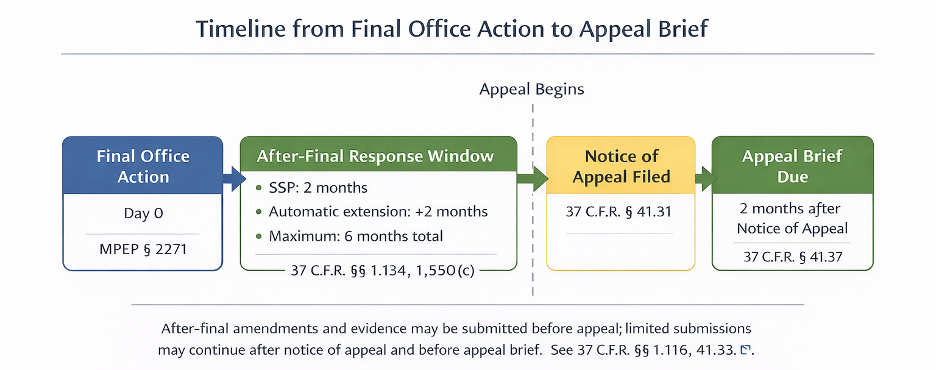
The procedural stages illustrated above in Figure 7-1 frame the petition practice addressed in the sections that follow. Section 7.2 discusses petitions seeking withdrawal of finality. Section 7.3 addresses extensions of time following a final rejection, including extensions affecting the timing of a notice of appeal. Sections 7.4 and 7.5 examine petitions concerning the entry of amendments and evidentiary submissions after final rejection. Section 7.6 then addresses requests for continued reexamination, which seek to reopen prosecution after final rejection in limited circumstances where doing so will advance resolution of the proceeding.
Footnotes
- 1.See MPEP § 2271 (Final Action) (describing issuance of final rejection in ex parte reexamination proceedings).
- 2.35 U.S.C. § 305 (“After the times for filing the statement and reply provided for by section 304 have expired, reexamination will be conducted according to the procedures established for initial examination under the provisions of sections 132 and 133.”).
- 3.35 U.S.C. § 134(b) (authorizing appeal from “the final rejection of any claim by the primary examiner” in a reexamination); see alsoMPEP § 2271 (“It is intended that the second Office action in the reexamination proceeding following the decision ordering reexamination will generally be made final.”).
- 4.MPEP § 2271.
- 5.37 C.F.R. § 1.116 (governing amendments and affidavits after final rejection); see also MPEP § 2272 (After Final Practice) (explaining treatment of amendments and evidence submitted after final rejection in ex parte reexamination proceedings).
- 6.MPEP § 2272 (“For an amendment filed after final rejection and prior to the appeal brief, a showing under 37 CFR 1.116(b) is required and will be evaluated by the examiner for all proposed amendments after final rejection except where an amendment merely cancels claims, adopts examiner’s suggestions, removes issues for appeal, or in some other way requires only a cursory review by the examiner.”).
- 7.Id. (“If the patent owner files an amendment or evidence after final rejection, the examiner will consider the submission and will issue an advisory action indicating whether the amendment or evidence has been entered and whether it overcomes the rejection.”).
§ 7.2 Petition to Withdraw Finality
Last updated: April 5, 2026
Where an Office action is improperly designated as final, the patent owner may seek supervisory review of that determination through a petition under 37 C.F.R. § 1.181. A petition requesting withdrawal of finality thus serves as a procedural safeguard ensuring that prosecution is not prematurely curtailed before the patent owner has had a fair opportunity to respond to the examiner’s grounds of rejection.
A. Procedural Nature of Finality Determinations
Final rejection in a reexamination proceeding represents a procedural determination that the examination phase should be brought to a close and that further review should proceed, if at all, through the appellate process. Because the designation of an Office action as final restricts the patent owner’s ability to amend the claims or submit additional evidence as a matter of right, the rules governing when an action may properly be made final serve an important procedural function in ensuring that the patent owner has had a fair opportunity to respond to the grounds of rejection. Where a final Office action is issued in circumstances inconsistent with those governing principles—such as where the action introduces a new ground of rejection or otherwise alters the basis of rejection without reopening prosecution—the propriety of the finality designation may be challenged through petition practice under 37 C.F.R. § 1.181 invoking the supervisory authority of the Director.1
In ex parte reexamination proceedings, the principles governing final rejection generally parallel those applied in ordinary examination practice. The Manual of Patent Examining Procedure (“MPEP”) explains that a second or subsequent action on the merits may be made final, subject to certain limitations intended to ensure that the patent owner has had an opportunity to respond to the examiner’s grounds of rejection.2 Where those limitations are not satisfied, the Office action should not be designated as final, and petition practice provides the mechanism for obtaining review of the finality determination.
B. Improper Finality Based on New Grounds of Rejection
The most common basis for seeking withdrawal of finality arises where the Office action introduces a new ground of rejection. The governing inquiry is whether the rejection presented in the final Office action differs materially from the rejection previously advanced, such that the patent owner has not had a fair opportunity to respond. As the Court of Customs and Patent Appeals explained, “the ultimate criterion of whether a rejection is considered ‘new’ is whether appellants have had fair opportunity to react to the thrust of the rejection.”3
Consistent with that principle, the Office has identified several circumstances in which a rejection will be regarded as presenting a new ground of rejection. These include situations in which the examiner (1) changes the statutory basis of the rejection, (2) relies on different teachings of the prior art to support the rejection, (3) introduces new factual analysis or calculations supporting the rejection, or (4) relies on different structural features or claim limitations as the basis for the rejection.4 In such circumstances, the rejection raises issues that were not previously presented to the patent owner, and the Office action ordinarily should not be made final.
The MPEP reflects the same principle in its guidance governing final rejection practice. Under that guidance, a second or subsequent Office action on the merits shall be final except where it introduces a new ground of rejection that was neither necessitated by amendment of the claims nor based on information submitted by the applicant or patent owner in an information disclosure statement filed within the period prescribed by the rules.5 Where a final rejection nonetheless introduces such a new ground, a petition may be filed seeking withdrawal of the finality designation so that the patent owner may respond through continued prosecution.
C. Newly Cited Prior Art Against Unamended Claims
Finality may also be improper where the Office action introduces newly cited prior art against claims that were not amended in a manner necessitating that rejection. The governing principle is that a final Office action should not be used to introduce entirely new prior-art theories against claims that the patent owner has not materially changed.6
Accordingly, the MPEP instructs that a second or subsequent action on the merits ordinarily should not be made final if it includes a rejection based on newly cited prior art against claims that were not amended, or were amended in a manner that did not necessitate the new rejection.7 Where such circumstances arise, petition practice may be used to request withdrawal of the finality designation so that the patent owner may respond to the newly asserted prior art.
D. Petition Practice for Withdrawal of Finality
A challenge to the designation of an Office action as final must be presented by petition rather than by appeal. The issue presented by such a petition concerns the procedural propriety of the finality designation, rather than the substantive merits of the rejection itself. The petition is therefore filed under 37 C.F.R. § 1.181, invoking the supervisory authority of the Director to review the examiner’s procedural determination.
In practice, a petition seeking withdrawal of finality typically asserts that the final Office action introduced a new ground of rejection or otherwise failed to satisfy the requirements governing final rejection practice. If the petition is granted, the Office withdraws the finality designation and reopens prosecution, permitting the patent owner to respond to the rejection through further amendment or argument.
Petitions seeking withdrawal of finality are subject to the timing requirements of 37 C.F.R. § 1.181(f), which provides that a petition ordinarily must be filed within two months of the action from which relief is requested. In reexamination proceedings, however, the Office has specifically directed that a petition requesting withdrawal of finality must be filed “within the time period for filing a notice of appeal.”8 Because the filing of a notice of appeal marks an important procedural transition in the proceeding, petitions seeking withdrawal of finality are therefore ordinarily presented before the appeal process begins.
E. Opposability
A petition seeking withdrawal of a final Office action is opposable by the third-party requester in ex parte reexamination proceedings. The Office has identified “Withdrawal of final Office action” among the categories of petitionable matters in reexamination practice that may be opposed by the requester through submission of responsive comments.9
Where a petition seeking withdrawal of finality is denied, the patent owner must proceed within the procedural framework governing post-final practice. The procedural mechanisms available at that stage—including extensions of time and the potential entry of amendments or evidentiary submissions after final rejection—are addressed in the sections that follow.
Footnotes
- 1.37 C.F.R. § 1.181(a)(3) (authorizing petitions invoking the supervisory authority of the Director).
- 2.MPEP § 2271 (“The grounds of rejection must (in the final rejection) be clearly developed to such an extent that the patent owner may readily judge the advisability of an appeal. However, where a single previous Office action contains a complete statement of a ground of rejection, the final rejection may refer to such a statement and also should include a rebuttal of any arguments raised in the patent owner’s response.”).
- 3.In re Kronig, 539 F.2d 1300, 1302 (C.C.P.A. 1976) (“the ultimate criterion of whether a rejection is considered ‘new’ … is whether appellants have had fair opportunity to react to the thrust of the rejection”); see also MPEP § 1207.03(a) (quoting Kronig,539 F.2d at 1302).
- 4.MPEP § 1207.03(a) (identifying circumstances constituting a new ground of rejection, including changes in statutory basis, reliance on different teachings of a reference, introduction of new factual analysis, or reliance on different structural features).
- 5.MPEP § 706.07(a) (“Second or any subsequent actions on the merits shall be final, except where the examiner introduces a new ground of rejection that is neither necessitated by applicant’s amendment of the claims, nor based on information submitted in an information disclosure statement ….”).
- 6.See id.
- 7.Id.
- 8.MPEP § 2272 (“The petition under 37 CFR 1.181 must be filed within the time period for filing a notice of appeal.”).
- 9.“Streamlined Patent Reexamination Proceedings,” 76 Fed. Reg. 22854, 22858 (Apr. 25, 2011) (identifying “Withdrawal of final Office action”—Petitionable? Yes, 1.181. Opposable? Yes).
§ 7.3 Extensions of Time After Final Rejection
Last updated: April 5, 2026
Following a final rejection in an ex parte reexamination proceeding, the timing of further action is governed by extension practices that differ materially from those applicable earlier in examination and that are closely tied to the patent owner’s decision whether to initiate appeal review. Most notably, the Office construes the filing of a timely first response to a final rejection as including a request for an automatic two-month extension of the shortened statutory period for response. This practice reflects the unique procedural posture created by a final rejection, where the patent owner must decide whether to pursue an appeal while also potentially presenting after-final amendments or evidentiary submissions. The extension framework applicable at this stage therefore accommodates the need for the patent owner to obtain the examiner’s ruling on an after-final submission before deciding whether to file a notice of appeal.1
A. Automatic Two-Month Extension Following a Timely First Response
In ex parte reexamination, the filing of a timely first response to a final rejection is construed as including a request for an extension of the shortened statutory period for an additional two months.2 This automatic extension applies whether the response is formal or informal, and even if the response is unsigned.3 The purpose of this practice is to permit the patent owner to obtain the examiner’s ruling on an after-final submission before deciding whether to pursue an appeal.4
Under this framework, the final Office action ordinarily sets a two-month shortened statutory period for response. If the patent owner files a timely first response within that period, the Office automatically extends the response period by two additional months. The total period for response therefore becomes four months from the mailing date of the final rejection unless further extensions are granted upon a showing of sufficient cause.5
The automatic extension practice reflects the Office’s policy that the patent owner should be able to evaluate the examiner’s position in response to an after-final submission before deciding whether to file a notice of appeal.6 In many instances, the examiner will issue an advisory action explaining whether the after-final amendment or evidence has been entered and whether the rejections are maintained.7 The automatic extension practice therefore allows the patent owner to obtain the examiner’s ruling on an after-final submission before deciding whether to initiate an appeal.
B. Maximum Six-Month Statutory Limit
Although extensions of time are available, the response period following a final rejection cannot exceed six months from the mailing date of the final Office action.8 This six-month outer limit derives from the general statutory framework governing reply periods to Office actions under 35 U.S.C. § 133.9
Accordingly, even where the automatic two-month extension applies, any additional extension must remain within the overall six-month limit measured from the mailing date of the final rejection.10 If no appropriate response is filed within the permitted period, the prosecution of the reexamination proceeding will generally be terminated.11
C. Extensions Beyond the Automatic Period — Showing of Sufficient Cause
Extensions beyond the automatic two-month period require a petition demonstrating sufficient cause under 37 C.F.R. § 1.550(c).12
For example, patent owners occasionally request additional time in order to prepare affidavits or declarations under 37 C.F.R. § 1.116(e).13 While such requests may be granted, the grant of an extension merely preserves the opportunity to file the submission; it does not guarantee that the submission will ultimately be admitted.14 The examiner may still refuse to enter the affidavit or declaration if the patent owner fails to demonstrate why the evidence was not presented earlier in the proceeding.15
D. Extensions Affecting the Notice of Appeal
The timing of a notice of appeal represents a critical procedural demarcation in ex parte reexamination practice. The notice of appeal must be filed within the period permitted for response to the final rejection.16 Accordingly, extensions of time following a final rejection directly affect the time available for filing the notice of appeal.
This timing relationship has significant consequences for after-final practice. Amendments and evidentiary submissions governed by 37 C.F.R. § 1.116 may generally be filed before, or on the same date as, the notice of appeal.17 Moreover, petitions under 37 C.F.R. § 1.181 requesting that the final rejection be withdrawn, or requesting entry of a non-entered amendment, must be filed within the time period for filing a notice of appeal.18 Extensions of the response period therefore expand the window during which such after-final submissions and petitions may be presented for consideration.
Once a notice of appeal is filed, however, the procedural posture of the case changes. The window for presenting after-final amendments and evidentiary submissions under 37 C.F.R. § 1.116 correspondingly narrows, and further submissions are subject to the additional limitations imposed by the appeal rules. Extensions of time thereafter primarily affect the schedule for appellate filings—such as the appeal brief—and the automatic two-month extension is unavailable once the notice of appeal has been filed.19 The practical consequences of the notice of appeal demarcation can be summarized as follows.
Table 7-3. Procedural Treatment Before and After Filing a Notice of Appeal
| Before Notice of Appeal | After Notice of Appeal but Before Appeal Brief | |
| Automatic Extension | Filing a timely first response to a final rejection automatically extends the shortened statutory period by two months. SeeMPEP § 2265(VII). | Automatic extension unavailable once notice of appeal is filed. Extensions governed by 37 C.F.R. § 1.550(c). See MPEP § 2265(VII). |
| Petitions | Petitions directed to the final rejection (e.g., seeking withdrawal of finality or entry of amendment) generally must be filed within the time period for filing a notice of appeal. See MPEP § 2272. | Petitions directed to the final rejection are generally no longer timely once a notice of appeal has been filed. See MPEP § 2272. |
| Amendments | Amendments may be filed under 37 C.F.R. § 1.116 before or on the same date as the notice of appeal. See 37 C.F.R. § 1.116(b). | Amendments may still be admitted after the notice of appeal but before the appeal brief under § 1.116 and § 41.33(a). See37 C.F.R. § 41.33(a). |
| Evidence | Affidavits or other evidence may be submitted before or on the same date as the notice of appeal upon the showing required by § 1.116(e). See 37 C.F.R. § 1.116(e). | Evidence after notice of appeal admitted only if it overcomes all rejections and the § 41.33(d) showing is satisfied. See 37 C.F.R. § 41.33(d). |
As shown above in Table 7-3, the filing of a notice of appeal materially alters the procedural framework governing after-final submissions and extensions of time, narrowing the patent owner’s remaining opportunities to shape the administrative record through amendments, evidence, or petitions.
E. Advisory Actions and Examiner-Granted Extensions
In some circumstances, the examiner may determine that the advisory action cannot be issued sufficiently early for the patent owner to meaningfully consider the examiner’s ruling before the response period expires. In such situations, the examiner may grant additional time in the advisory action to permit the patent owner to respond appropriately.20
This practice reflects the principle recognized in Theodor Groz & Sohne & Ernst Bechert Nadelfabrik KG v. Quigg, which emphasized the importance of providing a fair opportunity for the patent owner to evaluate the examiner’s position before deciding whether to pursue an appeal.21
The procedural constraints described above frame the circumstances under which after-final amendments and evidentiary submissions may be considered, which are addressed in § 7.4 and § 7.5 below.
F. Opposability of Extension Requests
The 2011 Federal Register Notice on “Streamlined Patent Reexamination Proceedings” states that an “Extension of time to file a notice of appeal or brief on appeal by Patent Owner in ex parte reexam” is petitionable under § 1.550(c) but is not opposable by the third-party requester.22
As a result, the Office treats such extension requests as matters between the patent owner and the Office, without participation by the requester.
Footnotes
- 1.35 U.S.C. § 134(b) (authorizing patent owner appeal from final rejection in ex parte reexamination); 37 C.F.R. § 41.31(a)(3) (setting deadline to file notice of appeal by patent owner in ex parte reexamination).
- 2.MPEP § 2265(VII) (“the filing of a timely first response to a final rejection … is construed as including a request to extend the shortened statutory period for an additional two months”).
- 3.MPEP § 2272(I) (“the filing of any timely first response to a final rejection (even an informal response or even a response that is not signed) will automatically result in the extension of the shortened statutory period for an additional two months”).
- 4.MPEP § 2265(VII) (“An object of this practice is to obviate the necessity for appeal merely to gain time to consider the examiner’s position in reply to a response timely filed after final rejection. Accordingly, the shortened statutory period for response to a final rejection to which a proposed first response has been received will be extended two months.”).
- 5.Id.
- 6.Id.
- 7.MPEP § 2272(II) (describing advisory Office action practice following a response after final rejection).
- 8.MPEP § 2265(VII) (“In no case can the period for response to the final rejection be extended to exceed six months from the mailing date of the final rejection.”).
- 9.35 U.S.C. § 133 (“Upon failure of the applicant to prosecute the application within six months after any action therein, of which notice has been given or mailed to the applicant, or within such shorter time, not less than thirty days, as fixed by the Director in such action, the application shall be regarded as abandoned by the parties thereto.”).
- 10.MPEP § 2265(VII).
- 11.37 C.F.R. § 1.550(d) (termination of reexamination prosecution).
- 12.37 C.F.R. § 1.550(c).
- 13.37 C.F.R. § 1.116(e) (“An affidavit or other evidence submitted after a final rejection or other final action (§ 1.113) … in an ex parte reexamination filed under § 1.510 … but before or on the same date of filing an appeal (§ 41.31 or § 41.61 of this title), may be admitted upon a showing of good and sufficient reasons why the affidavit or other evidence is necessary and was not earlier presented.”).
- 14.MPEP § 2265(VIII) (“Frequently, patent owners request an extension of time, stating as a reason therefor that more time is needed in which to submit an affidavit or declaration. When such a request is filed after final rejection, the granting of the request for extension of time is without prejudice to the right of the examiner to question why the affidavit or declaration is now necessary and why it was not earlier presented. See 37 CFR 1.116(e).”).
- 15.37 C.F.R. § 1.116(e); MPEP § 2265(VII) (“If the patent owner’s showing is insufficient, the examiner may deny entry of the affidavit, notwithstanding the previous grant of an extension of time to submit it.”).
- 16.37 C.F.R. § 41.31(a)(3) (notice of appeal in ex parte reexamination due within time period provided under § 1.134 for reply to final rejection).
- 17.37 C.F.R. § 1.116(b) (after-final amendments), § 1.116(e) (after-final affidavit or other evidence); see also 37 C.F.R. § 41.33 (amendments and evidence after filing notice of appeal).
- 18.MPEP § 2272 (“The petition under 37 CFR 1.181 must be filed within the time period for filing a notice of appeal.”).
- 19.MPEP § 2265(VII) (“This automatic two-month extension of time does not apply once the notice of appeal has been filed. In that instance, the patent owner will be notified that an appeal brief is due two months from the date of the notice of appeal to avoid dismissal of the appeal, and extensions of time are governed by 37 CFR 1.550(c).”).
- 20.MPEP § 2265(VII) (“In those situations where the advisory action cannot be mailed in sufficient time for the patent owner to consider the examiner’s position with respect to the amendment after final rejection (or other patent owner paper) and act on it before termination of the prosecution of the proceeding, the granting of additional time to complete the response to the final rejection or to take other appropriate action would be appropriate…. The additional time should be granted by the examiner, and the time granted should be set forth in the advisory Office action.”); MPEP § 2272(I) (“Notification of the examiner’s ruling should reach the patent owner with sufficient time for the patent owner to consider the ruling and act on it. Accordingly, the period for response to the final rejection should be appropriately extended in the examiner’s advisory action.”).
- 21.Theodor Groz & Sohne & Ernst Bechert Nadelfabrik KG v. Quigg, 10 U.S.P.Q.2d 1787, 1790 (D.D.C. 1988) (stating “PTO suggests no rational purpose for requiring an owner seeking reexamination to file notice of an administrative appeal before he knows the examiner’s ruling on a formally authorized submission of new evidence.”).
- 22.“Streamlined Patent Reexamination Proceedings,” 76 Fed. Reg. 22854, 22858 (Apr. 25, 2011) (identifying “Extension of time to file a notice of appeal or brief on appeal by Patent Owner in ex parte reexam” as petitionable but not opposable).
§ 7.4 After-Final Amendments
Last updated: April 5, 2026
Following a final rejection in an ex parte reexamination proceeding, amendments to the claims are governed primarily by 37 C.F.R. § 1.116. Unlike amendments submitted prior to final rejection, which are ordinarily entered as a matter of right, amendments filed after final rejection are subject to the examiner’s discretion and may be entered only under limited circumstances. The availability and treatment of such amendments also depend significantly on the procedural stage of the proceeding—most notably whether a notice of appeal has been filed. As discussed previously in § 7.3 of this treatise, the filing of a notice of appeal represents an important procedural demarcation that alters the framework governing after-final submissions, including amendments.
A. Governing Rule
Amendments filed after a final rejection in ex parte reexamination are governed by 37 C.F.R. § 1.116, which sets forth the circumstances under which such amendments may be admitted.1 The rule reflects the principle that the issuance of a final rejection is intended to bring the examination phase of the proceeding to a close. Accordingly, after-final amendments are not entered as a matter of right.
Under § 1.116, the examiner may enter an amendment after final rejection in several limited circumstances. For example, amendments that cancel claims, place the proceeding in condition for allowance, or adopt suggestions previously made by the examiner are typically considered appropriate for entry.2 Conversely, amendments that raise new issues or require further substantive examination are generally not entered after final rejection.3
The discretionary character of after-final amendment practice reflects the Office’s interest in preserving the finality of examination while still permitting limited claim adjustments that may resolve outstanding issues without the need for appellate review.
B. Amendments Before the Notice of Appeal
The principal procedural window for submitting after-final amendments occurs before the filing of a notice of appeal. During this period, amendments may be submitted under 37 C.F.R. § 1.116(b) and will be considered by the examiner in determining whether entry is appropriate.4
In many instances, the examiner will respond to the amendment through an advisory action indicating whether the amendment has been entered and whether the outstanding rejections are maintained.5 As discussed in § 7.3 (this treatise), the Office’s practice of providing an automatic two-month extension of time following a timely first response to a final rejection facilitates this process by allowing the patent owner to obtain the examiner’s ruling on an after-final submission before deciding whether to pursue an appeal.
This pre-appeal stage therefore provides the patent owner with an opportunity to attempt to resolve the rejection through amendment while still preserving the option of appellate review if the amendment is not entered or fails to overcome the rejection.
C. Amendments After the Notice of Appeal
Once a notice of appeal has been filed, the procedural posture of the proceeding changes. Amendments submitted after the filing of the notice of appeal are governed by 37 C.F.R. § 41.33(a), which governs amendments prior to the filing of the appeal brief. This rule states that such amendments “may be admitted as provided in § 1.116 of this title.”6
Entry of such amendments remains subject to the standards of § 1.116 and the examiner’s discretion.
D. Examiner Discretion and Advisory Actions
Whether an after-final amendment is entered is a matter committed largely to the examiner’s discretion under § 1.116.7 In exercising that discretion, the examiner evaluates whether the amendment resolves the outstanding issues without necessitating further substantive examination.8
If an amendment is submitted after final rejection, the examiner may respond in several ways. The amendment may be entered and considered on the merits; it may be entered only for purposes of appeal; or it may be refused entry.9 The examiner typically communicates this determination through an advisory action issued in response to the patent owner’s submission.10
Advisory actions therefore play an important role in after-final practice. They inform the patent owner whether the amendment has been entered and whether the outstanding rejections remain in effect, thereby allowing the patent owner to decide whether to proceed with an appeal.
E. Petition Practice When Entry Is Refused
If the examiner refuses to enter an amendment submitted after final rejection, the patent owner may seek review of that determination by filing a petition under 37 C.F.R. § 1.181 requesting entry of the amendment.11 Such petitions typically argue that the amendment satisfies the standards of § 1.116 and that the examiner improperly exercised discretion in refusing entry.
The timing of such petitions is significant. The Office instructs that a petition seeking entry of an amendment after final rejection must be filed within the time period for filing a notice of appeal.12 As discussed in § 7.3 (this treatise), extensions of time under 37 C.F.R. § 1.550(c) may extend the period for filing a notice of appeal.
The petition mechanism therefore functions as a procedural safeguard allowing the patent owner to obtain supervisory review of the examiner’s refusal to enter an amendment before the proceeding transitions fully into the appellate phase.
F. Opposability of Petitions Concerning Refusal to Enter Amendments
An examiner’s refusal to enter an amendment is not only petitionable by the patent owner, it also is opposable by the third-party requester. The Office’s 2011 Federal Register notice has expressly identified “Review of refusal to enter amendment” as a petitionable matter under 37 C.F.R. § 1.181 for which requester opposition is permitted.13
This treatment reflects the fact that the entry of an amendment may materially affect the scope of the claims under examination and therefore may directly affect the requester’s interests in the proceeding. Allowing requester participation in such petitions ensures that both parties may be heard on whether the amendment should be entered.
After-final amendments therefore occupy a central procedural position in post-final reexamination practice. They provide a limited mechanism for modifying the claims following a final rejection while preserving the integrity of the examination process. The treatment of after-final evidentiary submissions, which are governed by related but distinct standards, is addressed in the following section.
Footnotes
- 1.37 C.F.R. § 1.116.
- 2.MPEP § 2272 (“For an amendment filed after final rejection and prior to the appeal brief, a showing under 37 CFR 1.116(b) is required and will be evaluated by the examiner for all proposed amendments after final rejection except where an amendment merely cancels claims, adopts examiner’s suggestions, removes issues for appeal, or in some other way requires only a cursory review by the examiner.”); MPEP § 714.13 (Amendments and Other Replies After Final Rejection or Action, Procedure Followed).
- 3.MPEP § 2272(II) (“Unless the proposed amendment is entered in its entirety, the examiner will briefly explain the reasons for not entering a proposed amendment. For example, if the claims as amended present a new issue requiring further consideration or search, the new issue should be identified and a brief explanation provided as to why a new search or consideration is necessary.”).
- 4.37 C.F.R. § 1.116(b).
- 5.MPEP § 714 (“In addition to providing reasons for non-entry when the amendment is not in compliance with 37 CFR 1.116 (e.g., the proposed amendment raises new issues that would require further consideration and/or search), the examiner should also indicate in the advisory action any non-compliance in the after-final amendment.”).
- 6.37 C.F.R. § 41.33(a) (“Amendments filed after the date of filing an appeal pursuant to § 41.31(a)(1) through (a)(3) and prior to the date a brief is filed pursuant to § 41.37 may be admitted as provided in § 1.116 of this title.”).
- 7.MPEP § 2272.
- 8.MPEP § 714 (identifying reason for non-entry if “claims as amended present new issues requiring further consideration or search”).
- 9.Id. (“Examiners should indicate the status of each claim of record or proposed in the amendment, and which proposed claims would be entered on the filing of an appeal if filed in a separate paper. Whenever such an amendment is entered for appeal purposes, the examiner must indicate on the advisory action which individual rejection(s) set forth in the action from which the appeal was taken (e.g., the final rejection) would be used to reject the new or amended claim(s).”).
- 10.Id.
- 11.MPEP § 2272 (“In the event that the patent owner is of the opinion … that an amendment submitted after final rejection complies with 37 CFR 1.116 but the examiner improperly refused entry of such an amendment, the patent owner may … file a petition under 37 CFR 1.181 requesting entry of the amendment….”).
- 12.Id. (“The petition under 37 CFR 1.181 must be filed within the time period for filing a notice of appeal.”).
- 13.“Streamlined Patent Reexamination Proceedings,” 76 Fed. Reg. 22854, 22858 (Apr. 25, 2011).
§ 7.5 After-Final Evidence
Last updated: April 5, 2026
Following a final rejection, new evidentiary submissions are subject to the Office’s restrictive after-final procedures. Although the rules permit the submission of affidavits and other evidence at this stage, their entry is discretionary and is governed by 37 C.F.R. § 1.116(e), which requires a showing of good and sufficient reasons why the evidence is necessary and was not presented earlier.
A. Governing Rule
Following a final rejection in an ex parte reexamination proceeding, the submission of affidavits and other evidentiary materials is governed principally by 37 C.F.R. § 1.116(e). Evidence submitted after final rejection is not entered as a matter of right. Rather, the rule reflects the Office’s recognition that final rejection marks the close of ordinary examination practice, permitting additional evidentiary submissions only in limited circumstances designed to ensure fairness while preserving the efficiency of the proceeding.
Rule 1.116(e) permits entry of evidence submitted after final rejection in an ex parte reexamination, but before or on the same date as the filing of a notice of appeal, provided that the patent owner demonstrates “good and sufficient reasons” why the evidence is necessary and why it was not earlier presented.1 This standard reflects the Office’s broader principle that the evidentiary record should ordinarily be developed during the normal course of examination, rather than after final rejection.
B. Nature of Evidentiary Submissions After Final
Evidence submitted after final rejection may take a variety of forms. Common examples include declarations under 37 C.F.R. § 1.132, expert affidavits, experimental data, technical publications, or other documentary evidence offered to rebut the examiner’s reasoning.2 After-final evidence may also take the form of an affidavit or declaration of attribution or prior public disclosure under 37 C.F.R. § 1.130, or an affidavit or declaration establishing prior invention or common ownership under 37 C.F.R. § 1.131.3
Such materials are often presented to respond to factual assertions contained in the final rejection or to clarify technical issues relevant to patentability. Because final rejection signals the close of the normal examination phase, however, such evidentiary submissions must ordinarily be accompanied by an explanation demonstrating why the evidence was not earlier presented. The Office has long emphasized that the after-final stage is not intended to provide an unrestricted opportunity to introduce new material into the record, but rather a limited mechanism for addressing issues that could not reasonably have been resolved earlier.
C. Standard for Entry of Evidence
The governing standard under § 1.116(e) requires a showing of “good and sufficient reasons” demonstrating both the necessity of the evidence and why it was not earlier presented. The rule therefore imposes a two-part requirement: the evidence must be necessary to address the issues presented in the proceeding, and the submitting party must explain why the evidence was not presented during earlier stages of prosecution.
In practice, evidence submitted after final rejection may satisfy this standard where it responds directly to reasoning introduced in the final rejection or addresses factual issues first raised at that stage. For example, evidentiary submissions may be appropriate where the final rejection introduces new technical analysis, factual assertions, or reasoning that reasonably calls for rebuttal evidence.
Conversely, evidence that merely supplements previously available arguments without explaining the delay in submission may be refused entry. The determination ultimately rests within the examiner’s discretion, subject to supervisory review through the petition process discussed below.
D. Examiner Treatment and Advisory Actions
When evidence is submitted after final rejection, the examiner must determine whether the submission satisfies the requirements of § 1.116(e). If the examiner concludes that the evidentiary showing is sufficient, the evidence may be entered into the record and considered in evaluating the outstanding rejections.
If the examiner determines that the submission does not satisfy the rule’s requirements, entry of the evidence may be refused. The Office typically communicates this determination through an advisory action, which informs the patent owner whether the submission has been entered and whether the rejections remain maintained.4
This advisory-action practice reflects the transitional nature of the after-final stage. Although the proceeding remains technically within the examination phase, the issuance of a final rejection signals that the Office expects the next procedural step to be either appeal or other post-final practice rather than continued substantive examination.
E. Petition Practice Concerning Refusal to Enter Evidence
If the examiner refuses to enter evidence submitted after final rejection, the patent owner may seek supervisory review through a petition under 37 C.F.R. § 1.181. Such petitions typically contend that the evidentiary submission satisfies the requirements of § 1.116(e) and that the examiner improperly exercised discretion in refusing entry.
In reexamination proceedings, MPEP § 2272 provides that petitions challenging matters associated with final rejection—such as refusals to enter amendments under § 1.116(b)—must be filed within the time period for filing a notice of appeal.5 This deadline reflects the Office’s effort to resolve disputes concerning the evidentiary record before the proceeding transitions to appellate review.
Petition decisions illustrate that the Office may grant such relief where the evidentiary submission directly addresses issues raised in the final rejection and where the explanation for the timing of the submission satisfies the “good and sufficient reasons” standard of § 1.116(e).6 In one decision, for example, the Office granted a petition seeking entry of technical publications submitted after final rejection where the materials were offered to rebut factual assertions articulated in the final Office action.7
F. Effect of Filing the Notice of Appeal
The filing of a notice of appeal marks an important procedural transition in post-final practice. Once a notice of appeal has been filed, the proceeding moves toward appellate review before the Patent Trial and Appeal Board, and the ability to introduce new evidence becomes substantially restricted under 37 C.F.R. § 41.33(d), which permits such submissions only if the evidence overcomes all rejections under appeal and the party demonstrates good and sufficient reasons for the late submission.8
Accordingly, the period between the issuance of the final rejection and the filing of a notice of appeal constitutes the principal window during which evidentiary submissions under § 1.116(e) may be considered. This temporal boundary parallels the treatment of after-final amendments discussed in the preceding section and reinforces the role of the notice of appeal as the procedural dividing line between examiner reconsideration and appellate review.
Footnotes
- 1.37 C.F.R. § 1.116(e) (“An affidavit or other evidence submitted after a final rejection or other final action (§ 1.113) … in an ex parte reexamination filed under § 1.510, … but before or on the same date of filing an appeal (§ 41.31 or § 41.61 of this title), may be admitted upon a showing of good and sufficient reasons why the affidavit or other evidence is necessary and was not earlier presented.”).
- 2.37 C.F.R. § 1.132 (“When any claim of an application or a patent under reexamination is rejected or objected to, any evidence submitted to traverse the rejection or objection on a basis not otherwise provided for must be by way of an oath or declaration under this section.”).
- 3.37 C.F.R. §§ 1.130, 1.131.
- 4.MPEP § 714.13 (Amendments and Other Replies After Final Rejection or Action, Procedure Followed).
- 5.MPEP § 2272 (“the patent owner may … file a petition under 37 CFR 1.181 requesting entry of the amendment”; “The petition under 37 CFR 1.181 must be filed within the time period for filing a notice of appeal.”).
- 6.See In re Application No. 14/892,923 (2017-11-17 Petition Decision) (granting petition seeking entry of rebuttal publications submitted after final rejection).
- 7.Id. (“The rebuttal evidence simply amounts to publicly available literature submitted to counter the examiner’s contentions in the final Office action…. [P]etitioners have presented a showing of good and sufficient reasons for entry of the collection of technical publications….”).
- 8.37 C.F.R. § 41.33(d)(1) (“An affidavit or other Evidence filed after the date of filing an appeal pursuant to § 41.31(a)(1) through (a)(3) and prior to the date of filing a brief pursuant to § 41.37 may be admitted if the examiner determines that the affidavit or other Evidence overcomes all rejections under appeal and that a showing of good and sufficient reasons why the affidavit or other Evidence is necessary and was not earlier presented has been made.”).
§ 7.6 Request for Continued Reexamination (RCR)
Last updated: April 5, 2026
A request for continued reexamination (“RCR”) occupies a narrow and exceptional role in ex parte reexamination practice. Unlike after-final amendment and evidentiary practice governed by 37 C.F.R. § 1.116, and unlike petitions seeking supervisory review under 37 C.F.R. § 1.181, an RCR seeks to reopen prosecution after final rejection notwithstanding the Office’s strong institutional interest in bringing reexamination proceedings to prompt resolution. Because reexamination must be conducted “with special dispatch,” reopening prosecution is not routine, but instead is available only in limited circumstances where reopening will materially advance the proceeding toward resolution, rather than delay it.1
A. Source Authority and Non-Codified Status
The practice of requesting continued reexamination is not established by rule but instead derives from Office guidance set forth in an Official Gazette Notice issued in March 2005.2 That Notice explains that a patent owner may seek continued prosecution on the merits in a reexamination following a final rejection by filing a petition requesting such relief. The Notice advises that patent owners may seek such relief via petition under 37 C.F.R. § 1.182 until a rule is promulgated to codify this procedure. To date, no rule has been promulgated codifying this procedure.3
Accordingly, requests for continued reexamination are evaluated under § 1.182, which permits the Office to grant relief not otherwise provided for by rule.4 Petition decisions have consistently confirmed that an RCR remains a form of discretionary, gap-filling relief, rather than a matter of right.
B. Procedural Vehicle and Timing
An RCR must be presented by petition under 37 C.F.R. § 1.182.5 Because such petitions are not governed by a specific rule setting a deadline, they are subject to the general timeliness provision of 37 C.F.R. § 1.181(f), under which a petition “not filed within two months of the mailing date of the action or notice from which relief is requested may be dismissed as untimely.”6
In practice, the relevant “action” is the final rejection or action closing prosecution. The petition should therefore be filed within the period that governs the filing of a notice of appeal. This timing aligns the RCR with the broader procedural structure described in § 7.3 (this treatise). It is a mechanism available during the post-final, pre-appeal phase, before the proceeding transitions fully into appellate review.
Once a notice of appeal is filed, the procedural posture of the case changes, and the availability of reopening relief correspondingly narrows. Although § 1.182 does not expressly prohibit such relief after appeal has been initiated, the transition to the appellate phase significantly constrains the availability of reopening relief.
C. Substantive Standard: Bona Fide Advancement of the Proceeding
The governing standard for granting an RCR is whether the submission accompanying the petition constitutes “a bona fide attempt to advance the proceeding.”7 This standard reflects the statutory mandate that reexamination proceedings be conducted with special dispatch.
To satisfy this standard, the patent owner must do more than show that the proposed amendment or evidence could potentially overcome a rejection. Rather, the petition must demonstrate that entry of the submission would simplify the issues for appeal or eliminate issues in a manner that advances the proceeding toward issuance of a reexamination certificate.8
Petition decisions repeatedly emphasize that it is necessary, but not sufficient, to show how the submission might overcome pending rejections. The petitioner must also explain why the overall complexity of the proceeding will be reduced, such that the Office may reasonably expect that reopening prosecution will streamline, rather than prolong, the path to resolution.9
In evaluating this showing, the Office considers the petitioner’s arguments in light of the existing record, but does not undertake a substantive determination of patentability. The inquiry is procedural and forward-looking, focusing on whether reopening prosecution will promote efficient resolution of the case.
D. Relationship to After-Final Amendment and Evidence Practice
RCRs most commonly arise where the patent owner has sought entry of an amendment or evidentiary submission after final rejection under 37 C.F.R. § 1.116, and that submission has been denied entry. In that circumstance, the patent owner may pursue relief through multiple avenues.
A petition under 37 C.F.R. § 1.181 may be used to seek review of the examiner’s refusal to enter amendments or evidence, as discussed in this treatise’s § 7.4 and § 7.5. By contrast, an RCR under § 1.182 does not seek review of the examiner’s decision, but instead requests that prosecution be reopened notwithstanding that decision.
This distinction is significant. An RCR is not the appropriate vehicle for asserting examiner error. The appropriate vehicle for raising arguments regarding examiner error is through an appeal on substantive patentability issues or through a petition under § 1.181 for supervisory review of petitionable matters.10
The patent owner must therefore carefully distinguish between these forms of relief and select the appropriate procedural vehicle.
E. Limits on Availability
The availability of continued reexamination is sharply limited by the statutory requirement of special dispatch. Reopening prosecution after final rejection inherently risks delaying resolution of the proceeding and is therefore disfavored absent a clear showing of procedural benefit.11
Petition decisions identify several circumstances in which such relief is inappropriate. Reopening will generally be denied where the proposed submission would expand the issues under consideration, introduce new claim scope requiring additional analysis, or otherwise increase the complexity of the proceeding.12 Similarly, submissions that merely repeat or elaborate upon arguments already of record do not justify reopening.
The Office has also made clear that continued reexamination is not an analog to continued examination practice in original prosecution. There is no entitlement to repeated rounds of amendment and examination following final rejection in reexamination proceedings.
F. Common Bases for Denial
Consistent patterns emerge from petition decisions denying RCR. Relief is commonly denied where the petitioner fails to demonstrate that the proposed submission will simplify the issues for appeal.13
Denials also occur where the submission would expand the scope of issues under consideration, such as by introducing new claims or evidentiary materials that require extensive additional analysis.14 Where the submission does not address all outstanding issues, or seeks to re-prosecute an issue that has already been addressed and resolved, the Office has declined to reopen prosecution.
Petition decisions further reflect that submissions presenting after-final amendments, which attempt to recapture subject matter that was previously cancelled in the proceeding, do not support reopening.15 Attempts to use an RCR as a vehicle to submit after-final evidence that could have been presented earlier are likewise rejected as inconsistent with the special dispatch mandate.
These decisions collectively underscore that the central inquiry is not whether the patent owner has more to say, but whether reopening prosecution will materially advance resolution of the case.
G. Strategic Considerations
From a strategic perspective, an RCR represents a final opportunity to return the proceeding to examiner consideration before the onset of appellate review. As such, it must be evaluated in light of the alternatives available to the patent owner.
Where the primary concern is alleged examiner error (e.g., premature finality, improper refusal to enter amendments or evidence), a petition under § 1.181 may be the more appropriate vehicle. Where the record is sufficiently developed and the issues are well-defined, proceeding directly to appeal may be preferable. An RCR is most appropriate where a narrowly tailored submission can demonstrably eliminate or substantially reduce the issues requiring appellate review.
H. Transition to Appeal
The RCR represents the final procedural mechanism by which the patent owner may seek to alter the trajectory of the proceeding prior to appeal. Once such relief is denied, or not pursued, the reexamination proceeds into the appellate phase discussed in Chapter 8. In this way, RCR serves as the final off-ramp before the structured regime of appellate review takes hold.
Footnotes
- 1.35 U.S.C. § 305 (“All reexamination proceedings under this section, including any appeal to the Patent Trial and Appeal Board, will be conducted with special dispatch within the Office.”).
- 2.“Notice of Changes in Requirement for a Substantial New Question of Patentability for a Second or Subsequent Request for Reexamination While an Earlier Filed Reexamination Is Pending,” 1292 Off. Gaz. Pat. Office 20 (Mar. 1, 2005).
- 3.Ex parte reexamination 90/013,873 (2019-01-24 Petition Decision) (“No such rule providing for continued reexamination has been promulgated.”).
- 4.37 C.F.R. § 1.182.
- 5.Ex parte reexamination 90/013,873 (2019-01-24 Petition Decision).
- 6.37 C.F.R. § 1.181(f).
- 7.Ex parte reexamination 90/013,873 (2019-01-24 Petition Decision) (“the patent owner must make a bona fide effort, in the submission accompanying the § 1.182 petition, to define and reduce the issues for appeal or eliminate the issues to permit issuance of a reexamination certificate, since this is a key factor in reducing pendency of a reexamination proceeding”).
- 8.Id. (“petition must clearly discuss the manner in which the entry of the submission would act to overcome a rejection or satisfy a requirement of form such that the issues in the proceeding are better defined for appeal or eliminated for issuance of a reexamination certificate”).
- 9.Id. (“It is necessary, but not sufficient, to show the manner by which patent owner believes the proposed evidentiary submission would overcome pending rejections. The petitioner must also show reasoning why the underlying issues would be simplified or reduced so that the Office may fairly expect that entry of the submission will streamline the proceeding towards its resolution.”).
- 10.Id. (“Examiner error is provided for in the regulations through the appeal process or petitioning to the Director under 37 C.F.R. § 1.181.”).
- 11.Ex parte reexamination 90/010,278 (2010-06-25 Petition Decision) (“equity requires that a petition for [RCR] must balance that delay with a showing that patent owner supported the Office’s unequivocal statutory mandate to carry out an ex parte reexamination proceeding with special dispatch”).
- 12.Ex parte reexamination 90/006,984 (2009-06-22 Petition Decision); Ex parte reexamination 90/010,278 (2010-06-25 Petition Decision); Ex parte reexamination 90/013,873 (2019-01-24 Petition Decision).
- 13.Ex parte reexamination 90/010,278 (2010-06-25 Petition Decision) (“patent owner failed to show that entry of the declaration would act to define the issues for appeal, or further the issuance of a reexamination certificate, rather than raise new issues”).
- 14.Ex parte reexamination 90/006,984 (2009-06-22 Petition Decision) (patent owner’s submission “does not include an explanation of the relevance, to the newly proffered set of claim limitations, of the large volume of art/information of record and newly submitted art/information in EBAY’s companion petition”).
- 15.Ex parte reexamination 90/013,873 (2019-01-24 Petition Decision) (“Continued reexamination under § 1.182 is not the vehicle to recapture subject matter after Final rejection that was previously cancelled in the proceeding.”).
PART V
Appellate Review
Part V addresses petition practice during appellate review of ex parte reexamination, from the filing of a notice of appeal to the Patent Trial and Appeal Board through judicial review in the United States Court of Appeals for the Federal Circuit and implementation of the court’s mandate. As developed in Chapters 8 and 9, this stage governs jurisdictional transitions and adjudicatory review, where petition practice is limited to defined procedural roles—principally supervisory correction prior to Board jurisdiction, procedural matters within Board authority, preservation of appellate rights, and enforcement of the Federal Circuit’s mandate.
Chapter 8
Petitions in PTAB Appeal
This chapter addresses petition practice during the appellate phase of ex parte reexamination, from the notice of appeal through Board decision and rehearing. At this stage, the proceeding transitions from examiner-controlled prosecution to structured review under 37 C.F.R. Part 41.
Petition practice in this phase is defined by jurisdictional transitions. Prior to transfer of jurisdiction, supervisory petitions under 37 C.F.R. § 1.181 remain available to address procedural defects in the appeal process. Once jurisdiction passes to the Board under 37 C.F.R. § 41.35, petition authority shifts under § 41.3, and rehearing under § 41.52 becomes the primary mechanism for challenging Board action. After transfer of jurisdiction, petition practice becomes limited and subordinate to the Board’s adjudicatory authority.
The appeal proceeds through defined procedural pivot points—notice of appeal, appeal brief, examiner’s answer, and reply brief—that determine both the availability of petition practice and the timing of jurisdictional transfer. Each transition constrains supervisory intervention and shifts the proceeding toward record-based adjudication.
Within this framework, petitions serve targeted functions, including enforcing briefing compliance, addressing undesignated new grounds in the examiner’s answer, and managing timing through extensions and revival. After jurisdiction transfers, petition practice is limited to procedural matters, and rehearing displaces petition as the vehicle for challenging Board decisions.
§ 8.1 Notice of Appeal
Last updated: April 5, 2026
The filing of a notice of appeal marks the procedural transition from examiner-controlled prosecution to structured administrative review within the Office. Although the notice initiates the appellate phase, it does not immediately transfer authority to the Patent Trial and Appeal Board. Rather, the appeal proceeds through a defined sequence of filings—most notably the appeal brief, examiner’s answer, and reply brief—during which jurisdiction remains with the Central Reexamination Unit before ultimately passing to the Board.
The notice of appeal functions as a gateway: it fixes the patent owner’s election to seek appellate review, while preserving a limited set of limited mechanisms for shaping the record and correcting procedural defects prior to full Board jurisdiction.
A. Function and Governing Authority
In an ex parte reexamination proceeding, an appeal to the Board is taken by filing a notice of appeal from a final rejection.1 The notice must be filed within the time period for response to the final rejection.2 The notice itself is a concise procedural filing; it does not present substantive argument, but instead serves to notify the Office of the patent owner’s election to seek administrative review.3
The governing rules for ex parte appeals are set forth in 37 C.F.R. Part 41, including both the general provisions of Subpart A and the specific procedures for ex parte appeals in Subpart B.4 These rules establish the sequence of filings that follow the notice of appeal and define petition mechanisms applicable during the appellate phase.
B. Relationship to Final Rejection Practice
The notice of appeal must be understood in direct relation to the final rejection that precedes it. As discussed in Chapter 7, final rejection represents the Office’s determination that prosecution on the merits has reached a point at which further amendment or evidence will be restricted. The filing of a notice of appeal reflects the patent owner’s decision to challenge that determination before the Board rather than to continue attempting to advance prosecution within the confines of after-final practice.
At the same time, the filing of a notice of appeal does not immediately terminate all aspects of examiner-controlled procedure. Prior to the filing of an appeal brief—and, more importantly, prior to the filing of a reply brief—jurisdiction over the proceeding remains with the examiner.5 Accordingly, certain limited forms of after-final practice, as well as supervisory petitions under 37 C.F.R. § 1.181, may still be available during this interval, subject to the constraints described in Chapter 7.
C. Sequence of Appellate Filings and Deferred Transfer of Jurisdiction
Following the filing of a notice of appeal, the appellate process unfolds through a structured sequence of submissions governed by Part 41. The patent owner must file an appeal brief setting forth the arguments for patentability.6 The examiner then issues an answer responding to those arguments and maintaining or modifying the grounds of rejection.7 The patent owner may, in turn, file a reply brief addressing the examiner’s answer.8
Crucially, jurisdiction over the appeal does not pass to the Board upon the filing of the notice of appeal or even upon the filing of the appeal brief. Rather, under 37 C.F.R. § 41.35, jurisdiction passes to the Board only after the filing of the reply brief, or the expiration of the time for filing such a brief.9 This deferred transfer of jurisdiction creates an intermediate phase in which the proceeding is formally on appeal but remains, in important respects, under examiner control.
D. Petition Practice in the Pre-Jurisdiction Interval
The period between the filing of the notice of appeal and the transfer of jurisdiction to the Board is characterized by a narrowing but still meaningful role for petition practice. During this interval, petitions under 37 C.F.R. § 1.181 remain available to seek supervisory review of certain procedural determinations, including issues arising from the appeal brief and examiner’s answer prior to the transfer of jurisdiction.10 For example, a patent owner who contends that the examiner has failed to designate a new ground of rejection in the answer must seek review by petition within the time and manner prescribed by 37 C.F.R. § 41.40(a), prior to the filing of any reply brief.11 Such petitions operate as supervisory review mechanisms directed to the examiner’s handling of the appeal record, rather than as substitutes for Board review on the merits.
Once jurisdiction passes to the Board, however, the availability and nature of petition practice change materially. Authority over procedural matters shifts in part to the Chief Administrative Patent Judge and to panels of administrative patent judges under 37 C.F.R. § 41.3 and the delegations set forth in MPEP § 1002.02. Issues arising from the Board’s own decision, in turn, are addressed not by petition but through the rehearing mechanism of 37 C.F.R. § 41.52. These distinctions are developed in the sections that follow.
E. Structure of the Appeal Phase
The procedural stages initiated by the notice of appeal frame the petition practice addressed throughout this chapter. Section 8.2 addresses the appeal brief, including compliance requirements and petitions relating to non-compliant briefs. Section 8.3 examines the examiner’s answer and associated petition practice, including challenges to undesignated new grounds of rejection. Section 8.4 addresses the reply brief and the resulting transfer of jurisdiction to the Board. Section 8.5 analyzes the allocation of petition authority following that transfer, including the roles of the Chief Administrative Patent Judge, administrative patent judges, and the Board. Section 8.6 examines rehearing as the exclusive mechanism for Board-level reconsideration.
The distinction between petition-based supervisory review and Board adjudication becomes critical once jurisdiction passes under § 41.35, at which point procedural challenges are directed through the mechanisms provided in Part 41 rather than through § 1.181.
Footnotes
- 1.37 C.F.R. § 41.31(a) (“An appeal is taken to the Board by filing a notice of appeal.”); MPEP § 1204(III) (“In an ex parte reexamination filed on or after November 29, 1999, the patent owner may appeal to the Board only after the final rejection of one or more claims in the particular reexamination proceeding for which appeal is sought.”).
- 2.MPEP § 2273 (“The period for filing the notice of appeal is the period set for response in the last Office action which is normally 2 months.”).
- 3.MPEP § 1204 (noting that Form PTO/AIA/31 may be used for a notice of appeal).
- 4.See 37 C.F.R. Part 41, Subparts A and B.
- 5.37 C.F.R. § 41.35(a) (“Jurisdiction over the proceeding passes to the Board upon the filing of a reply brief….”).
- 6.37 C.F.R. § 41.37; MPEP § 1205 (appeal brief).
- 7.37 C.F.R. § 41.39; MPEP § 1207 (examiner’s answer).
- 8.37 C.F.R. § 41.41; MPEP § 1208 (reply brief).
- 9.37 C.F.R. § 41.35(a).
- 10.MPEP §§ 1205 (appeal brief), 1207 (examiner’s answer).
- 11.37 C.F.R. § 41.40(a) (“Any request to seek review of the primary examiner’s failure to designate a rejection as a new ground of rejection… must be by way of a petition… filed within two months… and before the filing of any reply brief.”).
§ 8.2 Extensions of Time and Revival of Terminated Appeal
Last updated: April 5, 2026
The appeal phase introduces a structured sequence of time periods governed by 37 C.F.R. Part 41, yet it does not displace the extension and revival mechanisms that govern the examination phase. Rather, the deadlines of the appeal are established by Part 41, while the mechanisms for enlarging or restoring those deadlines remain grounded in Part 1. This hybrid framework preserves the statutory mandate that ex parte reexamination proceedings be conducted with “special dispatch,” even as the proceeding transitions into appellate review.
A. Appeal-Stage Time Periods Under Part 41
The initiation and progression of an appeal in ex parte reexamination are governed by 37 C.F.R. Part 41, Subpart B. The patent owner must file a notice of appeal within the time set in the final rejection,1 followed by an appeal brief within two months from the filing of the notice of appeal.2 Subsequent stages of the appeal—including the response to a new ground in the examiner’s answer, reply brief, request for oral hearing, and request for rehearing—are likewise governed by specific time periods set forth in Part 41.3
These time periods define how jurisdiction transitions from the Central Reexamination Unit to the Patent Trial and Appeal Board, and ultimately to final disposition. However, Part 41 does not establish an independent regime for enlarging or restoring these deadlines, but instead incorporates the extension and revival mechanisms of Part 1.
B. Extensions of Time — Incorporation of § 1.550(c)
Part 41 expressly incorporates the extension framework of 37 C.F.R. § 1.550(c) for ex parte reexamination proceedings. For example, 37 C.F.R. § 41.37(e) provides that the two-month period for filing an appeal brief is “extendable under … § 1.550(c) of this title for ex parte reexamination proceedings.”4 Parallel incorporation provisions appear throughout the appeal rules, including for reply briefs, appeal forwarding fee, oral hearing requests, and rehearing requests.5
Accordingly, although the deadlines themselves arise under Part 41, the substantive standard for enlarging those deadlines is supplied by § 1.550(c) and its implementing guidance in MPEP § 2265. Under that framework, extensions are not automatic in third-party requested reexaminations, but require a showing of sufficient cause and must be for a reasonable period of time.6 A first extension of one month will generally be granted upon a documented showing of diligence and need, whereas longer extensions require extraordinary circumstances.7
This extension regime applies without relaxation at the appeal stage. The statutory requirement that reexamination proceedings be conducted with special dispatch continues to govern, and the Office balances the patent owner’s need for additional time against the obligation to avoid delay.8
The application of § 1.550(c) to appeal-stage deadlines is illustrated in Ex parte reexamination 90/014,811 (2023-06-30 Petition Decision), in which the patent owner sought a one-month extension of time to file an appeal brief. The CRU granted the request upon finding that the patent owner had provided a factual accounting of reasonably diligent behavior, explained the need for additional time, and requested a reasonable enlargement consistent with MPEP guidance.9 The decision confirms that appeal-stage extensions are evaluated under the same doctrinal framework as examination-phase extensions.
C. Jurisdictional Considerations
The forum for deciding extension requests depends upon the procedural posture of the appeal. Prior to the transfer of jurisdiction to the PTAB—generally occurring upon the filing of the reply brief—extension petitions are decided within the CRU or by the Office of Patent Legal Administration (“OPLA”).10 After jurisdiction passes to the PTAB, authority over certain procedural matters shifts to the Board, and petitions may be directed to the Chief Administrative Patent Judge under 37 C.F.R. § 41.3.11
This jurisdictional transition does not alter the governing standard for extensions, but it may affect the availability and forum for relief.
D. Failure to Meet Appeal Deadlines
Failure to comply with appeal-stage deadlines produces consequences that vary by procedural stage.
If the patent owner fails to timely file a notice of appeal or the required appeal fee, the appeal is dismissed and reexamination prosecution is terminated.12 The Office will then proceed toward issuance of a reexamination certificate reflecting the status of the claims at the time of final rejection.13
Similarly, failure to timely file an appeal brief results in dismissal of the appeal, after which the proceeding advances toward conclusion.14 Failures at later stages—such as omission of a reply brief or rehearing request—generally result in waiver of the corresponding right rather than termination of the proceeding.
E. Revival of Terminated Reexamination Following Missed Appeal Deadlines
Where failure to meet an appeal-stage deadline results in termination of the reexamination proceeding, relief may be sought through a petition to revive under 37 C.F.R. § 1.137. Rule 1.550(e) expressly provides that a petition under § 1.137 may be filed to revive a reexamination prosecution terminated for failure to timely respond.15
The requirements for revival mirror those applicable in the examination phase. The petition must include the required reply—such as a notice of appeal or appeal brief, depending on the posture—together with the petition fee and a statement that the entire delay was unintentional.16 The Office evaluates whether the submitted reply would have been sufficient to avoid termination had it been timely filed, applying the framework set forth in MPEP § 711.03(c).17
Thus, the appeal phase does not create a distinct revival doctrine. Rather, missed appeal deadlines are treated as failures to prosecute the reexamination and are remedied, if at all, under § 1.137.
F. Distinction Between Extension and Revival
The distinction between extension and revival is maintained in the appeal context. An extension under § 1.550(c) is sought prior to expiration of the applicable deadline and preserves continuity of prosecution upon a showing of sufficient cause. By contrast, revival under § 1.137 is sought after termination of the proceeding and requires a showing that the entire delay was unintentional.18
This distinction parallels that developed in §§ 6.2 and 6.3 and reflects a consistent procedural structure across the examination and appeal phases.
G. Requester Participation and Opposability
The 2011 Federal Register notice on streamlined patent reexamination proceedings identifies both extensions of time under § 1.550(c) and revival of terminated proceedings under § 1.137 as petitionable by the patent owner but not opposable by the third-party requester.19 These determinations are treated as procedural matters between the patent owner and the Office, rather than adversarial issues subject to requester participation.
Footnotes
- 1.37 C.F.R. § 41.31(a); MPEP § 2273.
- 2.37 C.F.R. § 41.37(a); MPEP § 2274.
- 3.37 C.F.R. §§ 41.39, 41.41, 41.47, 41.52.
- 4.37 C.F.R. § 41.37(e).
- 5.37 C.F.R. §§ 41.41(c), 41.45(c), 41.47(g), 41.50(f), 41.52(b).
- 6.37 C.F.R. § 1.550(c); MPEP § 2265.
- 7.MPEP § 2265.
- 8.35 U.S.C. § 305; MPEP § 2265.
- 9.Ex parte reexamination 90/014,811 (2023-06-30 Petition Decision).
- 10.37 C.F.R. § 41.35(a) (“Jurisdiction over the proceeding passes to the Board upon the filing of a reply brief under § 41.41 or the expiration of the time in which to file such a reply brief, whichever is earlier.”); MPEP § 1002.02(c)(4) (Petitions Decided in the Central Reexamination Unit).
- 11.37 C.F.R. § 41.3; MPEP § 1002.02(c)(4) (“Petitions in ex parte and inter partes reexamination proceedings for actions occurring after jurisdiction has transferred to the Patent Trial and Appeal Board (Board) or for petitions that have been expressly delegated to be decided by the Board are appropriately filed under 37 CFR 41.3.”).
- 12.MPEP § 2273 (“If the patent owner does not timely file a notice of appeal… the appeal is dismissed… [and] prosecution is then terminated…”).
- 13.MPEP § 2287.
- 14.37 C.F.R. § 41.37(b) (“On failure to file the brief within the period specified in paragraph (a) of this section, the appeal will stand dismissed.”); MPEP § 2274.
- 15.37 C.F.R. § 1.550(e).
- 16.37 C.F.R. § 1.137(a), (b); MPEP § 1002.02(f) (Chief APJ decides petitions to revive an ex parte reexamination terminated for failure to file a timely corrected brief in reply to a Notification of Defective or Non-Compliant Brief).
- 17.MPEP § 711.03(c); MPEP § 2268.
- 18.37 C.F.R. §§ 1.550(c), 1.137.
- 19.“Streamlined Patent Reexamination Proceedings,” 76 Fed. Reg. 22854, 22858 (Apr. 25, 2011).
§ 8.3 Appeal Brief and Related Petitions
Last updated: April 5, 2026
The appeal brief is the central operative document of the appellate phase in ex parte reexamination. It performs a dual function. First, it defines the issues presented for review by the Patent Trial and Appeal Board. Second, it marks the transition from a proceeding in which limited development of the record may still occur to one in which the record is, for all practical purposes, closed. The rules governing the appeal brief thus operate not merely as requirements of form and presentation, but as structural constraints that define the scope of appellate review and delimit the permissible content of the record.
A. Function of the Appeal Brief
The appeal brief is the vehicle through which the patent owner presents arguments challenging the examiner’s rejections. It defines the issues to be decided and frames the Board’s review. The Board does not conduct a de novo examination of the entire proceeding; rather, it reviews the examiner’s rejections based on the issues and arguments properly raised in the brief.¹
Because the appeal brief establishes the issues on appeal, it also operates as a gatekeeping mechanism. Issues not raised, or not argued with sufficient particularity, are treated as waived.² The importance of the appeal brief is therefore both procedural and substantive: it is the document that determines what the Board will decide, and what it will not.
B. Content Requirements and Waiver
The required contents of an appeal brief are set forth in 37 C.F.R. § 41.37(c). These requirements include, among other things, identification of the real party in interest, a statement of related proceedings, a summary of claimed subject matter, and an argument section explaining why each rejection is in error.³
The argument requirement is particularly significant. The appellant must identify each rejection being appealed and explain, with particularity, the alleged error in the examiner’s position with respect to each claim argued to be separately patentable.⁴ General assertions of error, or incorporation by reference of arguments made below, are insufficient.⁵
Failure to comply with these requirements carries substantive consequences. The Board may treat arguments as waived where they are not properly presented in the appeal brief.⁶ In this respect, the rules governing the content of the brief are not merely formal; they define the scope of appellate review.
C. The Appeal Brief as the Record-Closing Event
Although the notice of appeal initiates the appellate phase, it does not immediately foreclose further development of the record. The governing regulations instead establish a two-stage framework, culminating in the filing of the appeal brief, which serves as the definitive cutoff.
Between the filing of the notice of appeal and the appeal brief, limited submission of evidence may still be permitted. Under 37 C.F.R. § 41.33(d)(1), an affidavit or other evidence filed during this interval may be admitted if the examiner determines that the submission overcomes all rejections under appeal and that the patent owner provides a showing of good and sufficient reasons why the evidence is necessary and was not earlier presented.⁷ This standard is deliberately restrictive, requiring both substantive impact and a justification for the timing of the submission.
The filing of the appeal brief sharply curtails this flexibility. After the appeal brief is filed, amendments are admitted only in narrow circumstances, such as cancellation of claims that does not affect the scope of any other pending claim, or the rewriting of dependent claims into independent form.⁸ All other amendments are not admitted except under limited provisions associated with new grounds of rejection.⁹
Similarly, the submission of new evidence is effectively foreclosed after the filing of the appeal brief, subject only to the specific exceptions set forth in the rules governing examiner’s answers and Board decisions.¹⁰
The regulatory structure thus establishes a clear procedural pivot. While the notice of appeal signals the transition to appellate proceedings, the appeal brief functions as the definitive point at which the evidentiary record is, for practical purposes, fixed. The proceeding shifts from one in which limited record development may still occur to one focused on appellate review of an established record.
D. Limited Exception for Dictionaries
The restrictions on the submission of new evidence after the filing of an appeal brief are subject to a narrow but important exception. The term “Evidence,” as used in Part 41, is defined in 37 C.F.R. § 41.30 to include testimony, documents, and tangible objects, but expressly excludes dictionaries.¹¹
Because dictionaries are not treated as “Evidence” for purposes of Part 41, they are not subject to the timing restrictions imposed by 37 C.F.R. § 41.33(d). Accordingly, dictionaries may be cited for the first time on appeal, including in an appeal brief or reply brief, without violating the prohibition on new evidence.¹²
This exception confirms that the rules distinguish between the introduction of new factual matter, which is restricted, and the use of interpretive authorities, which remains permissible on appeal. Dictionaries are used to inform the meaning of claim terms, rather than to establish disputed facts. Their use is therefore consistent with the appellate nature of the proceeding, which permits legal argument and interpretation while restricting the introduction of new factual material.
E. Non-Compliant Appeal Briefs and Petition Practice
The Office reviews an appeal brief for compliance with the requirements of 37 C.F.R. § 41.37(c). If the brief is found to be non-compliant, the appellant is notified of the deficiencies and given an opportunity to file a corrected brief.¹³ If the appellant fails to timely cure the defects, the appeal will stand dismissed.¹⁴
Review of a determination of non-compliance is not obtained through the appeal itself, but by petition. Specifically, such review is by petition to the Chief Administrative Patent Judge under 37 C.F.R. § 41.3.¹⁵ The allocation of authority reflects the distinction between procedural compliance issues, which are addressed through petition practice, and substantive issues, which are addressed through the appeal.
F. Review of the Substantial New Question of Patentability
The determination that a substantial new question of patentability (“SNQ”) exists is a threshold determination in ex parte reexamination. Absent a showing that the SNQ determination constitutes ultra vires action issued in “brazen defiance” of statutory authorization as discussed previously in this treatise’s § 4.3, the SNQ determination is not independently reviewable by petition. The issue generally cannot be pursued through petition practice, nor raised for the first time on appeal.
Instead, the patent owner must preserve any challenge to the SNQ determination by raising it during the examination phase, such as in a patent owner statement under 37 C.F.R. § 1.530 or in a response under 37 C.F.R. § 1.111.¹⁶ If the examiner maintains the determination upon reconsideration, further review is obtained by presenting the issue to the Board in the appeal brief as part of the appeal of the examiner’s rejections.¹⁷
Footnotes
- 1.37 C.F.R. § 41.37(a), (c); MPEP § 2274.
- 2.37 C.F.R. § 41.37(c)(1)(iv) (“Except as provided for in §§ 41.41, 41.47 and 41.52, any arguments or authorities not included in the appeal brief will be refused consideration by the Board for purposes of the present appeal.”); MPEP § 1205.02 (“If a ground of rejection stated by the examiner is not addressed in the appellant’s brief, appellant has waived any challenge to that ground of rejection and the Board may summarily sustain it, unless the examiner subsequently withdrew the rejection in the examiner’s answer.”).
- 3.37 C.F.R. § 41.37(c)(1); MPEP § 1205.02; MPEP § 2274.
- 4.37 C.F.R. § 41.37(c)(1)(iv).
- 5.MPEP § 1205.02.
- 6.37 C.F.R. § 41.37(c)(1)(iv); MPEP § 1205.02.
- 7.37 C.F.R. § 41.33(d)(1).
- 8.37 C.F.R. §§ 41.33(b)(1) (“To cancel claims, where such cancellation does not affect the scope of any other pending claim in the proceeding”), 41.33(b)(2) (“To rewrite dependent claims into independent form”).
- 9.37 C.F.R. § 41.33(c); see also 37 C.F.R. §§ 41.39(b)(1), 41.50(a)(2)(i), 41.50(b)(1).
- 10.37 C.F.R. § 41.33(d)(2); see also 37 C.F.R. §§ 41.39(b)(1), 41.50(a)(2)(i), 41.50(b)(1).
- 11.37 C.F.R. § 41.30 (“Evidence means something (including testimony, documents and tangible objects) that tends to prove or disprove the existence of an alleged fact, except that for the purpose of this subpart Evidence does not include dictionaries, which may be cited before the Board.”).
- 12.Id.; 37 C.F.R. § 41.33(d).
- 13.37 C.F.R. § 41.37(d); MPEP § 1205.03.
- 14.37 C.F.R. § 41.37(d).
- 15.37 C.F.R. § 41.37(d) (“Review of a determination of non-compliance is by petition to the Chief Administrative Patent Judge. See § 41.3.”); 37 C.F.R. § 41.3; MPEP § 1002.02(f) (“Petitions to review a determination of a non-compliant brief.”).
- 16.MPEP § 2274 (“the patent owner may seek a final agency decision from the Board on the SNQ issue only if the patent owner has first requested reconsideration before the examiner (e.g., in a patent owner’s statement under 37 CFR 1.530 or in a patent owner’s response under 37 CFR 1.111) and then seeks review of the examiner’s SNQ determination before the Board”).
- 17.Id. (“In its appeal brief, the patent owner is to clearly present the issue and arguments regarding the examiner’s SNQ determination under a separate heading and identify the communication in which the patent owner first requested reconsideration before the examiner.”); see also “Clarification on the Procedure for Seeking Review of a Finding of a Substantial New Question of Patentability in Ex Parte Reexamination Proceedings,” 75 Fed. Reg. 36357, 36357 (June 25, 2010) (after reconsideration “if the examiner determines that the SNQ is proper, further review can be obtained by exhausting the patent owner’s rights through the reexamination proceeding and ultimately seeking review before the BPAI along with an appeal of any rejections”).
§ 8.4 Examiner’s Answer and Petitions Concerning New Grounds of Rejection
Last updated: April 5, 2026
The examiner’s answer marks the stage of the appeal at which the Office’s position is fully articulated and the procedural focus shifts to whether the appeal will proceed on the existing record or return to examination. In this posture, the governing rules establish a distinct petition mechanism for addressing situations in which the answer departs in substance from the rejections previously presented. Unlike most petition practice, this mechanism is tied directly to the timing of the next appellate step—the reply brief—and plays a central role in determining whether the proceeding remains on appeal or returns to examination.
A. Function of the Examiner’s Answer
The examiner’s answer is the Office’s formal response to the appeal brief. It addresses the arguments raised by the patent owner and sets forth the examiner’s position on each ground of rejection under review.1 Although framed as a responsive document, the examiner’s answer may also include modifications to the rationale supporting a rejection, or may rely on additional references or reasoning not previously articulated.
This dual character—as both response and potential source of new grounds—gives rise to the principal procedural concern at this stage of the proceeding: whether the examiner has effectively introduced a new ground of rejection that requires designation and affords the patent owner additional procedural options.
B. New Grounds of Rejection in the Examiner’s Answer
Under 37 C.F.R. § 41.39(a)(2), an examiner’s answer may include a new ground of rejection. Whether a new ground has been introduced, however, is not determined by formal labeling alone. Rather, the inquiry turns on whether the answer presents a materially different basis for rejection such that the patent owner has not previously had a fair opportunity to respond.2
The Manual of Patent Examining Procedure provides detailed guidance on this determination by identifying factual situations that do, and do not, constitute a new ground of rejection.3
A new ground of rejection is typically found where the examiner introduces new facts, new evidence, or a materially different rationale that changes the thrust of the rejection. For example, reliance on a new reference, a new portion of a reference, or a new line of reasoning not previously advanced may constitute a new ground.4 In such circumstances, the patent owner would be required to address issues that were not previously in dispute, warranting the procedural protections associated with designation of a new ground.
By contrast, not every elaboration or clarification constitutes a new ground. An examiner may provide additional explanation, respond to arguments raised in the appeal brief, or cite different portions of the same references in support of an existing rationale without creating a new ground of rejection.5 The key inquiry is whether the answer merely elaborates on the existing rejection or instead shifts its fundamental basis.
The examiner is required to designate any new ground of rejection expressly.6 This designation carries significant procedural consequences, as it affords the patent owner the option to reopen prosecution before the examiner.
Where a new ground is not designated but is present in substance, the patent owner must invoke the petition procedure under 37 C.F.R. § 41.40, discussed below.
C. Petition to Designate a New Ground Under 37 C.F.R. § 41.40
1. Nature of the Petition
A patent owner who believes that the examiner’s answer includes an undesignated new ground of rejection must seek review by petition under 37 C.F.R. § 1.181.7 The petition requests that the Office designate the answer as containing a new ground of rejection, thereby triggering the procedural consequences associated with such designation.
This issue is not addressed through the appeal itself. Rather, it is committed to petition practice, reflecting the procedural character of the question—whether the examiner has complied with the requirements governing the presentation of new grounds.
2. Timing and Waiver
The timing requirement for a petition under § 41.40 is strict. The petition must be filed within two months from the entry of the examiner’s answer and, critically, before the filing of any reply brief.8
Failure to timely file the petition constitutes a waiver of any argument that a rejection should have been designated as a new ground.9 The patent owner may not later raise the issue before the Board.
3. Unique Tolling Effect
The filing of a petition under § 41.40 has a distinctive procedural consequence: it tolls the time period for filing a reply brief.
This tolling mechanism is unique in petition practice. In most contexts, the filing of a petition does not suspend the time for taking other procedural actions, and parties must proceed concurrently while the petition is pending.
By contrast, § 41.40 recognizes that the filing of a reply brief carries jurisdictional significance. The filing of a reply brief transfers jurisdiction of the proceeding to the Board.10 If the time for filing a reply brief were not tolled during the pendency of the petition, there would be a substantial risk that jurisdiction would pass to the Board before the Office had resolved whether the examiner’s answer contained a new ground of rejection.
The rule avoids that result by suspending the reply-brief deadline while the petition is under consideration. Rule 41.40 serves as a procedural safeguard, ensuring that the determination of whether a new ground exists is made before the proceeding advances to the stage at which jurisdiction shifts to the Board.
D. Disposition of the Petition
The rules specify the consequences of each possible disposition of a petition under § 41.40.
1. Petition Granted—Reopening of Prosecution
If the petition is granted, the examiner’s answer is treated as containing a new ground of rejection. The proceeding returns to the examiner, and the patent owner is afforded an opportunity to respond under 37 C.F.R. § 1.111.11
The patent owner is given a two-month period to file such a response. Failure to do so results in dismissal of the appeal.12
This outcome restores the patent owner’s ability to address the newly presented ground within the examination phase, rather than being confined to appellate argument on the existing record.
2. Petition Denied—Appeal Maintained
If the petition is denied, the examiner’s answer stands without designation of a new ground. The patent owner may then proceed with the appeal by filing a single reply brief within two months.13
The proceeding remains on the appellate track, and the patent owner is limited to responding to the examiner’s answer within the constraints applicable to reply briefs.
3. Withdrawal of Petition
If a reply brief is filed after the filing of a petition, but before a decision on the petition is rendered, the reply brief is treated as a request to withdraw the petition and to maintain the appeal.14
This provision prevents simultaneous pursuit of both procedural pathways and reinforces the mutually exclusive nature of reopening prosecution and continuing the appeal.
E. Timing and Extension Framework
The time periods governing the petition procedure under 37 C.F.R. § 41.40 operate within the same extension framework that applies throughout the appeal phase. Although § 41.40 establishes a two-month period for seeking review of an undesignated new ground of rejection, that period is subject to the general extension provisions of 37 C.F.R. § 1.550(c), as incorporated by the appeal rules governing ex parte reexamination.15
At the same time, § 41.40 imposes a separate sequencing constraint: the petition must be filed before the filing of any reply brief.16 Accordingly, while extensions remain available under the established § 1.550(c) framework, the practical limitation at this stage arises from the coordination of the petition with the reply brief, which determines whether the opportunity for relief is preserved.
F. Relationship to the Reply Brief and Jurisdiction
The petition mechanism under § 41.40 operates in direct relation to the reply brief. The reply brief is the next procedural step in the appeal and is the filing that, upon submission or expiration of the time for submission, results in the transfer of jurisdiction to the Board.17
By tolling the time for filing the reply brief, § 41.40 ensures that the question of whether a new ground of rejection exists is resolved before jurisdiction shifts. This sequencing preserves the orderly progression of the proceeding and prevents the Board from being confronted with issues that should have been addressed at the examination level, aligning the timing of petition review with the jurisdictional transition effected by the reply brief.
Footnotes
- 1.37 C.F.R. § 41.39(a); MPEP § 2275.
- 2.37 C.F.R. § 41.39(a)(2).
- 3.MPEP § 1207.03.
- 4.Id. (factual situations constituting a new ground of rejection).
- 5.Id. (factual situations not constituting a new ground of rejection).
- 6.37 C.F.R. § 41.39(a)(2) (“The examiner must obtain the approval of the Director to furnish an answer that includes a new ground of rejection.”).
- 7.37 C.F.R. § 41.40(a) (“Any request to seek review of the primary examiner's failure to designate a rejection as a new ground of rejection in an examiner's answer must be by way of a petition to the Director under § 1.181 of this title filed within two months from the entry of the examiner's answer and before the filing of any reply brief.”).
- 8.37 C.F.R. § 41.40(a).
- 9.Id. (“Failure of appellant to timely file such a petition will constitute a waiver of any arguments that a rejection must be designated as a new ground of rejection.”).
- 10.37 C.F.R. § 41.35(a).
- 11.37 C.F.R. § 41.40(b) (“A decision granting a petition under § 1.181 to designate a new ground of rejection in an examiner’s answer will provide a two-month time period in which appellant must file a reply under § 1.111 of this title to reopen the prosecution before the primary examiner.”).
- 12.Id. (“On failure to timely file a reply under § 1.111, the appeal will stand dismissed.”).
- 13.37 C.F.R. § 41.40(c) (“A decision refusing to grant a petition under § 1.181 of this title to designate a new ground of rejection in an examiner’s answer will provide a two-month time period in which appellant may file only a single reply brief under § 41.41.”).
- 14.37 C.F.R. § 41.40(d) (“If a reply brief under § 41.41 is filed within two months from the date of the examiner’s answer and on or after the filing of a petition under § 1.181 to designate a new ground of rejection in an examiner’s answer, but before a decision on the petition, the reply brief will be treated as a request to withdraw the petition and to maintain the appeal.”).
- 15.37 C.F.R. § 41.40(e).
- 16.37 C.F.R. § 41.40(d) (“the reply brief will be treated as a request to withdraw the petition and to maintain the appeal”).
- 17.37 C.F.R. § 41.35(a).
§ 8.5 Reply Brief and Transfer of Jurisdiction to the Board
Last updated: April 5, 2026
The reply brief is the patent owner’s final merits submission and completes the briefing sequence. At this stage, the procedural focus shifts from development of the record to adjudication by the Patent Trial and Appeal Board. The filing of a reply brief—or the expiration of the time for filing one—marks the point at which jurisdiction transfers from the Central Reexamination Unit to the Board, with corresponding consequences for both the scope of the record and the forum for subsequent procedural requests.
A. Function and Scope of the Reply Brief
The reply brief is governed by 37 C.F.R. § 41.41 and MPEP § 1208. Its function is limited: it permits the patent owner to respond to points raised in the examiner’s answer and clarify arguments previously presented in the appeal brief.1
The reply brief is not a second opportunity to present the case anew. Rather, it operates as a targeted rebuttal to the examiner’s answer, completing the structured sequence of briefing that frames the issues for decision by the Board. In this respect, the reply brief reinforces the appellate nature of the proceeding, in which the issues have already been defined and the record largely fixed.
B. Permissible Content and Limitations
1. Responsive Nature of the Submission
The reply brief must be confined to arguments responsive to the examiner’s answer.2 It may address reasoning newly articulated in the answer or respond to specific points raised by the examiner, but it must remain tethered to the issues already presented in the appeal.
2. Prohibition on New Arguments
New arguments not raised in the appeal brief are generally not permitted in the reply brief.3 Failure to raise an argument in the appeal brief may result in waiver, and the reply brief may not be used to introduce new theories of patentability or new challenges to the examiner’s rejections.
This limitation ensures that the examiner has had a fair opportunity to respond and that the Board reviews issues that have been fully developed through the adversarial exchange of the appeal brief and examiner’s answer.
3. No Introduction of New Evidence
The reply brief does not provide a vehicle for introducing new evidence. By this stage, the evidentiary record is effectively closed, subject only to the narrow exceptions provided in the rules governing appeal practice.4
As discussed in § 8.3, the admission of evidence after the filing of an appeal brief is strictly limited under 37 C.F.R. § 41.33(d), and those limitations apply with full force at the reply brief stage.
C. Timing and Extensions
The reply brief must be filed within two months from the date of the examiner’s answer or, where applicable, from the decision on a petition under 37 C.F.R. § 41.40.5
Extensions of time are available under the same framework that governs the appeal phase generally. Although the deadlines are established under Part 41, enlargement of time is governed by 37 C.F.R. § 1.550(c), as incorporated by the appeal rules for ex parte reexamination.6
Where a petition under § 41.40 is filed, the time for filing the reply brief is tolled pending resolution of the petition, and a new two-month period is set following the decision on the petition.7
D. Transfer of Jurisdiction to the Board
1. Trigger for Jurisdictional Transfer
Jurisdiction over the proceeding passes to the Board upon the filing of a reply brief or the expiration of the time for filing a reply brief, whichever occurs first.8
This transfer marks a fundamental procedural transition from examiner-controlled prosecution to Board-controlled adjudication.
2. Consequences of Transfer
Once jurisdiction has passed to the Board, the Central Reexamination Unit no longer controls the course of the proceeding. The issues for decision are fixed, and authority over the appeal shifts to the Board.
The transfer of jurisdiction also signals that the record is closed for purposes of ordinary submissions, and the proceeding moves into the decisional phase.
E. Shift in Petition Authority
The transfer of jurisdiction to the Board carries with it a corresponding shift in petition authority.
Prior to transfer, petitions are decided within the Office—typically by the Central Reexamination Unit or the Office of Patent Legal Administration, depending on the nature of the request. After transfer, petitions concerning actions occurring in the appeal must be directed to the Board under 37 C.F.R. § 41.3.9
The Board, or the Chief Administrative Patent Judge, exercises authority over such petitions as provided in MPEP §§ 1002.02(f) and 1002.02(j).10 This includes procedural matters arising during the pendency of the appeal before the Board.
This allocation of authority reflects the institutional transition that accompanies jurisdictional transfer: once the appeal is before the Board, procedural control shifts accordingly.
F. Failure to File a Reply Brief
If the patent owner does not file a reply brief, jurisdiction nevertheless transfers to the Board upon expiration of the time for filing the reply brief.11
Unlike the failure to file an appeal brief—which results in dismissal of the appeal—the absence of a reply brief does not terminate the proceeding. Instead, the appeal proceeds on the appeal brief and the examiner’s answer.
The practical consequence is that the patent owner forfeits the opportunity to respond to the examiner’s answer, and the Board decides the appeal on the existing record.
Footnotes
- 1.37 C.F.R. § 41.41; MPEP § 1208.
- 2.37 C.F.R. § 41.41(b).
- 3.37 C.F.R. § 41.41(b)(2) (“Any argument raised in the reply brief which was not raised in the appeal brief, or is not responsive to an argument raised in the examiner’s answer, including any designated new ground of rejection, will not be considered by the Board for purposes of the present appeal, unless good cause is shown.”); MPEP § 1208.
- 4.37 C.F.R. § 41.41(b)(1) (“A reply brief shall not include any new or non-admitted amendment, or any new or non-admitted affidavit or other Evidence. See … § 41.33 for amendments, affidavits or other Evidence filed after the date of filing the appeal.”); 37 C.F.R. § 41.33.
- 5.37 C.F.R. § 41.41(a) (“Appellant may file only a single reply brief to an examiner’s answer within the later of two months from the date of either the examiner’s answer, or a decision refusing to grant a petition under § 1.181 of this title to designate a new ground of rejection in an examiner’s answer.”).
- 6.37 C.F.R. §§ 41.41(c), 1.550(c); MPEP § 2265.
- 7.37 C.F.R. § 41.40(a) (tolling), (b) (petition granted), (c) (petition not granted).
- 8.37 C.F.R. § 41.35(a).
- 9.37 C.F.R. § 41.3; MPEP § 1002.02(c)(4) (“Petitions in ex parte and inter partes reexamination proceedings for actions occurring after jurisdiction has transferred to the Patent Trial and Appeal Board (Board) or for petitions that have been expressly delegated to be decided by the Board are appropriately filed under 37 CFR 41.3.”).
- 10.MPEP §§ 1002.02(f), (j).
- 11.37 C.F.R. § 41.35(a).
§ 8.6 Board Decision and Rehearing
Last updated: April 5, 2026
The Board’s decision represents the culmination of appellate review within the Office and defines the posture for any further administrative or judicial proceedings. At this stage, the procedural mechanisms that governed earlier phases give way to a more limited framework in which most challenges to the Board’s action must be raised through rehearing rather than petition. This section examines the forms of Board decision under 37 C.F.R. § 41.50, the procedural consequences of those decisions, and the role of rehearing under § 41.52.
A. Forms of Board Decision Under 37 C.F.R. § 41.50
1. Affirmance, Reversal, and Partial Outcomes
Under 37 C.F.R. § 41.50(a), the Board may affirm or reverse the examiner’s decision in whole or in part.1 The Board’s decision resolves the issues presented on appeal and constitutes the Office’s adjudication of the patentability of the claims on the record developed during prosecution and briefing.
An affirmance of a rejection of a claim on any of the grounds specified constitutes a general affirmance of the examiner’s decision on that claim, except as to any ground specifically reversed by the Board.2 The decision on rehearing, if requested, is deemed to incorporate the original Board decision except as specifically altered on rehearing.
2. Board-Issued New Grounds of Rejection
The Board may also enter a new ground of rejection under 37 C.F.R. § 41.50(b).3 This authority reflects the Board’s role as an adjudicatory body capable of identifying deficiencies in patentability not previously articulated by the examiner.
When the Board enters a new ground, the patent owner must elect between two procedural paths: reopening prosecution before the examiner or maintaining the appeal through a request for rehearing.4 This election defines the subsequent course of the proceeding and carries significant consequences for the scope of further submissions and the posture of review.
3. Consequences of Election Following a New Ground
If the patent owner elects to reopen prosecution, the proceeding returns to the examiner for consideration of amendments or evidence directed to the new ground.5 The case thereby exits the appellate track and re-enters examination, albeit in a limited posture focused on the newly identified issues.
Alternatively, the patent owner may request rehearing and maintain the appeal before the Board. In that event, the patent owner is confined to the existing record and must challenge the Board’s new ground through argument rather than through the introduction of new evidence.6
This procedural fork ensures that the patent owner has a fair opportunity to respond to a Board-issued new ground while preserving the integrity of the appellate process.
B. Rehearing Under 37 C.F.R. § 41.52
1. Nature of Rehearing
Rehearing under 37 C.F.R. § 41.52 is the principal mechanism for challenging a Board decision within the Office.7 Unlike earlier stages of the proceeding, in which procedural issues may be raised by petition, rehearing is the primary—and in most instances exclusive—mechanism for challenging a Board decision within the Office.8
A request for rehearing is not an opportunity to reargue the case broadly. Rather, it is a focused request that the Board reconsider specific aspects of its decision.
2. Standard and Scope
A request for rehearing must state with particularity the points believed to have been misapprehended or overlooked by the Board.9 The rule reflects the adjudicatory nature of rehearing: the Board does not revisit the entire record de novo, but instead evaluates whether it has erred in its consideration of the appellant’s specifically-identified arguments and evidence previously presented.
New arguments and evidence are generally not permitted in a request for rehearing, except as expressly provided in the rule.10 This limitation reinforces the closed-record nature of the appeal as established in §§ 8.3–8.5.
3. Timing and Limitations
The patent owner may file a single request for rehearing within two months from the date of the Board’s decision.11 A second request for rehearing is not permitted unless the Board expressly authorizes it following a decision on rehearing.12
The decision on rehearing incorporates the original decision except as modified and is final for purposes of judicial review.13
C. Undesignated New Grounds in Board Decisions
1. Absence of Petition Remedy
Unlike an undesignated new ground of rejection in an examiner’s answer that is reviewable by petition under 37 C.F.R. § 1.181, no analogous petition mechanism exists for Board decisions.
The rules provide no petition-based mechanism to challenge the Board’s failure to designate a new ground of rejection.
2. Rehearing as Exclusive Remedy
Instead, 37 C.F.R. § 41.50(c) requires that any challenge to an undesignated new ground in a Board decision be raised in a request for rehearing. Failure to do so results in waiver.14
This requirement reflects a structural distinction between examination and appellate stages: once the proceeding is before the Board, procedural challenges to the content of the decision are addressed within the framework of rehearing rather than through petition practice.
3. Doctrinal Significance
This shift from petition to rehearing marks a transition from administrative supervision to adjudicatory finality. During examination and earlier stages of appeal, petition practice serves as the primary mechanism for correcting procedural irregularities. At the Board decision stage, however, rehearing displaces petition practice as the vehicle for review of the Board’s actions.
D. Residual Petition Practice at the Board Stage
Although rehearing predominates, a limited category of petitions remains available after the Board’s decision.
Petitions concerning actions occurring after jurisdiction has transferred to the Board, or matters expressly delegated to the Board, must be filed under 37 C.F.R. § 41.3.15 As explained in MPEP §§ 1002.02(f) and 1002.02(j), the Board or the Chief Administrative Patent Judge may decide certain procedural matters arising during the pendency of the appeal.16
These petitions, however, are confined to procedural or administrative issues and do not provide a mechanism for substantive review of the Board’s decision. Substantive challenges must be pursued through rehearing.
E. Finality and Return of Jurisdiction
1. Finality of the Board’s Decision
The Board’s decision, as modified and incorporated into any decision on rehearing, constitutes the final decision of the Office for purposes of judicial review.17 This finality defines the point at which the patent owner may seek review by the United States Court of Appeals for the Federal Circuit.
2. Return to the Examiner
Following the Board’s decision, jurisdiction returns to the examiner for such further action as may be required to implement the decision.18 This may include issuance of a reexamination certificate that confirms or cancels the challenged claims; alternatively, the examiner may set a time period in which the patent owner must rewrite any allowable new or amended dependent claims in independent form.19
This return of jurisdiction reflects the administrative structure of the Office, in which the Board resolves appellate issues and the examining corps carries those determinations into effect.
Footnotes
- 1.37 C.F.R. § 41.50(a) (“The Board, in its decision, may affirm or reverse the decision of the examiner in whole or in part on the grounds and on the claims specified by the examiner.”).
- 2.Id.
- 3.37 C.F.R. § 41.50(b).
- 4.37 C.F.R. §§ 41.50(b)(1) (reopen prosecution), 41.50(b)(2) (request rehearing).
- 5.MPEP § 1214.01 (Procedure Following New Ground of Rejection by Board).
- 6.37 C.F.R. § 41.52; MPEP § 1214.03 (Rehearing).
- 7.37 C.F.R. § 41.52.
- 8.Indeed, appellants have the right to request rehearing under 37 C.F.R. § 41.52, but no right to request Appeals Review Panel review. See“Appeals Review Panel,” www.uspto.gov/patents/ptab/appeals-review-panel (last updated Oct. 8, 2025) (“Requests for ARP review will not be accepted or considered.”).
- 9.37 C.F.R. § 41.52(a)(1) (“The request for rehearing must state with particularity the points believed to have been misapprehended or overlooked by the Board. Arguments not raised, and Evidence not previously relied upon, pursuant to §§ 41.37, 41.41, or 41.47 are not permitted in the request for rehearing except as permitted by paragraphs (a)(2) through (a)(4) of this section.”).
- 10.Id.
- 11.Id.
- 12.Id. (“No request for rehearing from a decision on rehearing will be permitted, unless the rehearing decision so modified the original decision as to become, in effect, a new decision, and the Board states that a second request for rehearing would be permitted.”).
- 13.Id. (“The decision on the request for rehearing is deemed to incorporate the earlier opinion reflecting its decision for appeal, except for those portions specifically withdrawn on rehearing, and is final for the purpose of judicial review, except when noted otherwise in the decision on rehearing.”).
- 14.37 C.F.R. § 41.50(c) (“Any request to seek review of a panel’s failure to designate a new ground of rejection in its decision must be raised by filing a request for rehearing as set forth in § 41.52. Failure of appellant to timely file such a request for rehearing will constitute a waiver of any arguments that a decision contains an undesignated new ground of rejection.”).
- 15.37 C.F.R. § 41.3; MPEP § 1002.02.
- 16.MPEP §§ 1002.02(f), (j).
- 17.37 C.F.R. § 41.52(a)(1).
- 18.37 C.F.R. § 41.54.
- 19.MPEP § 2278 (Action Following Decision).
§ 8.7 Appeals Review Panel
Last updated: April 5, 2026
The Appeals Review Panel (“ARP”) is the mechanism by which the Director exercises supervisory authority over Board decisions in ex parte appeals, including ex parte reexamination. Unlike the petition and rehearing mechanisms discussed in prior sections, ARP review is not party-invoked. Rather, it is initiated sua sponte by the Director and reflects the Director’s authority, as a presidentially appointed and Senate-confirmed officer, to exercise supervisory control over the Board consistent with the Appointments Clause.
A. Nature and Function of ARP Review
The ARP is a repaneled Board that reviews an existing Board decision, typically following a decision on rehearing, although not limited to that procedural posture.1 Its function is not to provide an additional layer of party-driven review, but to permit the Director to intervene in appropriate cases and ensure consistency, correctness, and policy alignment in Board decisions.
ARP review thus operates outside the conventional procedural pathways of appeal, petition, and rehearing. It is neither a continuation of the appeal initiated by the patent owner nor a mechanism for correcting procedural error through petition. Instead, it reflects the Director’s supervisory authority over the Board’s adjudications.
B. Initiation of ARP Review
ARP review is initiated solely at the discretion of the Director. The Director may convene the ARP sua sponte to review a decision in an ex parte appeal, reexamination appeal, or reissue appeal.2
No mechanism exists for a party to request ARP review. Requests for ARP review are not accepted or considered by the Office.3 Accordingly, ARP review stands in contrast to the petition and rehearing mechanisms discussed in §§ 8.4 and 8.6, both of which are invoked by the patent owner within defined procedural time limits.
In practice, ARP review most often occurs after the Board has issued a decision on rehearing, although the Director’s authority to convene the ARP is not limited to that posture.
C. Composition of the ARP
Appeals before the Board must be heard by at least three members designated by the Director.4 The Board itself includes the Director, the Deputy Director, the Commissioner for Patents, the Commissioner for Trademarks, and the administrative patent judges.5 The ARP is selected by the Director and typically consists of the Director, the Commissioner for Patents, and the Chief Judge of the Patent Trial and Appeal Board.6
This composition reflects the Director’s direct participation in the adjudicatory process and reinforces the supervisory character of ARP review.
D. Conflicts of Interest and Recusal
Members of the ARP are subject to conflict-of-interest requirements. Where a member has an actual or potential conflict, that member must recuse from participation in the ARP review.7
The Office applies the Standards of Ethical Conduct for Employees of the Executive Branch, codified at 5 C.F.R. Part 2635, and consults with the Department of Commerce Ethics Law and Programs Office as necessary. Conflicts may arise, for example, from prior involvement in the examination or prosecution of the patent at issue or a related patent.
The ARP also follows the conflict-of-interest guidance set forth in the Board’s Standard Operating Procedures, ensuring impartial adjudication notwithstanding the Director’s supervisory role.
E. Timing of ARP Decisions
The ARP aims to issue decisions promptly, typically within approximately three months of the decision to convene ARP review.8
Although no fixed regulatory deadline governs the ARP process, the “special dispatch” requirement of 35 U.S.C. § 305 applies to all ex parte reexamination proceedings, including during any appeal before the Board.
F. Effect and Status of ARP Decisions
ARP decisions are decisions of the Board and, by default, are treated as “routine” decisions under the Board’s Standard Operating Procedures.9 Such decisions may subsequently be designated as precedential or informative, following the procedures applicable to Board decisions generally.
The Director retains authority, at any time and in the Director’s sole discretion, to designate or de-designate an ARP decision, or a portion thereof, as precedential or informative.10 This authority underscores the policy-setting function of ARP review within the Office.
G. Review and Finality of ARP Decisions
No rehearing is available from an ARP decision.11 This limitation reflects the fact that ARP review itself functions as a form of internal reconsideration at the highest level of the Office.
An ARP decision constitutes a final agency action subject to judicial review. The patent owner may seek review by appeal to the United States Court of Appeals for the Federal Circuit, under the same procedures applicable to other Board decisions.12
Where the Director convenes the ARP, the delegation of the decision to the ARP is treated as equivalent to a timely request for rehearing for purposes of calculating the time for judicial review.13 As a result, the time period for judicial review runs from the final resolution of the ARP process.
Footnotes
- 1.USPTO, Appeals Review Panel, www.uspto.gov/patents/ptab/appeals-review-panel (last updated Oct. 8, 2025).
- 2.Id. (“The Director may, at her or his sole discretion, convene the ARP sua sponte to review a decision in an ex parte appeal, reexamination appeal, or reissue appeal, and the appeal will be repaneled to the ARP.”).
- 3.Id. (“Requests for ARP review will not be accepted or considered.”).
- 4.35 U.S.C. § 6(c) (“Each appeal … shall be heard by at least 3 members of the Patent Trial and Appeal Board, who shall be designated by the Director.”).
- 5.35 U.S.C. § 6(a).
- 6.USPTO, Appeals Review Panel (“The ARP is selected by the Director impartially and, by default, consists of the Director, the Commissioner for Patents, and the Chief Judge of the Patent Trial and Appeal Board.”).
- 7.Id.
- 8.Id.
- 9.Id. (citing PTAB Standard Operating Procedure 2, Revision 11).
- 10.Id. (“This process places no limitation on the authority of the Director to designate or de-designate an issued decision or portion thereof as precedential or informative at any time, at the Director’s sole discretion.”).
- 11.Id. (“An appellant may not request rehearing of ARP decisions.”).
- 12.Id.
- 13.Id. (“An order by the Director delegating a decision to the ARP is treated like a timely request for rehearing for the purposes of 37 C.F.R. § 90.3(b) and, therefore, resets the time for appeal or civil action (where available) to no later than sixty-three (63) days after final resolution of the ARP process.”).
Chapter 9
Petitions in Judicial Review
This chapter addresses petition practice at the final stage of ex parte reexamination—judicial review before the Federal Circuit and implementation of the court’s mandate within the Office. At this stage, control shifts from the Office to the Federal Circuit.
Petition practice in this phase is narrow. Within the Office, petitions no longer govern prosecution or appeal but instead serve limited functions: preserving appellate jurisdiction through extensions under 37 C.F.R. § 90.3(c), operating against the backdrop of statutory limits on judicial review, and ensuring compliance with the Federal Circuit’s mandate on remand.
The sections that follow address these functions in sequence: § 9.1 (notice of appeal and extensions), § 9.2 (appeal bar and scope of review), § 9.3 (third-party requester participation), and § 9.4 (post-mandate remand).
§ 9.1 Notice of Appeal and Extensions Under 37 C.F.R. § 90.3
Last updated: April 5, 2026
The transition from administrative review within the Office to judicial review in the United States Court of Appeals for the Federal Circuit is initiated by filing a notice of appeal. In ex parte reexamination, that right of appeal is governed by 35 U.S.C. § 141(b) and is subject to strict timing requirements under 37 C.F.R. Part 90. At this stage, petition practice is confined to a single function: preserving appellate jurisdiction through a timely request for extension of the notice-of-appeal deadline under 37 C.F.R. § 90.3(c).
A. Statutory Right of Appeal in Reexamination
Under 35 U.S.C. § 141(b), a patent owner who is dissatisfied with the final decision of the Patent Trial and Appeal Board in an ex parte reexamination may appeal that decision only to the Federal Circuit.1 Unlike patent application practice, no alternative pathway exists for seeking review by civil action in district court.
The statutory trigger for appeal is a “final decision” of the Board. In the reexamination context, that finality may arise from several procedural postures, including an initial Board decision where no rehearing is sought, a decision on rehearing, or a decision following Appeals Review Panel review, as discussed below.
B. Governing Rules and Jurisdictional Nature of Deadline
Appeals from Board decisions in reexamination proceedings are governed by 37 C.F.R. Part 90 and MPEP § 2279.2 The patent owner must file a notice of appeal within sixty-three (63) days of the relevant triggering decision.3
This deadline is strictly enforced and operates as a jurisdictional prerequisite to Federal Circuit review. Failure to timely file a notice of appeal results in forfeiture of the right to judicial review, absent the limited relief available under 37 C.F.R. § 90.3(c).
The notice of appeal is filed with the Director of the USPTO and must be coordinated with the filing requirements of the court, including submission of a docketing statement and payment of applicable fees.
C. Triggering Events for the Sixty-Three Day Deadline
The determination of when the 63-day period begins to run depends on the procedural posture of the case at the conclusion of Board proceedings.
1. Board Decision Without Rehearing
Where the Board issues a decision and no request for rehearing is filed, the 63-day period runs from the date of the Board’s decision.4 This represents the default and most straightforward scenario.
2. Decision on Rehearing
Where a timely request for rehearing is filed under 37 C.F.R. § 41.52, the sixty-three-day period runs from the date of the decision on rehearing.5 The rehearing decision is deemed to incorporate the original Board decision except as modified and constitutes the operative final decision for purposes of judicial review.6
Only a proper and timely request for rehearing will have this effect. An untimely or improper rehearing request does not toll or reset the time for appeal.
3. Appeals Review Panel (ARP) Decision
Where the Director convenes an Appeals Review Panel, the operative final decision for purposes of appeal is the decision following ARP review. The delegation of a decision to the ARP is treated as equivalent to a timely request for rehearing for purposes of resetting the appeal deadline.7
Accordingly, the 63-day period runs from the final resolution of the ARP process, ensuring that judicial review proceeds from the Director-supervised decision.
D. Extensions of Time Under 37 C.F.R. § 90.3(c)
1. Availability and Scope
The 63-day period for filing a notice of appeal may be extended only under the limited provisions of 37 C.F.R. § 90.3(c).8 This mechanism provides a narrow avenue for relief where additional time is required to preserve appellate rights.
The general extension provisions of § 1.136 and § 1.550(c) do not apply.9 Accordingly, § 90.3(c) represents the principal mechanism for obtaining additional time before the jurisdictional deadline expires.
2. Decision Authority
Petitions under § 90.3(c) are decided by the Office of the General Counsel, as reflected in MPEP § 1002.02(k)(1).10 This allocation of authority distinguishes such petitions from earlier-stage petitions, which are typically decided by the Central Reexamination Unit, the Office of Patent Legal Administration, or the Board.
3. Standard for Granting Relief
A petition for extension under § 90.3(c) must demonstrate good cause or sufficient justification for the requested relief. The Office evaluates such petitions on a case-by-case basis, considering the patent owner’s diligence and the surrounding circumstances.
The Office applies a standard similar to that used in the Federal courts for granting extensions. Under § 90.3(c), the Director may extend the time (A) for good cause if requested before the expiration of the time provided for initiating judicial review or (B) upon a showing of excusable neglect in failing to initiate judicial review if requested after the expiration of the time period.11
4. Illustrative Petition Decision Granting Extension
Ex parte reexamination 90/014,915 (2025-08-20 Petition Decision) illustrates both the availability and limits of relief under the “good cause” provision of § 90.3(c)(1)(i). The patent owner filed a request for extension before expiration of the 63-day deadline, placing the request within the “good cause” framework rather than the more demanding “excusable neglect” standard applicable to untimely requests.12
The asserted good cause was the pendency of a contemporaneously filed petition under 37 C.F.R. § 1.181 seeking Director review. The patent owner argued that a favorable decision on that petition could obviate the need for Federal Circuit appeal. The Office agreed that the pending § 1.181 petition constituted sufficient justification for an extension, recognizing that resolution of the petition could materially affect the necessity of judicial review.13
At the same time, the Office declined to grant the requested indefinite stay of the appeal deadline. Instead, the Office granted the request in part, prescribing a definite extension: the patent owner’s time to file a notice of appeal would run for sixty (60) days from the date on which the Director decides the pending § 1.181 petition. The Office further made clear that no additional extensions would be granted based on future petitions.14
The decision reflects two governing principles. First, a timely request grounded in concrete, case-specific circumstances—such as a pending Director-level petition that could eliminate the need for appeal—may satisfy the “good cause” standard under § 90.3(c)(1)(i). Second, the Office will not permit open-ended delay of the jurisdictional deadline; extensions are structured and finite, ensuring that the transition to judicial review remains prompt and predictable.
In this respect, § 90.3(c) marks the final procedural checkpoint within the Office before the reexamination exits the administrative framework and enters the judicial system.
Footnotes
- 1.35 U.S.C. § 141(b) (“A patent owner who is dissatisfied with the final decision in an appeal of a reexamination to the Patent Trial and Appeal Board under section 134(b) may appeal the Board’s decision only to the United States Court of Appeals for the Federal Circuit.”).
- 2.37 C.F.R. Part 90; MPEP § 2279.
- 3.37 C.F.R. § 90.3(a)(1) (“The notice of appeal filed pursuant to 35 U.S.C. 142 must be filed with the Director of the United States Patent and Trademark Office no later than sixty-three (63) days after the date of the final Board decision.”).
- 4.Id.
- 5.37 C.F.R. §§ 41.52(a)(1), 90.3(b)(1).
- 6.37 C.F.R. § 41.52(a)(1).
- 7.USPTO, Appeals Review Panel, www.uspto.gov/patents/ptab/appeals-review-panel (last updated Oct. 8, 2025 (“An order by the Director delegating a decision to the ARP is treated like a timely request for rehearing for the purposes of 37 C.F.R. § 90.3(b) and, therefore, resets the time for appeal or civil action (where available) to no later than sixty-three (63) days after final resolution of the ARP process.”).
- 8.37 C.F.R. § 90.3(c).
- 9.MPEP § 1216 (“Extensions of time under 37 CFR 1.136(b) and 37 CFR 1.550(c) and fee extensions under 37 CFR 1.136(a) are not available to extend the time for the purpose of seeking judicial review once a decision or a decision on rehearing has been entered.”).
- 10.MPEP § 1002.02(k)(1) (delegating to General Counsel petitions under § 90.3(c) seeking to extend the time for filing a notice of appeal).
- 11.MPEP § 1216.
- 12.Ex parte reexamination 90/014,915 (2025-08-20 Petition Decision) (“the extension request here—filed in writing before the expiration of the period for filing the appeal notice—falls under the ‘good cause’ provision”).
- 13.Id. (“The Director agrees that the Renewed Petition provides good cause for the requested extension as a favorable decision on the petition could obviate the appeal.”).
- 14.Id. (“There will be no additional time provided for [patent owner] to seek judicial review, based on the filing of any future petitions by [patent owner] in this case.”).
§ 9.2 Appeal Bar and Scope of Judicial Review
Last updated: April 5, 2026
Not all determinations made by the Office in post-issuance proceedings are subject to judicial review. Congress has imposed targeted limits on appealability that define the boundaries of judicial review by the United States Court of Appeals for the Federal Circuit. In ex parte reexamination, that boundary is governed by 35 U.S.C. § 303(c). In inter partes review, it is governed by 35 U.S.C. § 314(d). A comparison of these provisions illustrates that the appeal bar in reexamination is narrower and issue-specific, whereas the appeal bar in inter partes review is broader and decision-level.
A. The Ex Parte Reexamination Appeal Bar — 35 U.S.C. § 303(c)
1. Statutory Scope
Section 303(c) provides that “[a] determination by the Director … that no substantial new question of patentability has been raised will be final and nonappealable.”1 The provision applies only to the Director’s threshold determination under § 303(a) that a request for reexamination fails to raise a substantial new question of patentability (“SNQ”).
By its terms, the statute bars judicial review only of this specific negative determination. It does not purport to limit review of positive SNQ determinations or other issues arising from the Director’s order.
2. Asymmetric and Issue-Specific Bar
The appeal bar in § 303(c) is both asymmetric and issue-specific.
First, it applies only to negative determinations. Where the Director determines that no SNQ exists and declines to order reexamination, that negative SNQ determination is not appealable. By contrast, where the Director determines that an SNQ exists and orders reexamination, the statute imposes no bar to subsequent judicial review.
Second, the bar is limited to the specific issue of whether an SNQ has been raised. It does not extend to other determinations made by the Office, including discretionary determinations under 35 U.S.C. § 325(d), procedural rulings, or the merits of any rejections issued during the reexamination.
3. Federal Circuit Clarification
The Federal Circuit has confirmed the limited scope of § 303(c). In In re Swanson, the court exercised jurisdiction to review a positive SNQ determination in a reexamination.2 The court reviewed the ultimate SNQ determination as a legal question subject to de novo review.3
The limited nature of § 303(c) was further confirmed in In re Vivint, Inc., where the court explained that § 303(c) “does not apply to a determination that a substantial new question of patentability has been raised, and it does not apply to a determination under 35 U.S.C. § 325(d).”4 The court in Vivint went on to review the Office’s § 325(d) analysis and concluded that the agency had “abused its discretion and acted arbitrarily and capriciously under § 325(d).”5
These decisions make clear that once reexamination is ordered, the Federal Circuit retains authority to review both the SNQ determination itself, as well as other issues decided in or closely related to the order for reexamination.
B. The Inter Partes Review Appeal Bar — 35 U.S.C. § 314(d)
1. Statutory Scope
Section 314(d) provides that “[t]he determination by the Director whether to institute an inter partes review under this section shall be final and nonappealable.”6 Unlike § 303(c), this provision applies to the Director’s institution decision as a whole.
2. Symmetric and Decision-Level Bar
The appeal bar in § 314(d) is broader than § 303(c) in two important respects.
First, it applies to both positive and negative determinations. Whether the Director institutes or denies inter partes review, the determination is insulated from appellate review under § 314(d).
Second, the bar applies to the entire institution decision, not merely to a particular issue. It encompasses the threshold “reasonable likelihood” determination, discretionary considerations, and other issues closely tied to the institution decision.7
3. Doctrinal Consequence
The breadth of § 314(d) reflects a congressional choice to insulate the institution decision in inter partes review from judicial second-guessing. As a result, the Federal Circuit generally lacks jurisdiction to review the Director’s institution decision, subject only to limited exceptions.
C. Integration with Petition Practice
The limited scope of § 303(c) has important implications for petition practice. Once reexamination is ordered, the patent owner may raise procedural and discretionary challenges through petition practice and preserve those issues for appeal.
As illustrated in Vivint, discretionary determinations under § 325(d) may be raised by petition under 37 C.F.R. § 1.181 and subsequently reviewed by the Federal Circuit.8 The appeal bar in § 303(c) does not preclude such review, because it is confined, by its terms, to the threshold determination that “no substantial new question of patentability has been raised.”9
Footnotes
- 1.35 U.S.C. § 303(c).
- 2.In re Swanson, 540 F.3d 1368 (Fed. Cir. 2008).
- 3.Id. at 1381 (“[T]he ultimate question of whether the reexamination is based on a substantial new question of patentability, in light of how a reference was previously considered, remains a question of law, which we review de novo.”).
- 4.In re Vivint, Inc., 14 F.4th 1342, 1350 n.5 (Fed. Cir. 2021).
- 5.Id. at 1346 (“While the ex parte reexamination in this case was based on substantial new questions of patentability, the Patent Office abused its discretion and acted arbitrarily and capriciously under § 325(d).”).
- 6.35 U.S.C. § 314(d).
- 7.Cuozzo Speed Techs., LLC v. Lee, 579 U.S. 261, 274–75 (2016) (appeal bar in § 314(d) applies “where the grounds for attacking the decision to institute inter partes review consist of questions that are closely tied to the application and interpretation of statutes related to the Patent Office’s decision to initiate inter partes review”).
- 8.Vivint, 14 F.4th at 1352 (holding that “the Patent Office abused its discretion by denying Vivint’s § 1.181 petitions”).
- 9.35 U.S.C. § 303(c).
§ 9.3 Third-Party Requester Participation on Appeal
Last updated: April 5, 2026
Although ex parte reexamination proceeds without requester participation following the order granting reexamination, courts recognize limited mechanisms by which a third-party requester may participate in subsequent judicial review. Such participation does not arise as a matter of statutory right, but from the court’s discretionary authority to permit non-party involvement where it would assist adjudication without expanding the scope of issues on appeal, introducing new grounds, or altering the requester’s non-party status.
A. Absence of Statutory Participation Rights
The reexamination statute provides no role for the third-party requester in appellate proceedings. Judicial review of a reexamination is initiated by the patent owner under 35 U.S.C. § 141(b), with the Director representing the Office. Under that provision, the third-party requester has no right to file merits briefs, participate in oral argument, or seek rehearing or further review.
Nevertheless, courts have permitted requester participation in appropriate circumstances.1 Requester participation in court proceedings is not a matter of right, but of judicial discretion.
B. Intervention
Early cases reflect a willingness by courts to permit intervention by third-party requesters under limited circumstances.
In In re Etter, the Federal Circuit permitted the third-party requester to intervene in an appeal from reexamination and to file a brief in support of affirmance.2 The court noted that the requester “was permitted to intervene and brief matters in this court.”3
Similarly, in Reed v. Quigg, a district court, reviewing a reexamination determination in a de novo civil action under 35 U.S.C. § 145, granted a third-party requester’s motion to intervene under Federal Rule of Civil Procedure 24.4 The court found that the requester possessed a “significantly protectable interest” in the validity of the patent, that disposition of the action could impair that interest, and that the Office might not adequately represent it.5 The court nevertheless imposed limitations on the scope of the intervenor’s participation by limiting it to the extent stipulated by both the Office and patent owner.
C. Amicus Curiae Participation
More recent practice reflects a shift toward amicus curiae participation as the principal mechanism for requester involvement on appeal. This approach reflects both doctrinal caution and practical considerations, as amicus participation avoids the procedural and jurisdictional complexities associated with intervention.
The Federal Circuit has repeatedly accepted amicus briefs from third-party requesters in ex parte reexamination appeals. For example, amicus participation by requesters has been permitted in In re Baxter Int’l, Inc.,6 In re Suitco Surface, Inc.,7 and In re American Academy of Science Tech Center.8 In each instance, the requester—often also a defendant in parallel district court litigation—submitted an amicus brief addressing issues grounded in the reexamination record.
Most recently, in In re Blaze Mobile, Inc., the Federal Circuit granted a motion by third-party requester Samsung for leave to file an amicus brief.9 This decision reflects the modern practice of permitting requester participation through amicus briefing where such participation is limited, relevant, and helpful to the court.
D. Considerations Supporting Amicus Participation
Decisions permitting amicus participation by third-party requesters reflect a consistent set of considerations. Courts have been more likely to grant leave where:
- the requester demonstrates a direct and concrete interest in the outcome, often through parallel litigation or commercial activity affected by the patent;
- the requester’s positions are already embedded in the administrative record, having been presented during the reexamination;
- the proposed amicus submission will assist the court by providing technical, factual, or procedural context not fully developed in the existing briefing;
- the amicus brief is aligned with the issues on appeal and does not introduce new grounds or expand the scope of review;
- the requester acknowledges its non-party status and seeks limited participation consistent with Federal Rule of Appellate Procedure 29; and
- participation will promote judicial efficiency without complicating or delaying the proceeding.
These considerations reflect the court’s central inquiry: whether the proposed participation will aid adjudication without expanding the scope of issues on appeal, introducing new grounds, or altering the requester’s non-party status.
Footnotes
- 1.MPEP § 2279 (“While the reexamination statutory provisions do not provide for participation by any third party requester during any court review, the courts have permitted intervention by a third party requester in appropriate circumstances.”) (citing In re Etter, 756 F.2d 852 (Fed. Cir. 1985); Reed v. Quigg, 230 USPQ 62 (D.D.C. 1986)).
- 2.In re Etter, 756 F.2d 852 (Fed. Cir. 1985).
- 3.Id. at 857–58, 862.
- 4.Reed v. Quigg, 1986 WL 84371, at *1 (D.D.C. May 13, 1986).
- 5.Id. at *2–3 (granting intervention based on protectable interest, potential impairment, and inadequate representation).
- 6.In re Baxter Int’l, Inc., 678 F.3d 1357 (Fed. Cir. 2012) (amici curiae Fresenius USA, Inc., et al.).
- 7.In re Suitco Surface, Inc., 603 F.3d 1255 (Fed. Cir. 2010) (amicus curiae 3M Innovative Properties Company).
- 8.In re Am. Acad. of Sci. Tech. Ctr., 367 F.3d 1359 (Fed. Cir. 2004) (amicus curiae Novell, Inc.).
- 9.In re Blaze Mobile, Inc., No. 25-1485 (Fed. Cir. Sept. 4, 2025) (granting motion for leave to file amicus brief by third-party requester Samsung).
§ 9.4 Post-Mandate Remand and Petition Practice
Last updated: April 5, 2026
Following a decision by the United States Court of Appeals for the Federal Circuit, the Patent and Trademark Office is obligated to implement the court’s mandate. This obligation requires adherence to both the letter and spirit of the mandate, as informed by the court’s opinion.
In some cases, however, the Office and the patent owner may disagree as to how the mandate should be implemented—for example, whether the reexamination should conclude with issuance of a reexamination certificate (confirming or canceling claims) or instead be terminated without issuance of a certificate. The latter is generally appropriate where the Federal Circuit resolves the appeal without reaching the merits of the claims’ patentability.
Where such disagreements arise, the patent owner’s recourse lies in petition practice before the Board—specifically, a petition under 37 C.F.R. § 41.3 to the Chief Judge—and, if necessary, a second appeal to the Federal Circuit.
A. The Mandate Rule in Reexamination Proceedings
Under 35 U.S.C. § 144, the Federal Circuit’s mandate “shall govern the further proceedings in the case.”1 This incorporates the well-established “mandate rule,” which requires that the agency carry out the appellate court’s instructions faithfully and without deviation.
The Federal Circuit has emphasized that “both the letter and the spirit” of the mandate must be observed, and that issues within the scope of the appeal that are not expressly remanded are foreclosed from further adjudication.2 Accordingly, the Office’s role on remand is limited: it must implement—not reinterpret—the appellate disposition.
B. Misinterpretation of Mandate
The consequences of misapplying the mandate are illustrated by Valspar Sourcing, Inc. v. PPG Industries, Inc.
In the initial appeal from an inter partes reexamination, the patent holder mooted the third-party requester’s appeal by granting it a covenant not to sue. The Federal Circuit held that the covenant mooted the requester’s appeal of the Board’s patentability determinations, thus depriving the court of Article III jurisdiction over the appeal. Because the mootness was caused by the patent owner’s unilateral action of granting the covenant, the Federal Circuit determined that vacatur, rather than affirmance, was the appropriate equitable remedy in this situation. As a result, the court vacated the Board’s decision and dismissed the appeal as moot, without remanding the case for further proceedings.3
Upon receiving the mandate, however, the Board issued an order remanding the proceeding to the examiner and treated the examiner’s pre-Board rejections as reinstated, directing issuance of a reexamination certificate canceling the claims.4 This action effectively converted vacatur into an adverse merits outcome against the patent owner by reviving rejections that the Federal Circuit had not authorized the Office to adjudicate.
The patent owner challenged this action by petitioning the Chief Judge under 37 C.F.R. § 41.3, arguing that the Office had misinterpreted the mandate. The petition explained that a “dismissal and vacatur without remand” terminates the proceeding and leaves “nothing left for the court or agency below to do.”5 The Chief Judge dismissed the petition, and the patent owner appealed the petition decision to the Federal Circuit.
On appeal the second time, the Federal Circuit agreed with the patent owner, holding that the Office had misapplied the court’s mandate. The court emphasized that vacatur in the context of mootness is intended to “clear[] the path for future relitigation” and eliminate any binding effect of the underlying decision.6 The Board’s approach—reviving examiner rejections and issuing a certificate canceling claims—was inconsistent with that purpose and therefore erroneous. The Federal Circuit held that, because it had vacated without remand, the Office should have simply concluded the reexamination proceeding by vacating it in its entirety, without further adjudication and without issuance of a reexamination certificate.7 The court further pointed the Office to its own guidance confirming that, where a reexamination proceeding is vacated, no certificate should issue.8
On remand following this second appeal, the Office complied with the mandate and terminated the reexamination without issuing a reexamination certificate.9
C. Petition Practice Under 37 C.F.R. § 41.3
The procedural vehicle for challenging the Board’s implementation of an appellate mandate is a petition under 37 C.F.R. § 41.3. This provision governs petitions in matters within the jurisdiction of the Board, including procedural and administrative actions taken following remand.10
In Valspar, the patent owner properly invoked § 41.3 to seek review by the Chief Administrative Patent Judge, arguing that the Board’s post-mandate action exceeded its authority and conflicted with the Federal Circuit’s disposition.11 Although the petition was denied at the agency level, the Federal Circuit confirmed that such petition decisions are themselves reviewable on appeal, and that the court had jurisdiction to ensure proper implementation of its mandate.12
Thus, § 41.3 serves as the primary mechanism for raising mandate-compliance issues arising from actions of the Board, while challenges to mandate implementation by other components of the Office (e.g., the CRU or OPLA) may be pursued under § 1.181, preserving such issues for judicial review in a second appeal if necessary.
The post-mandate phase represents the final juncture at which petition practice intersects with appellate review. While most petition activity occurs during examination and appeal, post-mandate petition practice provides a critical backstop to ensure that the Office faithfully executes the Federal Circuit’s mandate. In this way, petition practice under §§ 41.3 and 1.181 functions as the procedural bridge between mandate enforcement within the Office and renewed judicial review.
Footnotes
- 1.35 U.S.C. § 144.
- 2.Valspar Sourcing, Inc. v. PPG Indus., Inc., 780 F. App’x 917, 922 (Fed. Cir. 2019); Engel Indus., Inc. v. Lockformer Co., 166 F.3d 1379, 1383 (Fed. Cir. 1999) (“Unless remanded by this court, all issues within the scope of the appealed judgment are deemed incorporated within the mandate and thus are precluded from further adjudication.”).
- 3.PPG Indus., Inc. v. Valspar Sourcing, Inc., 679 F. App’x 1002, 1006 (Fed. Cir. 2017) (vacating Board decision and dismissing appeal as moot without remand).
- 4.Inter partes reexamination 95/001,950 (2017-06-07 Order Remanding) (treating examiner’s rejections as standing following Federal Circuit’s vacatur of Board’s decision).
- 5.Inter partes reexamination 95/001,950 (2017-06-21 Petition) (arguing that vacatur without remand terminates proceeding and that no reexamination certificate should issue).
- 6.Valspar, 780 F. App’x at 921 (quoting United States v. Munsingwear, Inc., 340 U.S. 36, 39–41 (1950)).
- 7.Id. at 922 (limiting Office action to concluding reexamination without further adjudication or certificate).
- 8.Id. (citing MPEP § 2694(A) (9th ed. 2018) (“The prosecution of the [inter partes] reexamination proceeding may be brought to an end, and the proceeding itself concluded, by ... vacating the examination proceeding.... (In these instances, no reexamination certificate is issued).”)).
- 9.Inter partes reexamination 95/001,950 (2019-12-19 Decision Terminating Reexamination) (terminating proceeding without issuance of certificate).
- 10.37 C.F.R. § 41.3; see also MPEP §§ 1002.02(f), (j).
- 11.Supra note 5.
- 12.Valspar, 780 F. App’x at 920 (confirming jurisdiction to review Board’s petition decisions that reflected the Board’s final determination of the scope of the mandate and made clear no further prosecution on merits would occur).
- 13.Id. at 920, 922.
